
Last updated 09-01-2026
Category:
Reviews:
Join thousands of AI enthusiasts in the World of AI!
OneOver
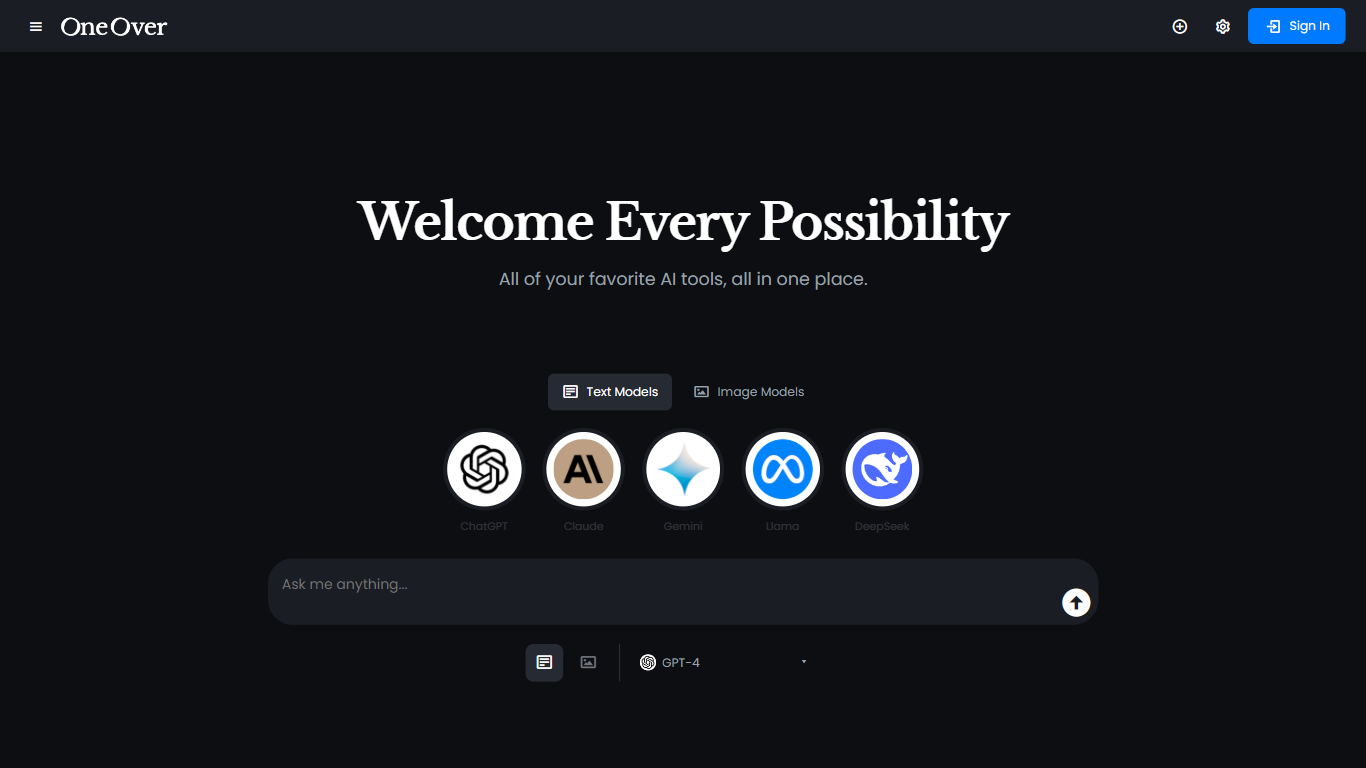
OneOver is a creative studio that puts multi-model chat, image generation, video, voice, and music in one browser workspace. You can run GPT, Claude, Gemini, Grok, and dozens of other models in a single thread, attach PDFs and images, flip on web search, and swap models without losing context. Guests get five chat messages before signup, and new accounts receive 50 one-time starter credits.
Where most tools make you pick one provider and buy separate subscriptions for images or video, OneOver routes everything through one shared credit balance. Subscription refills, plan bonuses, and pay-as-you-go packs all spend across chat, diffusion, video, speech, music, and playground mini apps. Switching from GPT-5.4 Nano to Claude Opus 5 is a dropdown change in the same conversation, not a copy-paste hop between sites.
Creators and marketers use OneOver to draft copy, iterate visuals, and turn prompts or photos into short clips from one library. Developers can hit the same model routes through a REST API with streaming support. Pro and Studio also ship seat-based team plans that pool monthly credits with member soft limits and one invoice.
Switch between GPT-5.6 Sol, Claude Opus 5, Gemini 3.6 Flash, and Grok 4.6 in one thread without losing context
Pro includes 1,400 credits per month (1,000 base plus 400 bonus) for chat, images, and short video work
Text-to-speech and text-to-music generators sit beside image and video studios in the same credit pool
Pay-as-you-go packs start at $5 for 500 credits that never expire and stack with subscription balances
REST API covers chat, image generation, and usage metering with streaming and one-field model swaps
Ten playground mini apps include Meme Generator, Upscaler, and Homework Helper with costs from 1 credit
Swap between GPT, Claude, Gemini, and Grok in one thread without restarting the conversation.
One credit balance covers chat, images, video, voice, music, and playground mini apps.
Pay-as-you-go packs never expire and stack behind subscription credits automatically.
Trust pages document SOC 2 Type 2 infrastructure, JSON export, and one-click account deletion.
Developers can call the same models through a REST API with streaming support.
Heavy image or video work burns credits quickly on the $10 Pro tier.
Access is web-only; OneOver does not list native iOS or Android apps.
The developers docs page returned a 403 during research, so API details may require a signed-in session.
Does OneOver have a free plan?
Yes. OneOver's Free plan costs $0 and includes 50 one-time starter credits, enough for roughly 30 chats. Guests can also send five chat messages before creating an account.
What AI models does OneOver support?
OneOver lists 50+ active models, including GPT-5.6 Sol, GPT-5.4 Nano, Claude Opus 5, Claude Fable 5, Gemini 3.6 Flash, Grok 4.6, Llama 4 Maverick Instruct, and DeepSeek V4 Flash. Image, video, voice, and music generation use additional diffusion and audio models in the same workspace.
How do OneOver credits work?
OneOver keeps plan credits and pay-as-you-go credits in one balance and spends subscription credits first. Pro refills 1,400 credits monthly and Studio refills 3,200; purchased packs from $5 to $20 never expire. Fast chat models start at 1 credit per message while frontier models such as Claude Fable 5 start at 12 credits.
What mini apps are available on OneOver?
OneOver's Playground lists ten mini apps, including Meme Generator, DeleteThem, FitSwitcher, Upscaler, Homework Helper, and Quiz Me. Each app shows its own credit cost on the playground page, with several photo tools starting around 14 credits.
How does OneOver handle data privacy?
OneOver documents SOC 2 Type 2 infrastructure, encryption in transit and at rest, PCI-compliant Stripe payments, and row-level data isolation. Users can export JSON data or delete accounts from settings, and the trust page states prompts are not used to train OneOver models.
Does OneOver offer an API?
Yes. OneOver exposes a REST API for chat, image generation, and usage across the models it carries, including GPT, Claude, Gemini, Grok, and Flux. Streaming is supported, and switching models is a one-field change behind a single API key.