Claude 3 \ Anthropic vs Switch Transformers
When comparing Claude 3 \ Anthropic vs Switch Transformers, which AI Large Language Model (LLM) tool shines brighter? We look at pricing, alternatives, upvotes, features, reviews, and more.
In a comparison between Claude 3 \ Anthropic and Switch Transformers, which one comes out on top?
When we put Claude 3 \ Anthropic and Switch Transformers side by side, both being AI-powered large language model (llm) tools, The upvote count shows a clear preference for Claude 3 \ Anthropic. Claude 3 \ Anthropic has attracted 8 upvotes from aitools.fyi users, and Switch Transformers has attracted 6 upvotes.
Disagree with the result? Upvote your favorite tool and help it win!
Claude 3 \ Anthropic

What is Claude 3 \ Anthropic?
Claude 3 is Anthropic's third-generation large language model family, released in March 2024. It includes three tiers: Haiku for speed and cost, Sonnet for balanced performance, and Opus for the highest reasoning depth. Each model targets a different tradeoff between intelligence, latency, and price.
The family handles text, code, analysis, and vision tasks. Claude 3 models process photos, charts, graphs, and technical diagrams. They support a 200K token context window at launch, with inputs exceeding 1 million tokens available to select customers. Opus and Sonnet launched on claude.ai and the Claude API in 159 countries, with Haiku following shortly after.
Anthropic built Claude 3 with Constitutional AI safety methods and Responsible Scaling Policy guardrails. The models are available through the Claude API, Amazon Bedrock, and Google Cloud Vertex AI. Sonnet powers the free tier on claude.ai, while Opus is available to Claude Pro subscribers.
Switch Transformers
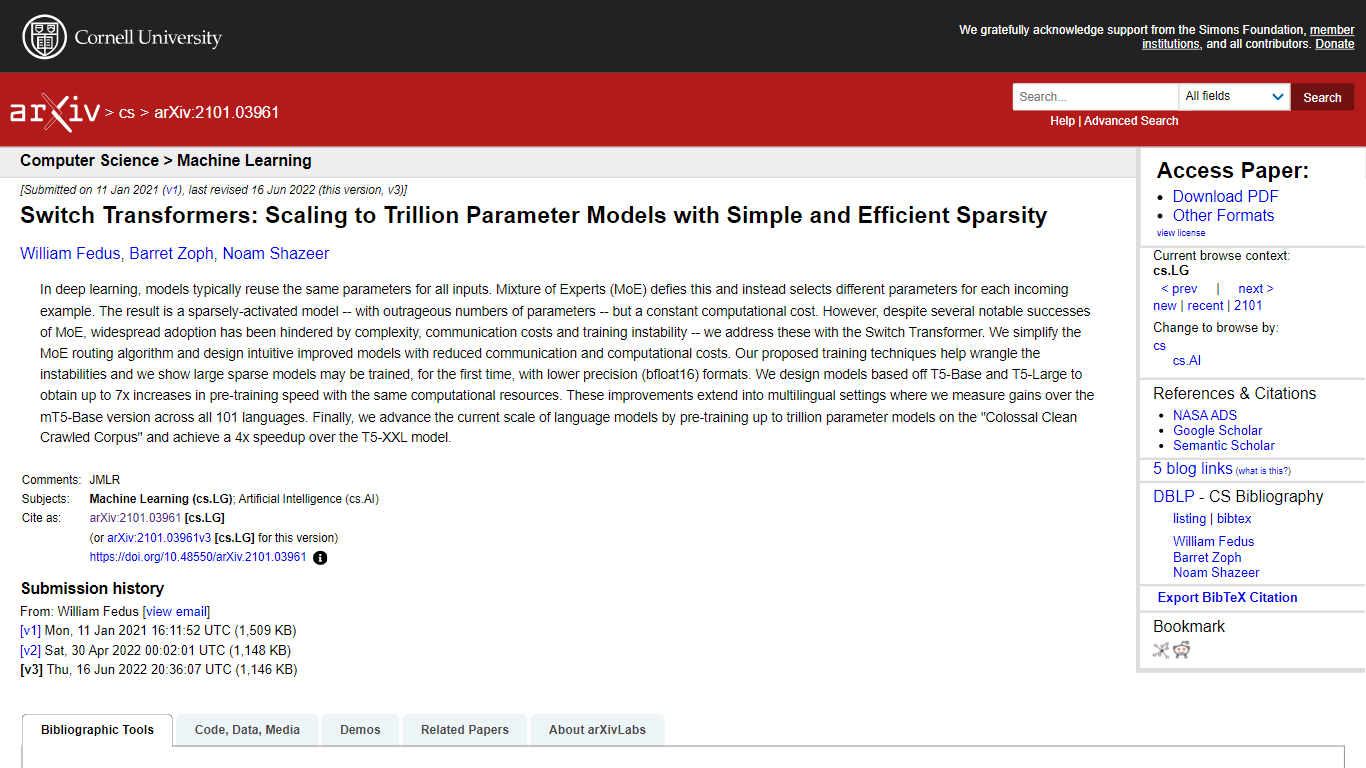
What is Switch Transformers?
Switch Transformers introduce a sparse Mixture of Experts architecture that routes each input to a single expert, reducing communication overhead while scaling to trillion-parameter language models with constant compute cost. The paper from Google researchers William Fedus, Barret Zoph, and Noam Shazeer simplifies MoE routing, improves training stability, and reports up to 7x faster pre-training than dense T5 models on the same compute budget.
The approach builds on the T5 architecture and supports multilingual training across 101 languages. Switch Transformers also enable training with bfloat16 precision for faster, more stable large-scale runs. The work targets researchers and engineers who need to scale NLP models without proportional increases in hardware cost.
Published on arXiv as a research paper, Switch Transformers documents methods for efficient sparse activation rather than a commercial SaaS product. The paper and PDF are freely available for download and citation.
Claude 3 \ Anthropic Upvotes
Switch Transformers Upvotes
Claude 3 \ Anthropic Top Features
Three model tiers (Haiku, Sonnet, Opus) let you pick the right balance of speed, cost, and reasoning depth
200K token context window at launch, with 1M+ token inputs available to select enterprise customers
Vision support for photos, charts, graphs, PDFs, and technical diagrams
Haiku reads a ~10k token research paper with charts in under three seconds for live chat workloads
Available on claude.ai, the Claude API, Amazon Bedrock, and Google Cloud Vertex AI
Switch Transformers Top Features
Sparse activation routes each input to one expert for constant compute
Simplified MoE routing reduces communication between model parts
Scales to trillion-parameter models on the T5 architecture
Supports multilingual training across 101 languages
Enables faster pre-training with bfloat16 precision
Claude 3 \ Anthropic Category
- Large Language Model (LLM)
Switch Transformers Category
- Large Language Model (LLM)
Claude 3 \ Anthropic Pricing Type
- Freemium
Switch Transformers Pricing Type
- Free