CodeFlying vs mshumer/gpt-prompt-engineer - GitHub
Dive into the comparison of CodeFlying vs mshumer/gpt-prompt-engineer - GitHub and discover which AI Model Generation tool stands out. We examine alternatives, upvotes, features, reviews, pricing, and beyond.
In a comparison between CodeFlying and mshumer/gpt-prompt-engineer - GitHub, which one comes out on top?
When we compare CodeFlying and mshumer/gpt-prompt-engineer - GitHub, two exceptional model generation tools powered by artificial intelligence, and place them side by side, several key similarities and differences come to light. Interestingly, both tools have managed to secure the same number of upvotes. Since other aitools.fyi users could decide the winner, the ball is in your court now to cast your vote and help us determine the winner.
Don't agree with the result? Cast your vote and be a part of the decision-making process!
CodeFlying


What is CodeFlying?
CodeFlying lets you describe an app idea in chat and get back websites, mobile apps, and messaging mini apps for Telegram, WhatsApp, Line, and similar channels. Upload a reference image on the homepage when you want layout or visual direction baked into the first generation.
Most no-code builders stop at landing pages or one output type. CodeFlying also advertises WeChat mini-program building in its site keywords, plus posters, marketing copy, and an AI customer service agent alongside the app generator. The public gallery groups community builds into Personal Tools, Enterprise, Education, Entertainment, and E-commerce tabs so you can browse by use case before prompting.
The product targets creators who want a single builder for web, mobile, and messaging surfaces without writing code first. Coffy, a voice assistant on the homepage, helps when you do not have a starting idea. CodeFlying is operated by KUAFUAI LTD., powered by KuaFuAI, supports 14 interface languages, and its meta description reports more than 1 million creators on the platform.
mshumer/gpt-prompt-engineer - GitHub
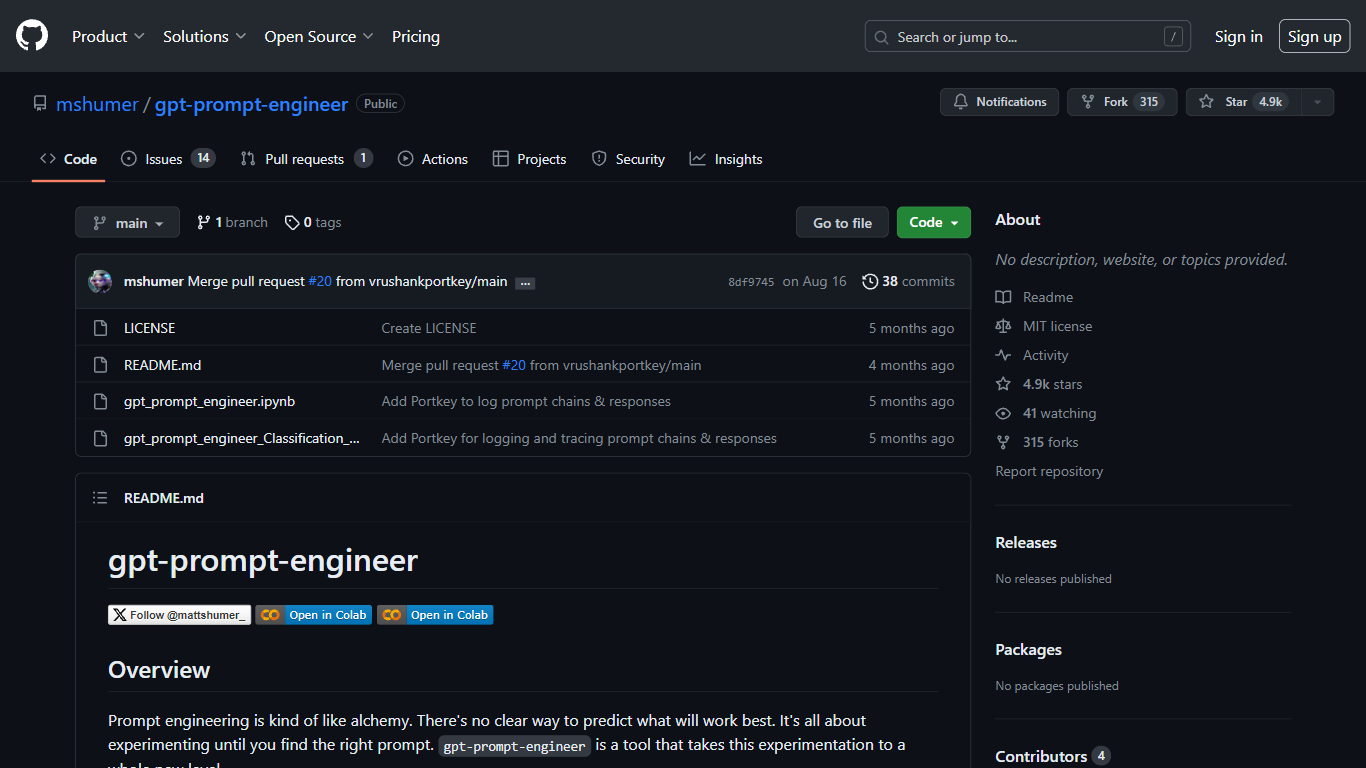
What is mshumer/gpt-prompt-engineer - GitHub?
mshumer/gpt-prompt-engineer is an open source prompt engineering toolkit that generates, tests, and ranks candidate prompts for a task you define. You describe the use case, supply test cases, and the notebooks create multiple prompt variants, run them against every test case, and sort results with an ELO rating system starting at 1200. It ships as Jupyter notebooks you can run in Google Colab or locally.
Most prompt tools help you write one prompt at a time. gpt-prompt-engineer treats prompt selection like a tournament: dozens of candidates compete on your test cases, and the highest ELO scores surface the winners. Separate notebooks cover classification tasks, Claude 3 Opus with auto-generated test cases, and Opus-to-Haiku conversion for cheaper inference. Optional Weights & Biases and Portkey logging trace each run.
ML engineers, prompt engineers, and AI developers use it when they need reproducible prompt tuning instead of manual trial and error. The repo has 9.7k GitHub stars and runs on your own OpenAI or Anthropic API keys. It is free under the MIT license.
CodeFlying Upvotes
mshumer/gpt-prompt-engineer - GitHub Upvotes
CodeFlying Top Features
Accept chat prompts up to 50,000 characters on the homepage builder
Generate websites, mobile apps, and mini apps for Telegram, WhatsApp, and Line
Upload reference images in PNG, JPEG, GIF, WebP, or SVG to steer visual direction
Build WeChat mini programs alongside web and mobile targets per site keywords
Call Coffy for voice-guided help when you need a first project idea or prompt
Bundle AI marketing tools and a smart customer agent with apps you publish
Switch the interface among 14 languages including English, Spanish, Japanese, and Arabic
mshumer/gpt-prompt-engineer - GitHub Top Features
Generates multiple prompt candidates from a task description and user-supplied test cases
Ranks prompts with an ELO rating system starting at 1200 per candidate
Supports GPT-4, GPT-3.5-Turbo, and Claude 3 Opus model backends
Classification notebook scores true/false test cases and prints a results table
Claude 3 notebook auto-generates test cases from input variable definitions
Opus-to-Haiku conversion notebook cuts latency and cost while preserving output quality
Optional Weights & Biases and Portkey logging for experiment tracking
CodeFlying Category
- Model Generation
mshumer/gpt-prompt-engineer - GitHub Category
- Model Generation
CodeFlying Pricing Type
- Freemium
mshumer/gpt-prompt-engineer - GitHub Pricing Type
- Free