Connected Papers vs scite.ai
In the contest of Connected Papers vs scite.ai, which AI Research tool is the champion? We evaluate pricing, alternatives, upvotes, features, reviews, and more.
If you had to choose between Connected Papers and scite.ai, which one would you go for?
When we examine Connected Papers and scite.ai, both of which are AI-enabled research tools, what unique characteristics do we discover? Neither tool takes the lead, as they both have the same upvote count. Be a part of the decision-making process. Your vote could determine the winner.
Don't agree with the result? Cast your vote and be a part of the decision-making process!
Connected Papers


What is Connected Papers?
Connected Papers helps researchers explore academic literature through visual similarity graphs instead of citation trees. Enter a paper DOI, arXiv link, PubMed URL, or title and the site builds a force-directed map of closely related work. Each graph analyzes about 50,000 papers and surfaces the few dozen with the strongest bibliographic connections to your origin paper.
Unlike citation indexes that only link direct references, Connected Papers clusters papers by co-citation and bibliographic coupling, so related studies can sit side by side even when they never cite each other. The layout pushes dissimilar work away and highlights the shortest similarity path back to your seed paper. That visual approach makes it easier to spot seminal papers and emerging trends than scrolling flat result lists.
Grad students, thesis writers, and applied scientists use it to skim new fields, catch papers they missed, and build bibliographies from a shortlist of must-include references. The free tier covers casual exploration, while premium plans remove the monthly graph cap for heavy literature reviews.
scite.ai
What is scite.ai?
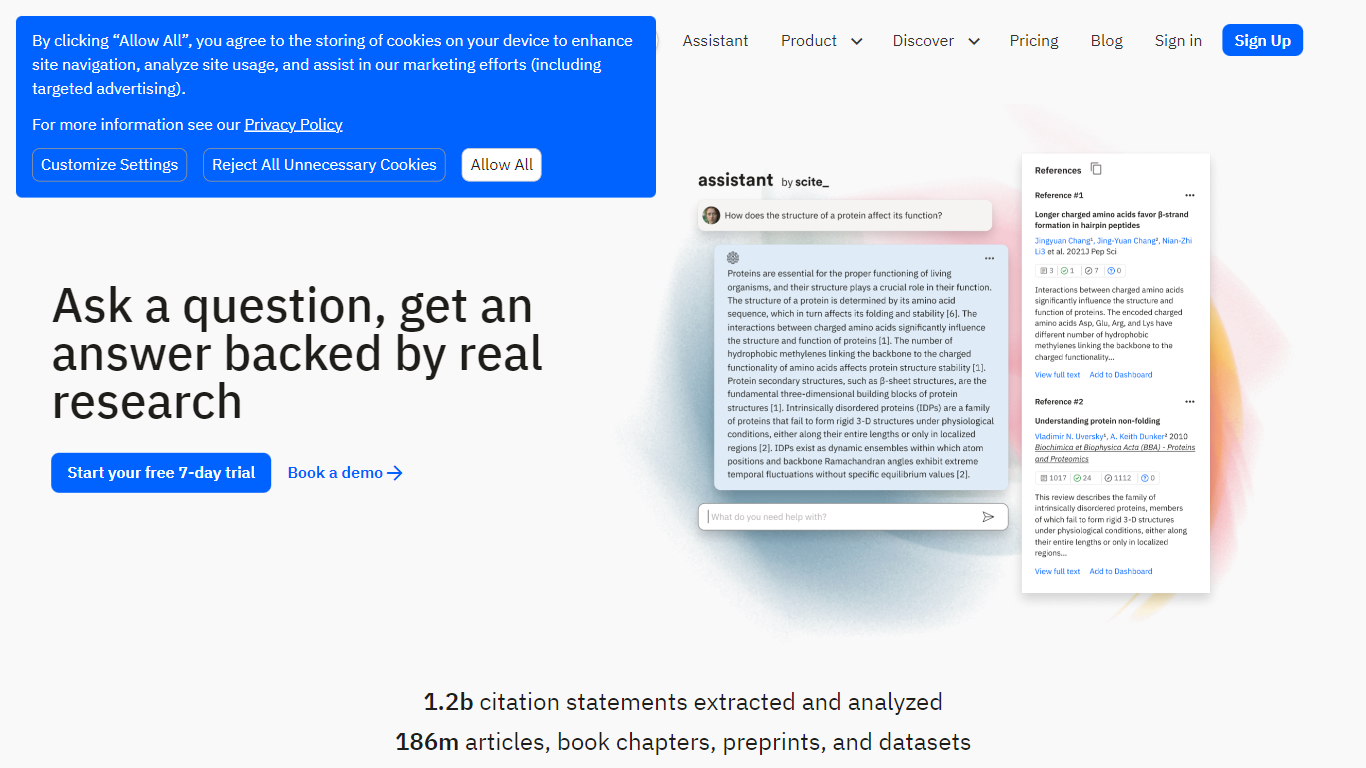
Scite helps research teams ask literature questions and get answers tied to full-text papers, not abstract snippets alone. Its Assistant searches across 280M+ full-text scholarly articles, and Smart Citations show whether later work supported, contradicted, or mentioned a finding.
General research chatbots guess when paywalls block the PDF. Scite licenses content from Wiley, SAGE, and 40+ other publishers, so it reads inside the paper and links each claim to a specific sentence you can verify in one click. That evidence-first design targets literature reviews where you need to know if a result still holds, not just that it exists.
Grad students run disputed-or-affirmed checks before citing a paper. R&D teams trace grants, clinical trials, and patents in one search. Pro users get API access, 2,500 MCP credits per month, and collections up to 10,000 papers. Scite also plugs into Claude, ChatGPT, and Zotero so answers show up inside existing workflows.
Connected Papers Upvotes
scite.ai Upvotes
Connected Papers Top Features
Each graph analyzes about 50,000 papers and selects the strongest matches to your origin paper
Build graphs from a DOI, arXiv URL, PubMed link, or paper title search
Similarity ranking uses co-citation and bibliographic coupling, not just direct citations
Free plan includes 5 graphs per month with multi-origin graphs, saved papers, and graph history
Premium Academic plan is $6 per month billed at $72 annually for unlimited graphs
Paper data comes from the Semantic Scholar corpus covering hundreds of millions of publications
scite.ai Top Features
Search across 280M+ full-text scholarly articles plus patents, trials, grants, and preprints
Smart Citations classify later papers as supporting, contrasting, or mentioning a source
Basic plan includes 250 MCP credits per month and ChatGPT and Claude integrations
Pro plan adds API access, 2,500 MCP credits per month, and collections up to 10,000 papers
Publisher agreements with Wiley, SAGE, and 40+ partners for licensed full-text access
7-day free trial on paid plans before subscription billing begins
Database cites 1.6B+ citations indexed across 300M+ scholarly sources
Connected Papers Category
- Research
scite.ai Category
- Research
Connected Papers Pricing Type
- Freemium
scite.ai Pricing Type
- Freemium