DATAKU vs Deepnote AI
In the clash of DATAKU vs Deepnote AI, which AI Data Science tool emerges victorious? We assess reviews, pricing, alternatives, features, upvotes, and more.
When we put DATAKU and Deepnote AI head to head, which one emerges as the victor?
Let's take a closer look at DATAKU and Deepnote AI, both of which are AI-driven data science tools, and see what sets them apart. Deepnote AI stands out as the clear frontrunner in terms of upvotes. Deepnote AI has 8 upvotes, and DATAKU has 7 upvotes.
Don't agree with the result? Cast your vote and be a part of the decision-making process!
DATAKU

What is DATAKU?
DATAKU is a data science site that tracks AI benchmarks, API pricing, and model releases, then packages the numbers into free calculators and downloadable datasets. The homepage archives articles on inference costs, funding rounds, and head-to-head model comparisons, while the Tools section hosts eight utilities such as an LLM cost calculator, benchmark decoder, and model graveyard.
Most AI news sites summarize press releases. DATAKU cross-references provider docs, leaderboard scores, and its own pricing tables, which is why the downloadable datasets page lists 48-row pricing histories and 62-row benchmark score tables under CC BY 4.0 licenses.
Data analysts, ML engineers, and buyers use DATAKU when they need cost-per-token math, benchmark context, or CSV exports instead of marketing claims. The About page describes the project as benchmark and pricing tracking run by a former Tokyo data analyst.
Deepnote AI
What is Deepnote AI?
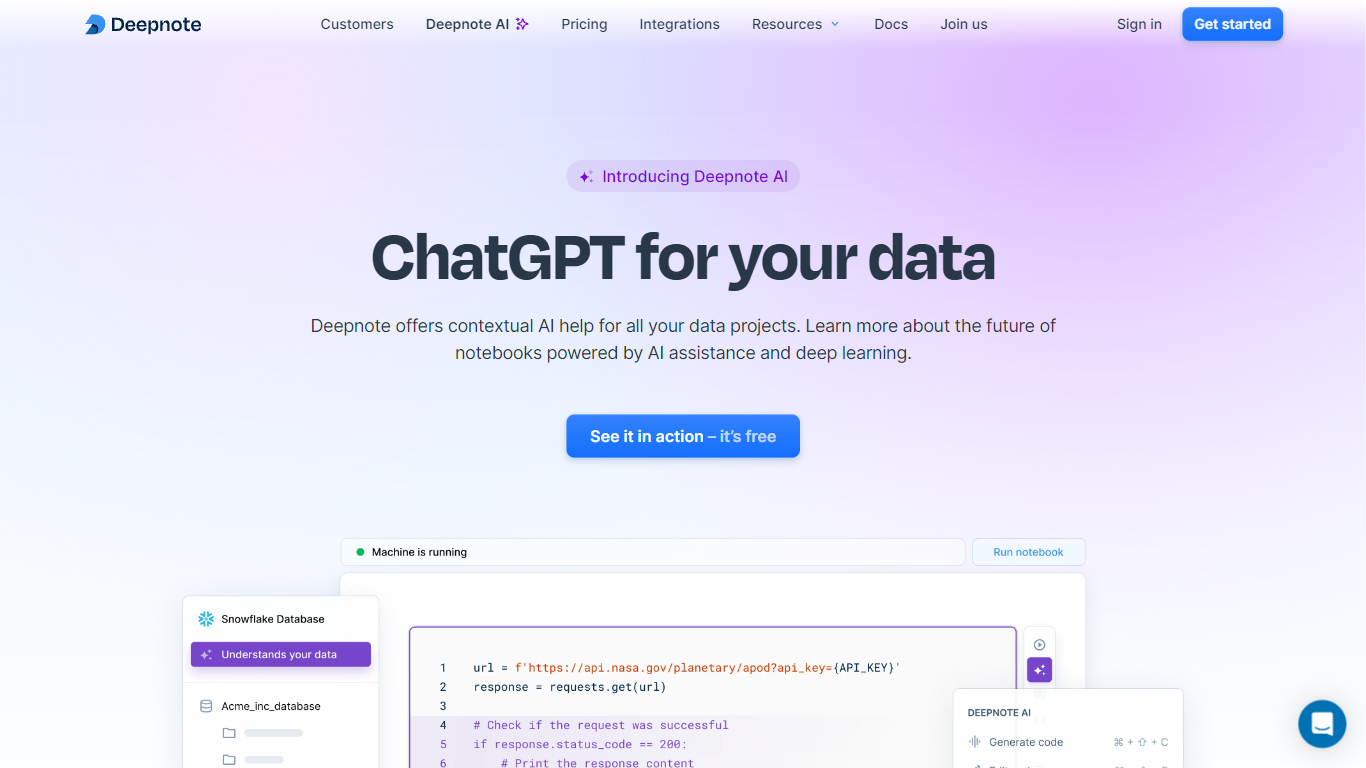
Deepnote AI is the assistant layer inside Deepnote, a collaborative data science notebook platform. It sits alongside your Python cells, SQL blocks, and charts, reading project context, connected warehouse metadata, and notebook history before suggesting code. You can ask in plain language, get full notebooks generated from a prompt, or fix a failing cell without leaving the workspace.
Most coding copilots treat each file as an island. Deepnote AI is built for notebooks tied to live data: its suggestions reference schemas from integrations you already connected, and auto-notebook generation can output runnable Python, SQL, and narrative text in one pass. That trade-off means it is not a general IDE plugin for arbitrary repos; it is narrowly focused on analysis workflows inside Deepnote.
Data scientists, analysts, and analytics engineers use it for exploratory analysis, query drafting, debugging pipeline cells, and turning notebook work into shareable data apps. Teams that already centralize work in Deepnote get the most value, especially when multiple editors collaborate on the same project with revision history and scheduled runs.
DATAKU Upvotes
Deepnote AI Upvotes
DATAKU Top Features
LLM Cost Calculator estimates API spend across OpenAI, Anthropic, Google, Meta, and Mistral models
Benchmark Decoder explains what benchmarks measure and which models score highest
AI Training Data Tracker documents sources and cutoff dates for 18+ major models
Model Graveyard archives 25+ deprecated models with replacement notes
Downloadable datasets include 48-row pricing history and 62-row benchmark tables (CC BY 4.0)
AI Energy Calculator estimates watts, kWh, and CO2 per model query
Deepnote AI Top Features
Free plan includes 10 AI code completions and 5 generate, edit, or explain calls per month
Team plan offers GPT-5.5 and Sonnet 4.6 access plus $39 in monthly AI credits per editor
Auto notebook generation builds runnable Python, SQL, and text blocks from a single prompt
Reads connected warehouse schemas and project metadata for context-aware suggestions
Supports 40+ integrations including Snowflake, BigQuery, PostgreSQL, and Databricks via SQL blocks
Workspace admins opt in to AI features; Deepnote holds SOC 2 Type II certification
DATAKU Category
- Data Science
Deepnote AI Category
- Data Science
DATAKU Pricing Type
- Free
Deepnote AI Pricing Type
- Freemium