Gemini 3 vs wav2vec 2.0
In the contest of Gemini 3 vs wav2vec 2.0, which AI Large Language Model (LLM) tool is the champion? We evaluate pricing, alternatives, upvotes, features, reviews, and more.
If you had to choose between Gemini 3 and wav2vec 2.0, which one would you go for?
When we examine Gemini 3 and wav2vec 2.0, both of which are AI-enabled large language model (llm) tools, what unique characteristics do we discover? The upvote count reveals a draw, with both tools earning the same number of upvotes. Every vote counts! Cast yours and contribute to the decision of the winner.
Want to flip the script? Upvote your favorite tool and change the game!
Gemini 3

What is Gemini 3?
Gemini 3 is Google's frontier large language model, released in November 2025 as the flagship of the Gemini family. It combines reasoning, multimodal understanding, and agentic coding in one model so you can learn from mixed media, build interactive apps, and plan multi-step tasks with less back-and-forth prompting.
Where most frontier models compete on raw benchmark scores alone, Gemini 3 ships across Google's consumer and developer stack on day one: Search AI Mode, the Gemini app, AI Studio, Vertex AI, Gemini CLI, and the Antigravity agentic IDE. That breadth is the trade-off profile. You get one model wired into Gmail, Calendar, and generative search UI, not a standalone API you integrate yourself.
Developers, researchers, and students use Gemini 3 for vibe coding, document analysis, long video lectures, and multi-step planning. Google AI Ultra subscribers in the U.S. can run Gemini Agent for inbox and calendar workflows, while enterprises deploy the same model through Vertex AI and Gemini Enterprise.
Google DeepMind led development with extensive safety testing, including third-party evaluations and a published model card. Related posts on the same blog now cover follow-on models like Gemini 3.7 Flash and Gemini 3.5 Transcribe, while Deep Think remains on a staged rollout to Google AI Ultra subscribers.
wav2vec 2.0
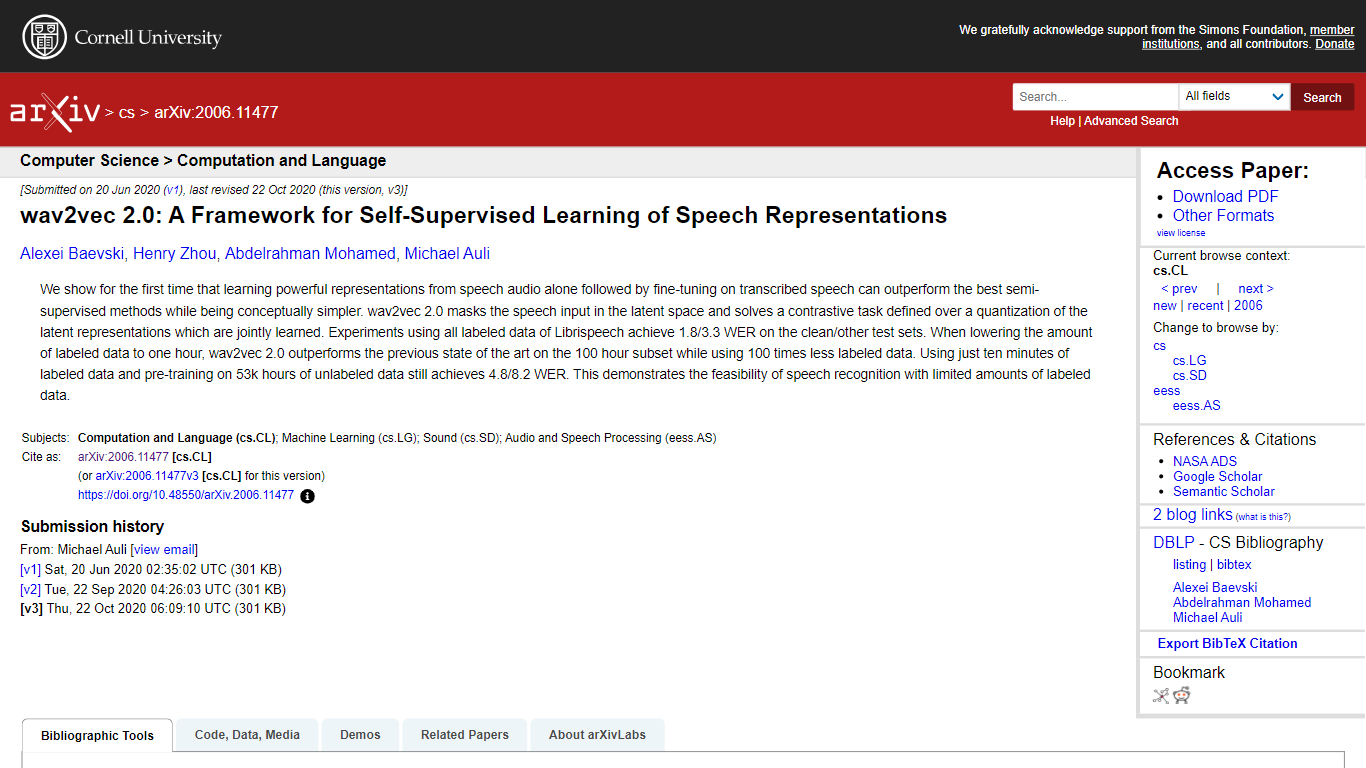
What is wav2vec 2.0?
wav2vec 2.0 is a self-supervised learning framework that learns speech representations directly from raw audio. It masks portions of the speech input in a latent space and solves a contrastive task over quantized latent representations, which are learned jointly with the model. This approach allows the model to leverage large amounts of unlabeled speech data effectively. After pre-training, wav2vec 2.0 can be fine-tuned on small amounts of labeled speech data to achieve state-of-the-art speech recognition performance. The model has demonstrated strong results even when fine-tuned with just minutes of labeled audio, making it highly efficient for low-resource scenarios.
The framework simplifies speech recognition by removing the need for complex semi-supervised pipelines, relying instead on a single end-to-end model. It achieves impressive word error rates on standard benchmarks like Librispeech and TIMIT, outperforming previous methods that require much more labeled data. The quantization of latent speech representations enables the model to learn discrete speech units, which improves robustness and generalization.
wav2vec 2.0 targets researchers and developers working on speech recognition, especially those interested in leveraging unlabeled audio data to reduce annotation costs. Its ability to perform well with limited labeled data opens opportunities for building speech systems in low-resource languages or domains. The model architecture is based on convolutional feature encoders and Transformer networks, allowing it to capture both local and global speech patterns.
Technically, wav2vec 2.0 combines contrastive learning with a masking strategy applied in the latent space, which differs from previous approaches that mask input audio directly. This design choice improves the quality of learned representations. The model is trained on large unlabeled datasets, such as 53,000 hours of speech, and fine-tuned on smaller labeled subsets. This two-stage training process balances scalability and accuracy.
Overall, wav2vec 2.0 represents a significant advance in self-supervised speech representation learning. It reduces reliance on labeled data, simplifies training pipelines, and achieves competitive or superior performance compared to fully supervised or semi-supervised methods. The release of code and pretrained models supports adoption and further research in speech technology.
Gemini 3 Upvotes
wav2vec 2.0 Upvotes
Gemini 3 Top Features
1501 Elo on LMArena with a 1 million-token context window across text, images, video, audio, and code
Deep Think mode scores 41.0% on Humanity's Last Exam, rolling out to Google AI Ultra subscribers after safety review
Generative UI in AI Mode in Search builds visual layouts and interactive simulations from a single query
1487 Elo on WebDev Arena and 76.2% on SWE-bench Verified for agentic coding
Gemini Agent handles multi-step tasks across Gmail, Calendar, and the web for Google AI Ultra users in the U.S.
Available in Google AI Studio, Vertex AI, Gemini CLI, Antigravity, and third-party platforms like Cursor and GitHub
54.2% on Terminal-Bench 2.0 for terminal-based tool use and computer operation
wav2vec 2.0 Top Features
Self-supervised pretraining on raw audio 🎧 enables learning from unlabeled speech data
Latent space masking 🎭 improves model focus on context and robustness
Contrastive task over quantized representations 🔄 helps learn discrete speech units
Fine-tuning with minimal labeled data 📝 achieves strong speech recognition accuracy
Transformer-based architecture 🔗 captures long-range speech dependencies effectively
Gemini 3 Category
- Large Language Model (LLM)
wav2vec 2.0 Category
- Large Language Model (LLM)
Gemini 3 Pricing Type
- Freemium
wav2vec 2.0 Pricing Type
- Freemium