GPT Clone vs mshumer/gpt-prompt-engineer - GitHub
In the clash of GPT Clone vs mshumer/gpt-prompt-engineer - GitHub, which AI Model Generation tool emerges victorious? We assess reviews, pricing, alternatives, features, upvotes, and more.
When we put GPT Clone and mshumer/gpt-prompt-engineer - GitHub head to head, which one emerges as the victor?
Let's take a closer look at GPT Clone and mshumer/gpt-prompt-engineer - GitHub, both of which are AI-driven model generation tools, and see what sets them apart. Neither tool takes the lead, as they both have the same upvote count. You can help us determine the winner by casting your vote and tipping the scales in favor of one of the tools.
Don't agree with the result? Cast your vote and be a part of the decision-making process!
GPT Clone


What is GPT Clone?
GPT Clone offers a unique platform where you can create digital clones of various personas including psychologists, relationship experts, well-known figures like Donald Trump, and celebrities like Elon Musk and Taylor Swift. With the ability to engage in lifelike conversations, this service brings a novel interaction experience to users.
Utilizing custom Stable Diffusion models and advanced infrastructure, GPT Clone provides developers with fast, reliable, and high-quality API services. Whether you're looking to simulate conversations for entertainment, education, or professional consultation, GPT Clone delivers a seamless and interactive experience that mimics real-life interactions.
mshumer/gpt-prompt-engineer - GitHub
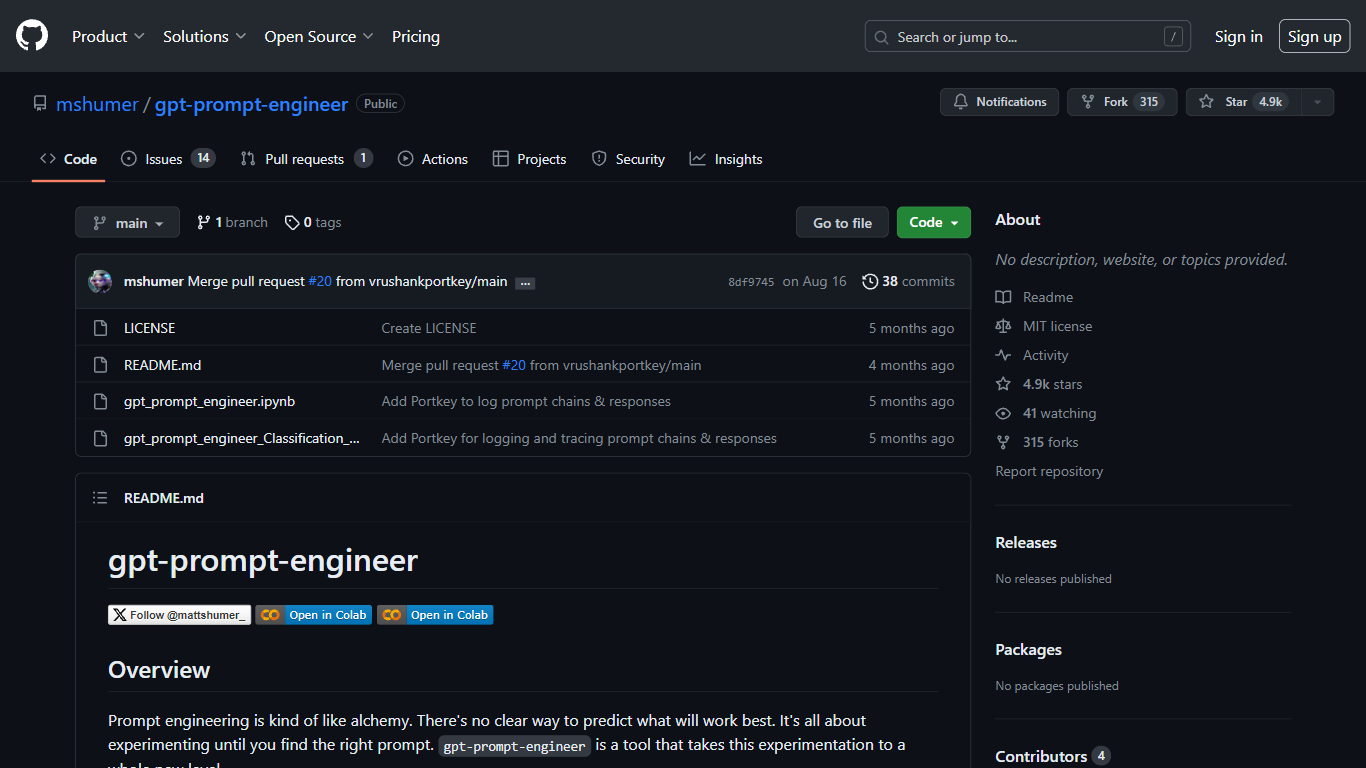
What is mshumer/gpt-prompt-engineer - GitHub?
mshumer/gpt-prompt-engineer is an open source prompt engineering toolkit that generates, tests, and ranks candidate prompts for a task you define. You describe the use case, supply test cases, and the notebooks create multiple prompt variants, run them against every test case, and sort results with an ELO rating system starting at 1200. It ships as Jupyter notebooks you can run in Google Colab or locally.
Most prompt tools help you write one prompt at a time. gpt-prompt-engineer treats prompt selection like a tournament: dozens of candidates compete on your test cases, and the highest ELO scores surface the winners. Separate notebooks cover classification tasks, Claude 3 Opus with auto-generated test cases, and Opus-to-Haiku conversion for cheaper inference. Optional Weights & Biases and Portkey logging trace each run.
ML engineers, prompt engineers, and AI developers use it when they need reproducible prompt tuning instead of manual trial and error. The repo has 9.7k GitHub stars and runs on your own OpenAI or Anthropic API keys. It is free under the MIT license.
GPT Clone Upvotes
mshumer/gpt-prompt-engineer - GitHub Upvotes
GPT Clone Top Features
Custom Stable Diffusion Models: Leverage specialized models for creating realistic digital personas.
High-Quality API Services: Access fast and reliable API endpoints for seamless integration.
Diverse Persona Cloning: Engage with a variety of cloned personas, from celebrities to subject matter experts.
Realistic Interactions: Experience conversations that closely mimic real-life exchanges.
Developer Support: Utilize robust infrastructure designed for developers to incorporate GPT Clone capabilities into various applications.
mshumer/gpt-prompt-engineer - GitHub Top Features
Generates multiple prompt candidates from a task description and user-supplied test cases
Ranks prompts with an ELO rating system starting at 1200 per candidate
Supports GPT-4, GPT-3.5-Turbo, and Claude 3 Opus model backends
Classification notebook scores true/false test cases and prints a results table
Claude 3 notebook auto-generates test cases from input variable definitions
Opus-to-Haiku conversion notebook cuts latency and cost while preserving output quality
Optional Weights & Biases and Portkey logging for experiment tracking
GPT Clone Category
- Model Generation
mshumer/gpt-prompt-engineer - GitHub Category
- Model Generation
GPT Clone Pricing Type
- Freemium
mshumer/gpt-prompt-engineer - GitHub Pricing Type
- Free