Hyperscience vs DeepFaceLab
In the battle of Hyperscience vs DeepFaceLab, which AI Data Science tool comes out on top? We compare reviews, pricing, alternatives, upvotes, features, and more.
Which one is better? Hyperscience or DeepFaceLab?
Upon comparing Hyperscience with DeepFaceLab, which are both AI-powered data science tools, Both tools have received the same number of upvotes from aitools.fyi users. The power is in your hands! Cast your vote and have a say in deciding the winner.
Not your cup of tea? Upvote your preferred tool and stir things up!
Hyperscience


What is Hyperscience?
Hyperscience reads, classifies, and extracts data from unstructured enterprise documents at scale through its Hypercell intelligent document processing platform. It handles invoices, mortgage files, benefits forms, and handwritten paperwork, then routes validated output into downstream systems with accuracy rates the company cites at 99.5% and automation rates near 98%.
Legacy OCR tools break on messy scans and need constant template retraining. Hyperscience uses a model-first architecture with specialized models plus ORCA, its zero-shot vision language model, to process new document types without prior training runs. The platform is FedRAMP High authorized and integrates with AWS, Azure, and Google Cloud for public sector and regulated workloads.
Operations teams in financial services, insurance, logistics, and government agencies use Hyperscience to replace manual data entry. Named a Leader in the first Gartner Magic Quadrant for Intelligent Document Processing (2025) and the Forrester Wave for Document Mining and Analytics (Q2 2026), with customers including American Express, MetLife, and the US Social Security Administration.
DeepFaceLab
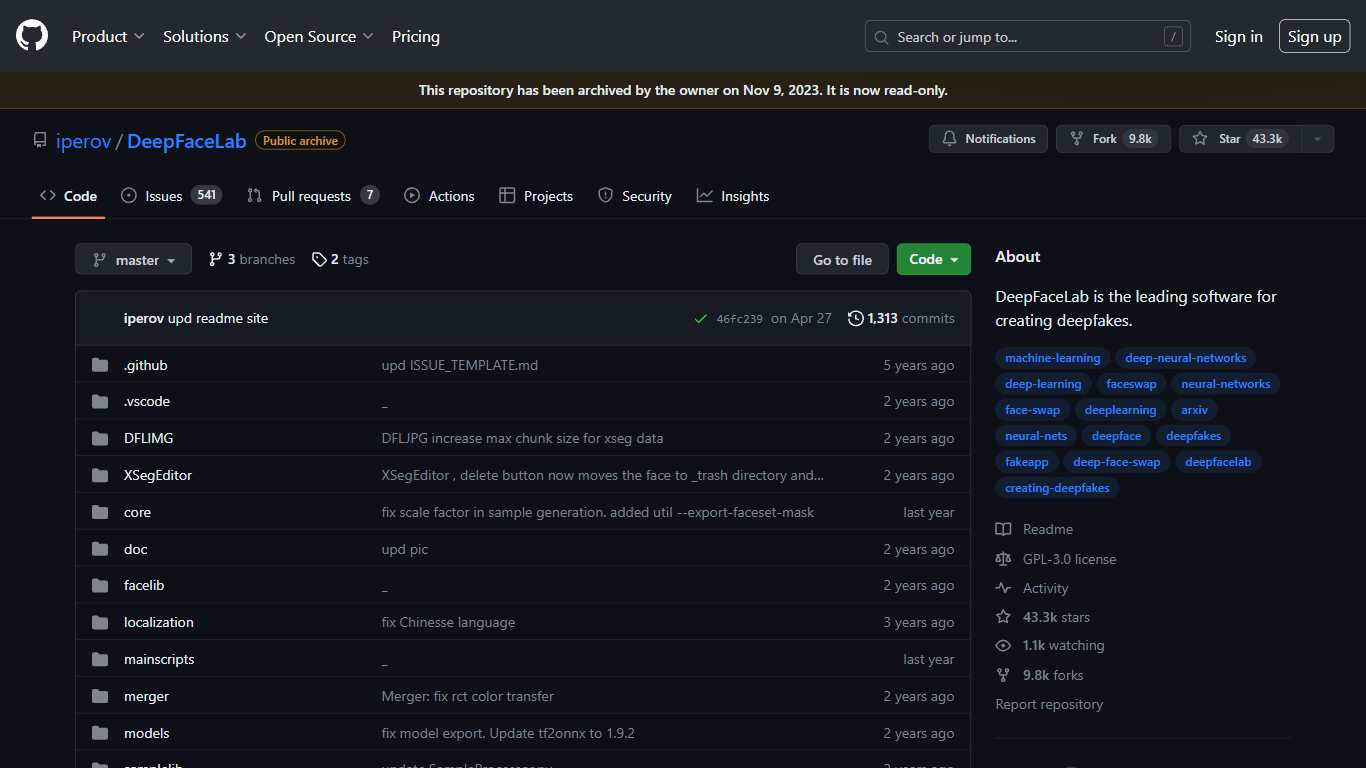
What is DeepFaceLab?
DeepFaceLab trains and runs deepfake face swaps on your own GPU through a full Python pipeline you control locally. Extract faces from source and destination videos, train a neural network model, and merge the swapped face back into footage at resolutions up to 512 pixels and beyond.
Unlike cloud deepfake apps that hide the pipeline, DeepFaceLab gives you every stage, including S3FD face extraction, XSeg masking, and model architectures like SAEHD. That depth comes with a steep learning curve: the README warns there is no one-click fix and expects comfort with After Effects or DaVinci Resolve for finishing work.
VFX artists, YouTube creators, and researchers who need local, GPU-based face replacement are the core audience. The repository was archived read-only on November 13, 2024, but the code, Windows builds, and 19,300+ GitHub stars remain accessible. The related DeepFaceLive project handles real-time streaming swaps separately.
Hyperscience Upvotes
DeepFaceLab Upvotes
Hyperscience Top Features
Hypercell platform reports 99.5% document processing accuracy and up to 98% automation even on handwritten forms
ORCA zero-shot vision language model extracts data from new document layouts without prior model training
FedRAMP High authorized deployment with multi-cloud support on AWS, Microsoft Azure, and Google Cloud Platform
Hypercell for SNAP and Freight Pay ship prebuilt flows for public benefits eligibility and logistics invoicing
Agentic workflow orchestration routes documents from ingestion through human-in-the-loop review to final decisions
Redaction and masking tools strip PII for FOIA, GDPR, and privacy-compliant document sharing
DeepFaceLab Top Features
19,300+ GitHub stars with 928 forks and GPL-3.0 open-source license
Face replacement, de-aging, and full head swap workflows with native resolution training
S3FD face extractor and XSeg editor for precise face masking
Windows builds distributed via torrent and Mega.nz; Linux port available
Built on TensorFlow with CUDA and DirectX GPU acceleration
Related DeepFaceLive project adds real-time face swap for streaming and video calls
Hyperscience Category
- Data Science
DeepFaceLab Category
- Data Science
Hyperscience Pricing Type
- Paid
DeepFaceLab Pricing Type
- Free