Legasite vs Taylor
In the battle of Legasite vs Taylor, which AI Developer tool comes out on top? We compare reviews, pricing, alternatives, upvotes, features, and more.
Which one is better? Legasite or Taylor?
Upon comparing Legasite with Taylor, which are both AI-powered developer tools, Both tools have received the same number of upvotes from aitools.fyi users. Your vote matters! Help us decide the winner among aitools.fyi users by casting your vote.
You don't agree with the result? Cast your vote to help us decide!
Legasite

What is Legasite?
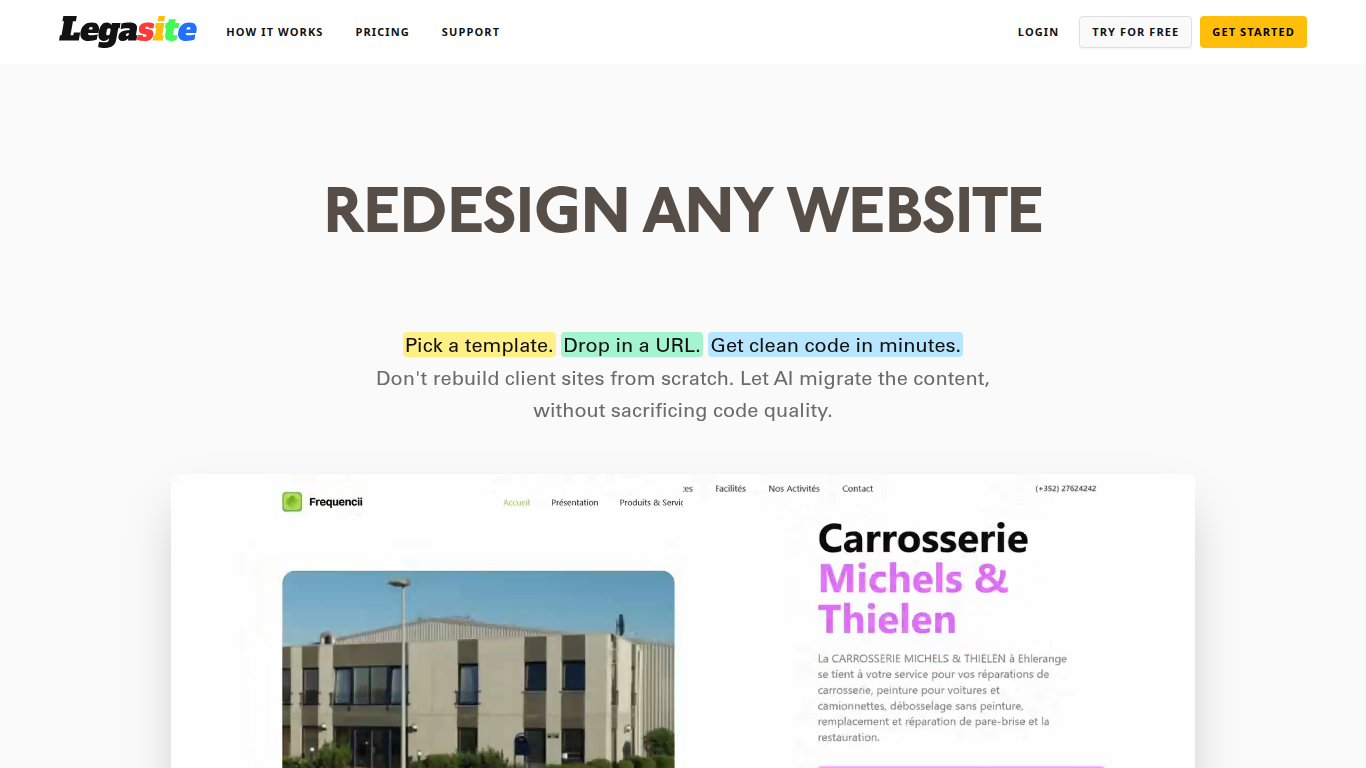
Legasite moves legacy websites into modern React and Next.js templates without rebuilding from scratch. You pick a template, drop in an existing site URL, and the platform extracts content, maps it to the layout, and generates downloadable source code in about 10 to 20 minutes.
The workflow centers on automated content extraction rather than manual copy-paste. Legasite pulls text, structure, and images from the source site, then populates a human-written template so the output follows component-based patterns with Tailwind CSS styling. You get a ZIP of real code you can deploy to Vercel, Netlify, or your own server.
It targets web agencies, freelance developers, and in-house dev teams handling client redesigns or internal UI modernization. The pitch is cutting migration grunt work so you spend time on customization and features instead of transferring content page by page.
Taylor
What is Taylor?
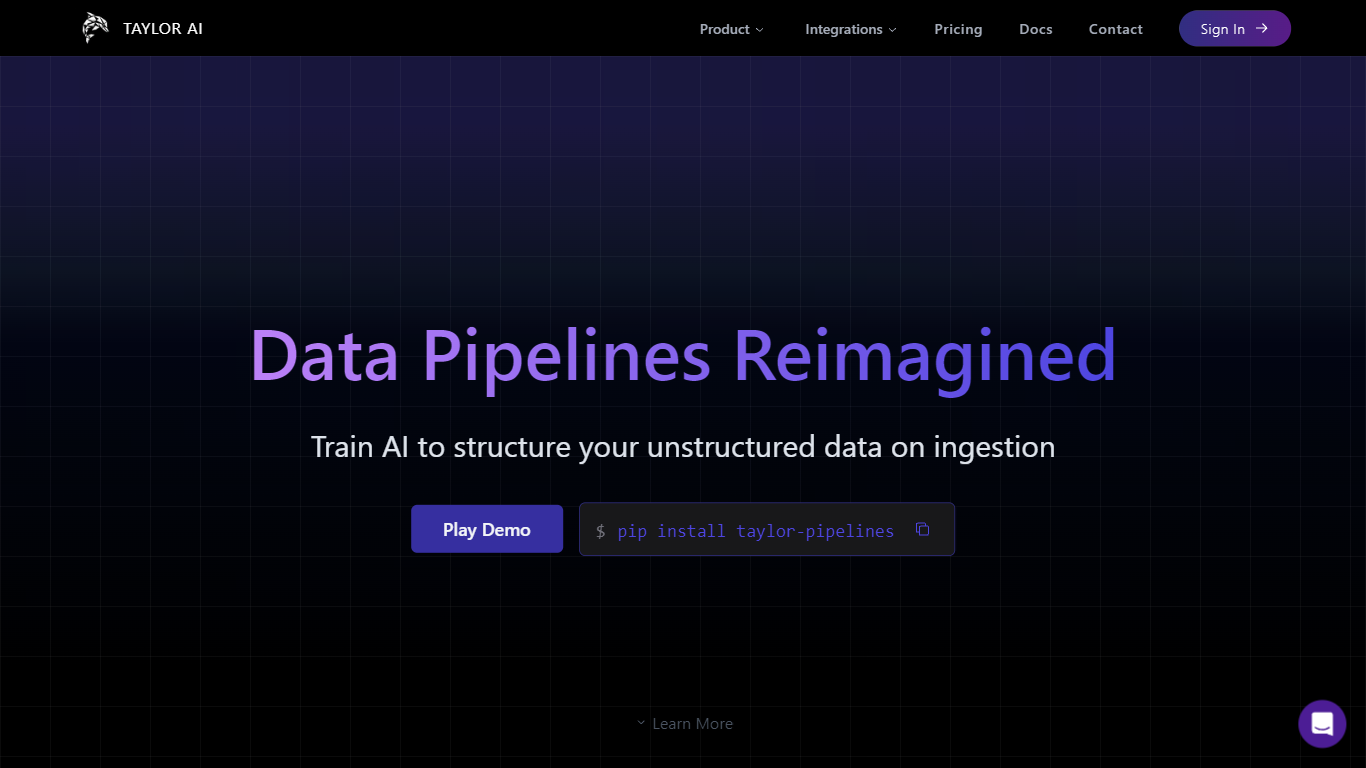
Taylor gives developers a production API for classifying and enriching unstructured text without running their own model stack. You send free-text records and Taylor returns labels from a taxonomy you define, using a classification ensemble tuned for deterministic results rather than open-ended LLM replies.
General-purpose LLMs work for one-off tagging but get expensive and inconsistent at volume. Taylor focuses on high-throughput text classification: batch parallel processing, drift monitoring, and private classifiers trained on taxonomies like IAB ad categories, O*NET occupation codes, NAICS industry classes, and legal clause types. The company also ships taylor-pipelines for building S3 data pipelines with a hosted UI.
Taylor was founded in 2023 in San Francisco and is backed by Y Combinator, General Catalyst, FoundersX, and Gaingels. The product targets government agencies, law firms, and private teams that need SOC2-compliant text enrichment through an API or spreadsheet workflow. Sign-in uses Google or GitHub, and support contact is [email protected].
Legasite Upvotes
Taylor Upvotes
Legasite Top Features
Drop in a URL and get React or Next.js code in 10 to 20 minutes
Content, structure, and images pulled automatically from the old site
Download a full ZIP you can deploy anywhere with no platform lock-in
Free plan includes 3 demo credits for single-page previews on signup
Basic plan at $20 per month supports about 20 pages with downloadable code
Agency plan at $100 per month supports about 200 pages per month
Tokens reset monthly with roughly 500K tokens consumed per generated page
Taylor Top Features
Text classification API that accepts custom taxonomies such as IAB tags, O*NET codes, and NAICS classes
Batch processing mode for high-volume parallel classification jobs
Monitoring alerts for accuracy drift, failures, and performance issues
taylor-pipelines library for streaming unstructured data from Amazon S3 into hosted workflows
Configurable score thresholds and max label counts per classification request
SOC2-compliant security with API and spreadsheet implementation options
Legasite Category
- Developer
Taylor Category
- Developer
Legasite Pricing Type
- Freemium
Taylor Pricing Type
- Freemium