
Last updated 07-30-2026
Category:
Reviews:
Join thousands of AI enthusiasts in the World of AI!
Taylor
Taylor gives developers a production API for classifying and enriching unstructured text without running their own model stack. You send free-text records and Taylor returns labels from a taxonomy you define, using a classification ensemble tuned for deterministic results rather than open-ended LLM replies.
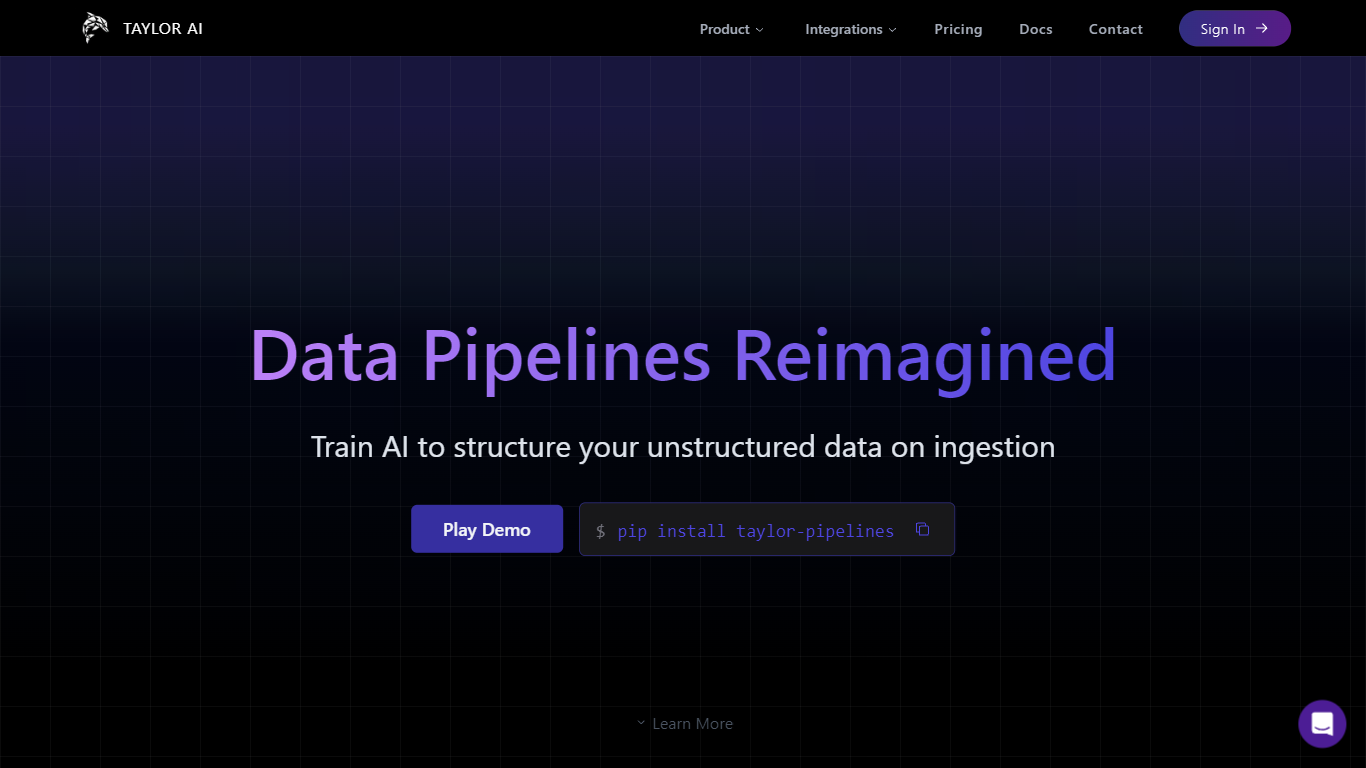
General-purpose LLMs work for one-off tagging but get expensive and inconsistent at volume. Taylor focuses on high-throughput text classification: batch parallel processing, drift monitoring, and private classifiers trained on taxonomies like IAB ad categories, O*NET occupation codes, NAICS industry classes, and legal clause types. The company also ships taylor-pipelines for building S3 data pipelines with a hosted UI.
Taylor was founded in 2023 in San Francisco and is backed by Y Combinator, General Catalyst, FoundersX, and Gaingels. The product targets government agencies, law firms, and private teams that need SOC2-compliant text enrichment through an API or spreadsheet workflow. Sign-in uses Google or GitHub, and support contact is [email protected].
Text classification API that accepts custom taxonomies such as IAB tags, O*NET codes, and NAICS classes
Batch processing mode for high-volume parallel classification jobs
Monitoring alerts for accuracy drift, failures, and performance issues
taylor-pipelines library for streaming unstructured data from Amazon S3 into hosted workflows
Configurable score thresholds and max label counts per classification request
SOC2-compliant security with API and spreadsheet implementation options
Purpose-built for high-volume text labeling instead of generic chat completions.
Supports standard industry taxonomies plus private label sets with monitoring built in.
taylor-pipelines integrates with Amazon S3 for streaming unstructured ingestion.
SOC2 compliance and spreadsheet access lower the barrier for non-engineering teams.
Homepage and pricing pages were bot-protected during research, so plan details were not directly verifiable.
Focused on classification and enrichment, not general content generation or chat use cases.
Custom taxonomy setup still needs clear labeled examples to reach peak accuracy.
What does Taylor do?
Taylor provides a production API for classifying and enriching unstructured text. Taylor lets teams bring custom taxonomies, run batch jobs, and monitor classifier accuracy without building in-house machine learning infrastructure.
How is Taylor different from using an LLM?
Taylor is built for deterministic text classification at scale rather than open-ended generation. Taylor combines a proprietary classification ensemble with LLM components where needed, aiming for higher accuracy and lower latency on repetitive labeling tasks.
Which taxonomies does Taylor support?
Taylor supports industry taxonomies including IAB categories, O*NET occupation codes, NAICS industry classes, Merchant Category Codes, and legal clause types. Taylor also lets you upload a private taxonomy for custom label sets.
Who is Taylor built for?
Taylor serves government agencies, law firms, and private companies that need to tag large text datasets. Developers integrate through the API, while analysts can run classifications from a spreadsheet interface.
How do I get started with Taylor?
Taylor offers Google and GitHub sign-in on trytaylor.ai. After login you can grab an API key, test predefined labelers on the site, and deploy batch classification jobs from the Taylor dashboard.
Does Taylor work with cloud data pipelines?
Yes. Taylor publishes the taylor-pipelines Python library for pulling unstructured data from Amazon S3. Pipelines pushed to Taylor's cloud runtime get a configuration UI so non-developers on your team can run them.