mshumer/gpt-prompt-engineer - GitHub vs GET3D | Nvidia
In the contest of mshumer/gpt-prompt-engineer - GitHub vs GET3D | Nvidia, which AI Model Generation tool is the champion? We evaluate pricing, alternatives, upvotes, features, reviews, and more.
If you had to choose between mshumer/gpt-prompt-engineer - GitHub and GET3D | Nvidia, which one would you go for?
When we examine mshumer/gpt-prompt-engineer - GitHub and GET3D | Nvidia, both of which are AI-enabled model generation tools, what unique characteristics do we discover? The upvote count is neck and neck for both mshumer/gpt-prompt-engineer - GitHub and GET3D | Nvidia. Be a part of the decision-making process. Your vote could determine the winner.
Want to flip the script? Upvote your favorite tool and change the game!
mshumer/gpt-prompt-engineer - GitHub

What is mshumer/gpt-prompt-engineer - GitHub?
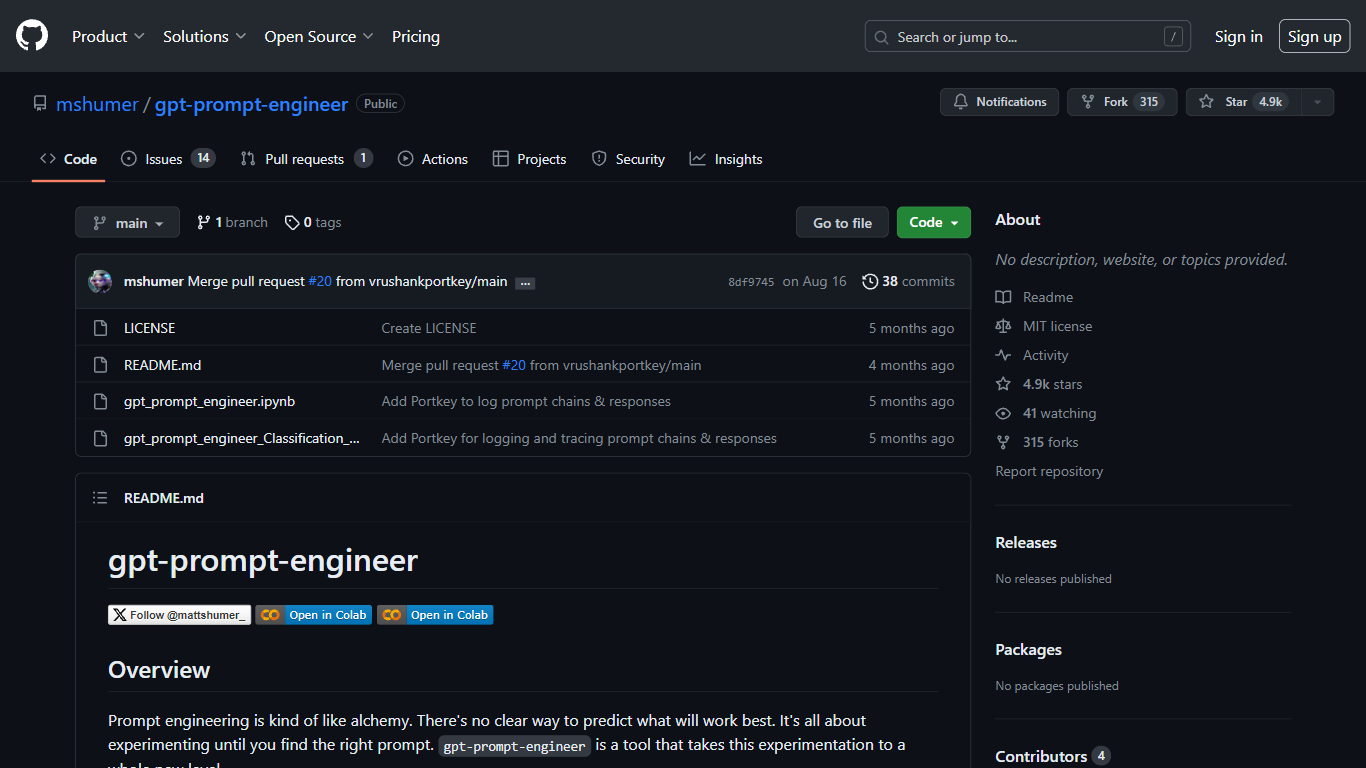
mshumer/gpt-prompt-engineer is an open source prompt engineering toolkit that generates, tests, and ranks candidate prompts for a task you define. You describe the use case, supply test cases, and the notebooks create multiple prompt variants, run them against every test case, and sort results with an ELO rating system starting at 1200. It ships as Jupyter notebooks you can run in Google Colab or locally.
Most prompt tools help you write one prompt at a time. gpt-prompt-engineer treats prompt selection like a tournament: dozens of candidates compete on your test cases, and the highest ELO scores surface the winners. Separate notebooks cover classification tasks, Claude 3 Opus with auto-generated test cases, and Opus-to-Haiku conversion for cheaper inference. Optional Weights & Biases and Portkey logging trace each run.
ML engineers, prompt engineers, and AI developers use it when they need reproducible prompt tuning instead of manual trial and error. The repo has 9.7k GitHub stars and runs on your own OpenAI or Anthropic API keys. It is free under the MIT license.
GET3D | Nvidia
What is GET3D | Nvidia?
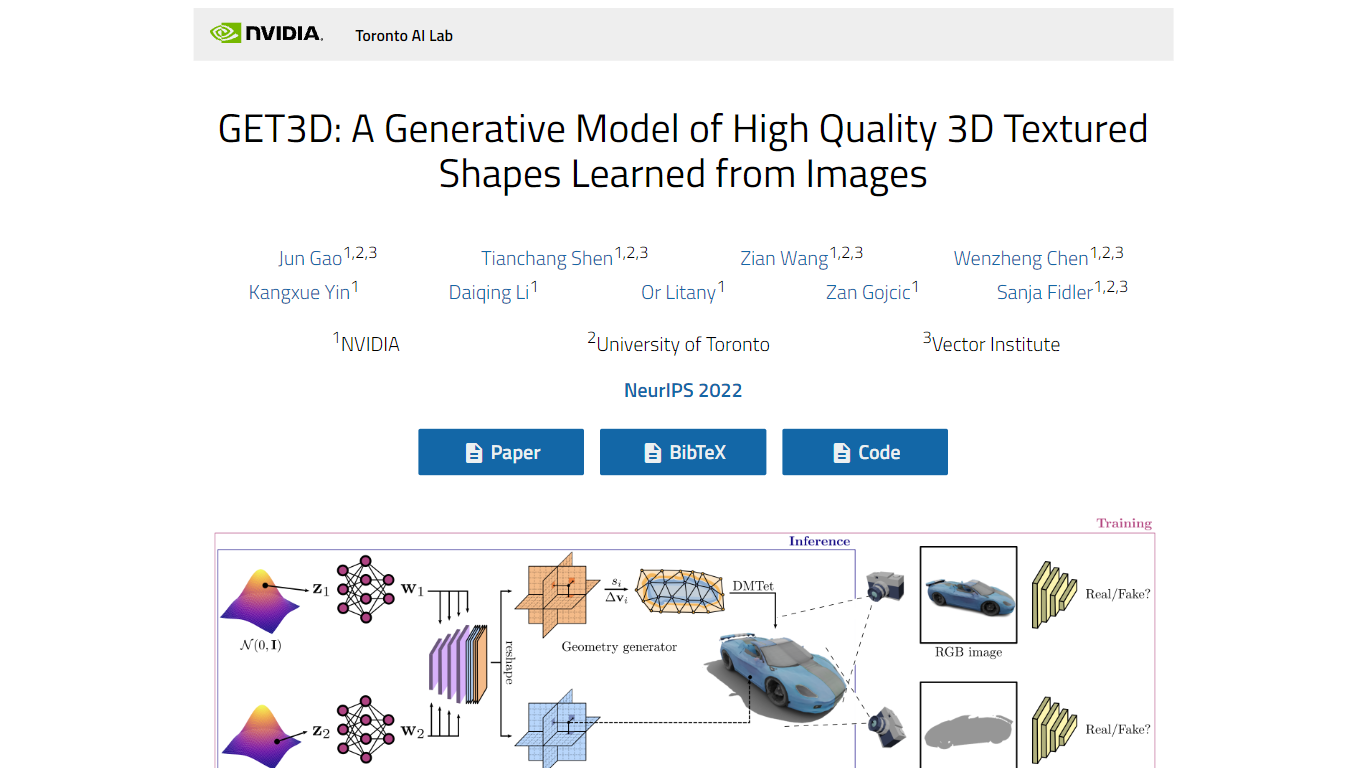
GET3D generates textured 3D mesh assets you can drop straight into a rendering engine, trained only from collections of 2D images. NVIDIA researchers built it to output explicit meshes with geometry and texture, not neural radiance fields that need custom renderers to use.
Most 3D generative models at the time either skipped textures, locked you into fixed topology, or required neural rendering pipelines to view results. GET3D uses differentiable marching tetrahedra (DMTet) plus adversarial losses on rasterized RGB images and silhouettes, so the output is a standard textured mesh. The trade-off is research-grade access: this is an NVIDIA Toronto AI Lab project from NeurIPS 2022, not a hosted SaaS with an upload button.
The model handles cars, chairs, animals, motorbikes, human characters, and buildings. It also supports text-guided shape generation via CLIP-based finetuning, similar to StyleGAN-NADA, and can disentangle geometry from texture through separate latent codes.
mshumer/gpt-prompt-engineer - GitHub Upvotes
GET3D | Nvidia Upvotes
mshumer/gpt-prompt-engineer - GitHub Top Features
Generates multiple prompt candidates from a task description and user-supplied test cases
Ranks prompts with an ELO rating system starting at 1200 per candidate
Supports GPT-4, GPT-3.5-Turbo, and Claude 3 Opus model backends
Classification notebook scores true/false test cases and prints a results table
Claude 3 notebook auto-generates test cases from input variable definitions
Opus-to-Haiku conversion notebook cuts latency and cost while preserving output quality
Optional Weights & Biases and Portkey logging for experiment tracking
GET3D | Nvidia Top Features
Outputs explicit textured 3D meshes usable in standard rendering engines
Trained from 2D image collections using adversarial losses on RGB and silhouettes
Generates cars, chairs, animals, motorbikes, humans, and buildings
Disentangles geometry and texture through separate latent codes
Supports text-guided shape generation via CLIP-based finetuning
Published at NeurIPS 2022 by NVIDIA, University of Toronto, and Vector Institute
mshumer/gpt-prompt-engineer - GitHub Category
- Model Generation
GET3D | Nvidia Category
- Model Generation
mshumer/gpt-prompt-engineer - GitHub Pricing Type
- Free
GET3D | Nvidia Pricing Type
- Free