
Last updated 07-30-2026
Category:
Reviews:
Join thousands of AI enthusiasts in the World of AI!
GET3D | Nvidia
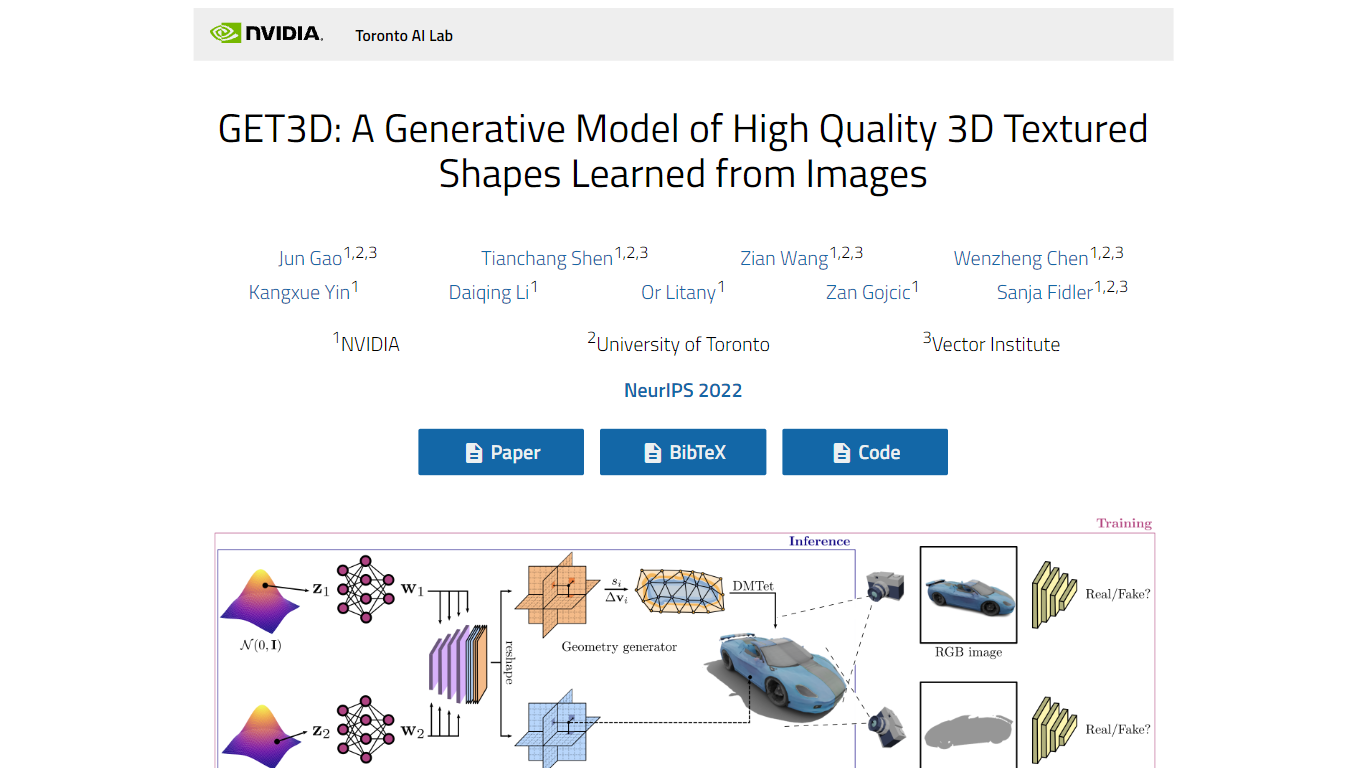
GET3D generates textured 3D mesh assets you can drop straight into a rendering engine, trained only from collections of 2D images. NVIDIA researchers built it to output explicit meshes with geometry and texture, not neural radiance fields that need custom renderers to use.
Most 3D generative models at the time either skipped textures, locked you into fixed topology, or required neural rendering pipelines to view results. GET3D uses differentiable marching tetrahedra (DMTet) plus adversarial losses on rasterized RGB images and silhouettes, so the output is a standard textured mesh. The trade-off is research-grade access: this is an NVIDIA Toronto AI Lab project from NeurIPS 2022, not a hosted SaaS with an upload button.
The model handles cars, chairs, animals, motorbikes, human characters, and buildings. It also supports text-guided shape generation via CLIP-based finetuning, similar to StyleGAN-NADA, and can disentangle geometry from texture through separate latent codes.
Outputs explicit textured 3D meshes usable in standard rendering engines
Trained from 2D image collections using adversarial losses on RGB and silhouettes
Generates cars, chairs, animals, motorbikes, humans, and buildings
Disentangles geometry and texture through separate latent codes
Supports text-guided shape generation via CLIP-based finetuning
Published at NeurIPS 2022 by NVIDIA, University of Toronto, and Vector Institute
Outputs standard textured meshes compatible with common 3D software
Trains from 2D image collections without requiring 3D ground truth
Disentangled geometry and texture codes let you swap materials without regenerating shape
Supports text-guided generation via CLIP finetuning
Free research project from a top-tier NeurIPS 2022 paper
Research project only, not a hosted commercial product
No self-serve SaaS interface or API for casual users
Business use requires separate NVIDIA Research Licensing
Paper dates to 2022; newer 3D generation models have since emerged
What is GET3D by NVIDIA?
GET3D is a generative model from NVIDIA Toronto AI Lab that creates explicit textured 3D meshes from 2D image collections. It was published at NeurIPS 2022 and outputs assets ready for standard 3D rendering engines.
Is GET3D free to use?
GET3D is a free NVIDIA research project. There is no commercial pricing or hosted SaaS product. Business licensing inquiries go through NVIDIA Research Licensing.
What 3D categories can GET3D generate?
GET3D generates textured meshes across multiple categories including cars, chairs, animals, motorbikes, human characters, and buildings. Demo videos on the project page show detailed geometry like wheels, windows, and clothing textures.
How does GET3D differ from neural radiance fields?
GET3D outputs standard textured mesh files via DMTet surface extraction rather than neural radiance field representations. This means generated assets can be imported into common 3D software without a custom neural renderer.
Can GET3D generate shapes from text prompts?
Yes. GET3D supports text-guided shape generation by finetuning the 3D generator with directional CLIP loss on rendered 2D images, following the StyleGAN-NADA approach described on the project page.
Who developed GET3D?
GET3D was developed by researchers at NVIDIA, the University of Toronto, and the Vector Institute. Lead authors include Jun Gao, Tianchang Shen, and Sanja Fidler, among others listed on the NeurIPS 2022 paper.