Versy.ai vs GET3D | Nvidia
Compare Versy.ai vs GET3D | Nvidia and see which AI Model Generation tool is better when we compare features, reviews, pricing, alternatives, upvotes, etc.
Which one is better? Versy.ai or GET3D | Nvidia?
When we compare Versy.ai with GET3D | Nvidia, which are both AI-powered model generation tools, The upvote count shows a clear preference for Versy.ai. Versy.ai has been upvoted 7 times by aitools.fyi users, and GET3D | Nvidia has been upvoted 6 times.
Feeling rebellious? Cast your vote and shake things up!
Versy.ai

What is Versy.ai?
Versy.ai turns floor plans, moodboards, and design briefs into explorable spatial experiences you share through a browser link. Architects and interior teams upload references, build scenes in the cloud, and let clients walk a project before approvals instead of decoding static boards.
Render farms and video tours show space but rarely keep layout, materials, and light in one live conversation. Versy.ai combines navigable interiors, AI-generated 3D assets, cloud material libraries, and lighting edits so stakeholders evaluate scale and atmosphere in real time without VR headsets.
Interior studios, architecture firms, and brand experience teams in beta use it for client presentations, studio reviews, and spatial marketing landings where one shareable link replaces scattered PDFs and render decks.
GET3D | Nvidia
What is GET3D | Nvidia?
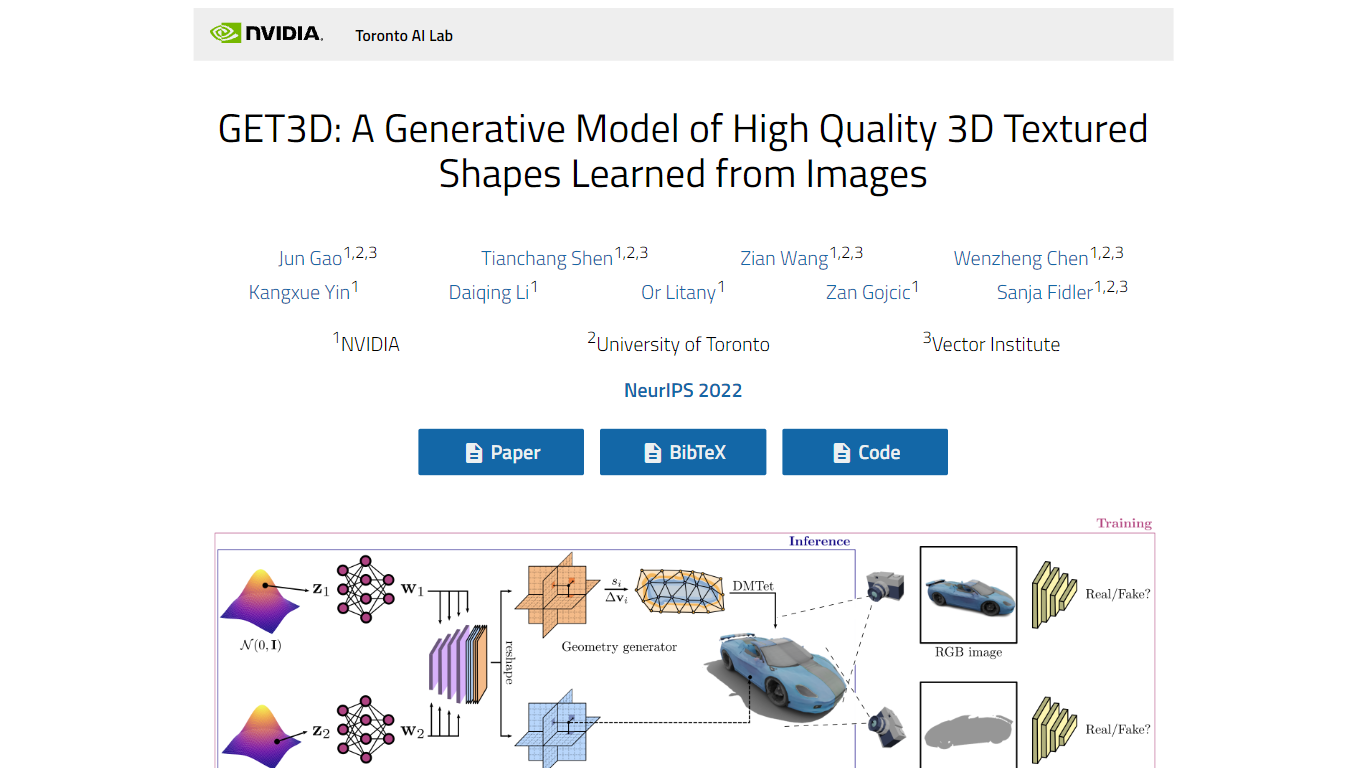
GET3D generates textured 3D mesh assets you can drop straight into a rendering engine, trained only from collections of 2D images. NVIDIA researchers built it to output explicit meshes with geometry and texture, not neural radiance fields that need custom renderers to use.
Most 3D generative models at the time either skipped textures, locked you into fixed topology, or required neural rendering pipelines to view results. GET3D uses differentiable marching tetrahedra (DMTet) plus adversarial losses on rasterized RGB images and silhouettes, so the output is a standard textured mesh. The trade-off is research-grade access: this is an NVIDIA Toronto AI Lab project from NeurIPS 2022, not a hosted SaaS with an upload button.
The model handles cars, chairs, animals, motorbikes, human characters, and buildings. It also supports text-guided shape generation via CLIP-based finetuning, similar to StyleGAN-NADA, and can disentangle geometry from texture through separate latent codes.
Versy.ai Upvotes
GET3D | Nvidia Upvotes
Versy.ai Top Features
Turn uploaded floor plans into navigable spatial experiences inside the browser
Generate custom 3D assets with AI and drag-drop restyle interiors in scene
Cloud libraries store materials and objects for reuse across projects
Edit lighting and atmosphere in seconds before sharing one review link
Beta access includes AI scene assembly and rewrite commands in the editor
Streams through the browser with no VR hardware requirement for viewers
GET3D | Nvidia Top Features
Outputs explicit textured 3D meshes usable in standard rendering engines
Trained from 2D image collections using adversarial losses on RGB and silhouettes
Generates cars, chairs, animals, motorbikes, humans, and buildings
Disentangles geometry and texture through separate latent codes
Supports text-guided shape generation via CLIP-based finetuning
Published at NeurIPS 2022 by NVIDIA, University of Toronto, and Vector Institute
Versy.ai Category
- Model Generation
GET3D | Nvidia Category
- Model Generation
Versy.ai Pricing Type
- Freemium
GET3D | Nvidia Pricing Type
- Free