15 Best AI 3D Object Generators tools in 2026
In the burgeoning world of artificial intelligence, AI 3D object generators stand at the forefront of a creative revolution, offering limitless possibilities to artists, designers, and hobbyists alike. These innovative tools harness the power of AI to turn simple textual descriptions into detailed 3D models, bridging the gap between imagination and reality. Whether it's for video games, virtual reality experiences, or prototyping physical objects, AI 3D object generators are transforming the way we create and interact with digital content.
Unlike traditional 3D modeling software, which requires extensive training and technical skills, AI-driven generators are designed to be user-friendly, making 3D design accessible to everyone. With just a few clicks and a description, users can conjure up anything from fantastical creatures to futuristic vehicles, all rendered in stunning detail. This technology not only democratizes the field of 3D design but also accelerates the creative process, allowing for rapid prototyping and iteration.
As AI continues to evolve, so too do the capabilities of these generators, promising ever more realistic and complex outputs. This advancement not only pushes the boundaries of digital art but also opens up new avenues for innovation across industries. From entertainment to engineering, AI 3D object generators are not just tools of creation but catalysts for the imagination, heralding a new era of digital craftsmanship.
Meshy
Why choose Meshy? and how does it work?
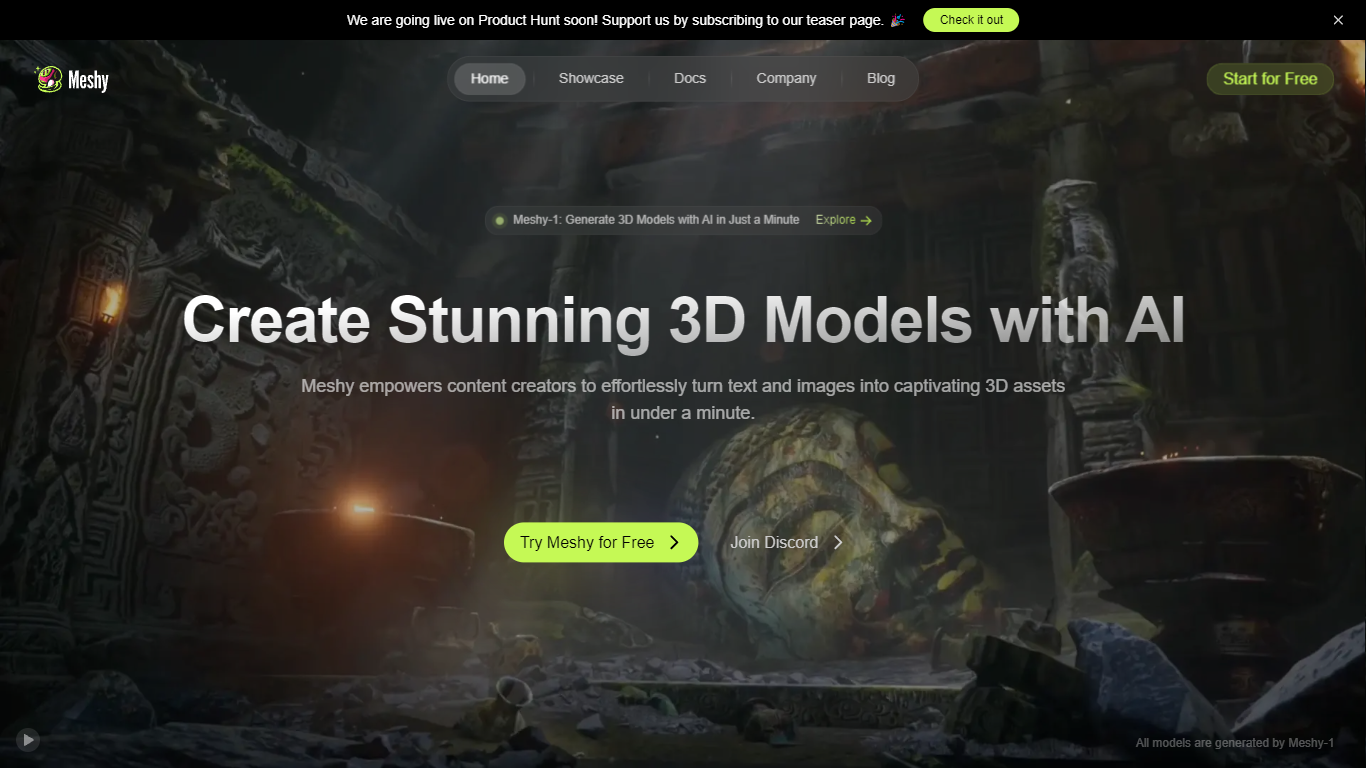
Meshy is a 3D generation platform that turns text prompts or reference images into textured 3D models in about a minute. You describe an object, upload a photo, or chat with the built-in 3D Agent, and Meshy returns export-ready meshes with PBR textures. The browser-based workflow targets game developers, 3D artists, and printing hobbyists who need assets without opening Blender first.
Most text-to-3D tools optimize for visuals alone. Meshy trains specifically for printability, exporting watertight, manifold models that pass slicer checks on the first try. It also ships dedicated Image to 3D, Text to 3D, and AI Texture Generator workflows, plus Blender and Unity plugins and a documented API at docs.meshy.ai.
Indie game studios, rapid prototypers, and makers use Meshy to block out characters, props, and printable figurines before refining in a DCC tool. Free users get 100 monthly credits; paid plans unlock private asset ownership, faster queues, and commercial rights without attribution.
Text to 3D supports prompts up to 800 characters across Meshy 4, 5, and 6 model versions
Each text generation costs 20 credits and typically completes in about one minute
Exports 8 formats: FBX, OBJ, GLB, USDZ, STL, BLEND, 3MF, and DXF
Built-in printability check flags non-manifold edges and auto-repairs before slicing
Blender and Unity plugins plus REST API documented at docs.meshy.ai
Free plan includes 100 credits per month with no credit card required
3DFY.ai
What is 3DFY.ai?
3DFY.ai revolutionizes the process of 3D model creation by leveraging the power of artificial intelligence. This innovative platform allows users to generate highly detailed 3D models with ease, using either a simple text prompt or a single image as the starting point. The technology is designed to cater to a wide range of industries and individual creatives, providing a scalable solution for high-quality 3D asset production. 3DFY.ai offers various services, including 3DFY Prompt, Megapacks, Image processing, and custom solutions that meet the specific needs of businesses and creators. With 3DFY.ai, producing 3D content is no longer confined by traditional methods like photogrammetry, 3D scanning, and manual creation, which are often costly, time-intensive, and difficult to scale up. This platform is perfect for those seeking to express themselves in the 3D space or businesses aiming to generate massive 3D datasets swiftly and efficiently.
AI-powered 3D Model Generation: Generates high-quality 3D models from text prompts or single images using AI.
Quality and Scale: Prioritizes asset quality without compromising the ability to produce models on a large scale.
Diverse Applications: Offers solutions for AR/VR online retail gaming and more.
Automated Technology: Minimizes human labor by automating the creation of 3D assets.
Flexible Services: Provides tools for individuals and enterprises including APIs and massive dataset generation services.
in3D
What does in3D do?
in3D is a mobile avatar generator that turns a phone camera scan into a realistic 3D character in about a minute. You walk through a short capture, customize the result, and export a rigged model as FBX, GLB, or USDZ for Blender, Unity, Unreal Engine, or MetaHuman pipelines. The app also supports AR previews, clothing try-on, and sharing avatars with friends through deeplinks.
Phone-scan avatar apps usually trade quality for speed. in3D targets photoreal full-body captures from a handheld scan rather than cartoon filters or static selfie meshes. Export paths include game-ready formats plus paid platform packs for VRChat, GTA V, and Second Life when you need a preset rig for a specific world.
Casual creators, indie game developers, and fashion or metaverse teams use in3D to prototype characters without a studio scan booth. Goodsize Inc., the company behind in3d.io, also ships separate Avaturn products for selfie-based web avatars and real-time AI faces.
Phone camera scan builds a photoreal 3D avatar in about one minute
Export rigged models as FBX, GLB, or USDZ from the app
MetaHuman export sends avatars straight into Epic's character pipeline
in3D SDK imports scans into Unity and Unreal Engine projects
5 Scans Monthly in-app purchase is $19.99 on the App Store listing
60 Scans Yearly in-app purchase is $179.99 on the App Store listing
Platform export packs include VRChat, GTA V, and Second Life options
Avaturn
Why choose Avaturn?
Avaturn is an avatar generator that builds realistic 3D characters from a single selfie. Game studios, app developers, and metaverse teams embed its plugin or API so users create personalized avatars with custom body shape, clothes, hairstyles, and accessories, then export a ready-to-use 3D model.
Compared with generic character creators, Avaturn focuses on photorealistic likeness from a phone photo and ships plugins for Unity, Unreal Engine, Three.js, Android, and iOS. The free developer tier has no cap on avatars created or exported, while the Pro plan at $800 per month adds white-label branding, custom garments, and up to 1,000 hosted avatars.
Marketing teams run avatar-based campaigns, VR software vendors deploy selfie avatars in social apps, and indie game developers skip building an in-house avatar pipeline. Agencies can also use Avaturn through a partner program listed on the site.
Generate a realistic 3D avatar from a single selfie with body, hair, clothing, and accessory customization
Plugins for Unity, Unreal Engine, Three.js, Android, and iOS with no limit on free-tier avatar exports
Pro plan at $800 per month includes 1,000 avatars, white-label branding, and $0.15 per extra avatar
API and web SDK let developers control the full avatar UX without routing users through Avaturn login
Upload custom garments and apply your own logos and colors on the Pro tier
Export compiled 3D models ready to drop into existing game characters
Immersity (formerly LeiaPix Converter)
Why use Immersity (formerly LeiaPix Converter)? and how does it work?
Immersity, formerly LeiaPix Converter, turns flat photos and videos into depth animations you can view on a normal screen or XR headset. You upload a 2D file, the Neural Depth Engine builds a depth map, and you export formats like side-by-side 3D, depth maps, spatial video for Apple Vision Pro, or animated Immersive Motion clips.
Generic 3D photo apps often stop at a single parallax wiggle. Immersity separates foreground and background into distinct layers with Neural Depth Rendering 4.0, which fills in obscured details when you pan or zoom the viewpoint. It also converts video, not just stills, with export options up to 4K on paid plans.
Creators, marketers, and XR hobbyists use it for social clips, travel footage, and stereoscopic content without building depth maps by hand. The free tier allows unlimited watermarked conversions up to 720p; paid image plans start at $4.99 per month for 500 credits and 4K output without watermarks.
Neural Depth Engine converts 2D images and videos into depth animations with layer separation in Immersity 4.0
Free plan offers unlimited watermarked conversions up to 720p; paid Image plan is $4.99 per month for 500 credits and 4K output
Exports include side-by-side 3D, anaglyph, depth maps, spatial video for Apple Vision Pro, and Immersive Motion MP4 or GIF
Video conversion supports formats like side-by-side full, top-bottom, and depth map exports from 100 to 600 credits per minute depending on resolution
Over 5 million users on the platform per Leia Inc., with a separate free Immersity for Mobile app on iOS and Android
convert.leiapix.com redirects to app.immersity.ai where users sign in with email or Google
GET3D | Nvidia
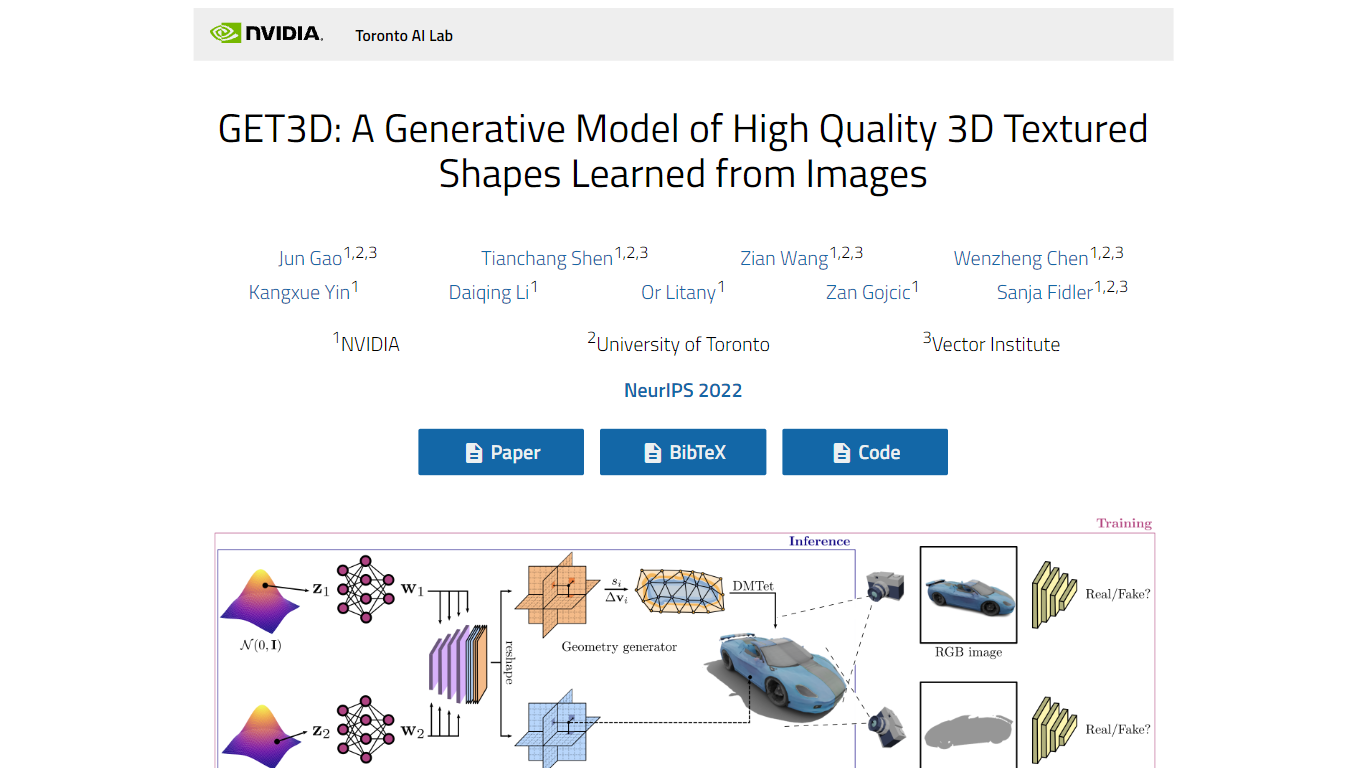
Why choose GET3D | Nvidia?
GET3D generates textured 3D mesh assets you can drop straight into a rendering engine, trained only from collections of 2D images. NVIDIA researchers built it to output explicit meshes with geometry and texture, not neural radiance fields that need custom renderers to use.
Most 3D generative models at the time either skipped textures, locked you into fixed topology, or required neural rendering pipelines to view results. GET3D uses differentiable marching tetrahedra (DMTet) plus adversarial losses on rasterized RGB images and silhouettes, so the output is a standard textured mesh. The trade-off is research-grade access: this is an NVIDIA Toronto AI Lab project from NeurIPS 2022, not a hosted SaaS with an upload button.
The model handles cars, chairs, animals, motorbikes, human characters, and buildings. It also supports text-guided shape generation via CLIP-based finetuning, similar to StyleGAN-NADA, and can disentangle geometry from texture through separate latent codes.
Outputs explicit textured 3D meshes usable in standard rendering engines
Trained from 2D image collections using adversarial losses on RGB and silhouettes
Generates cars, chairs, animals, motorbikes, humans, and buildings
Disentangles geometry and texture through separate latent codes
Supports text-guided shape generation via CLIP-based finetuning
Published at NeurIPS 2022 by NVIDIA, University of Toronto, and Vector Institute
Farm3D
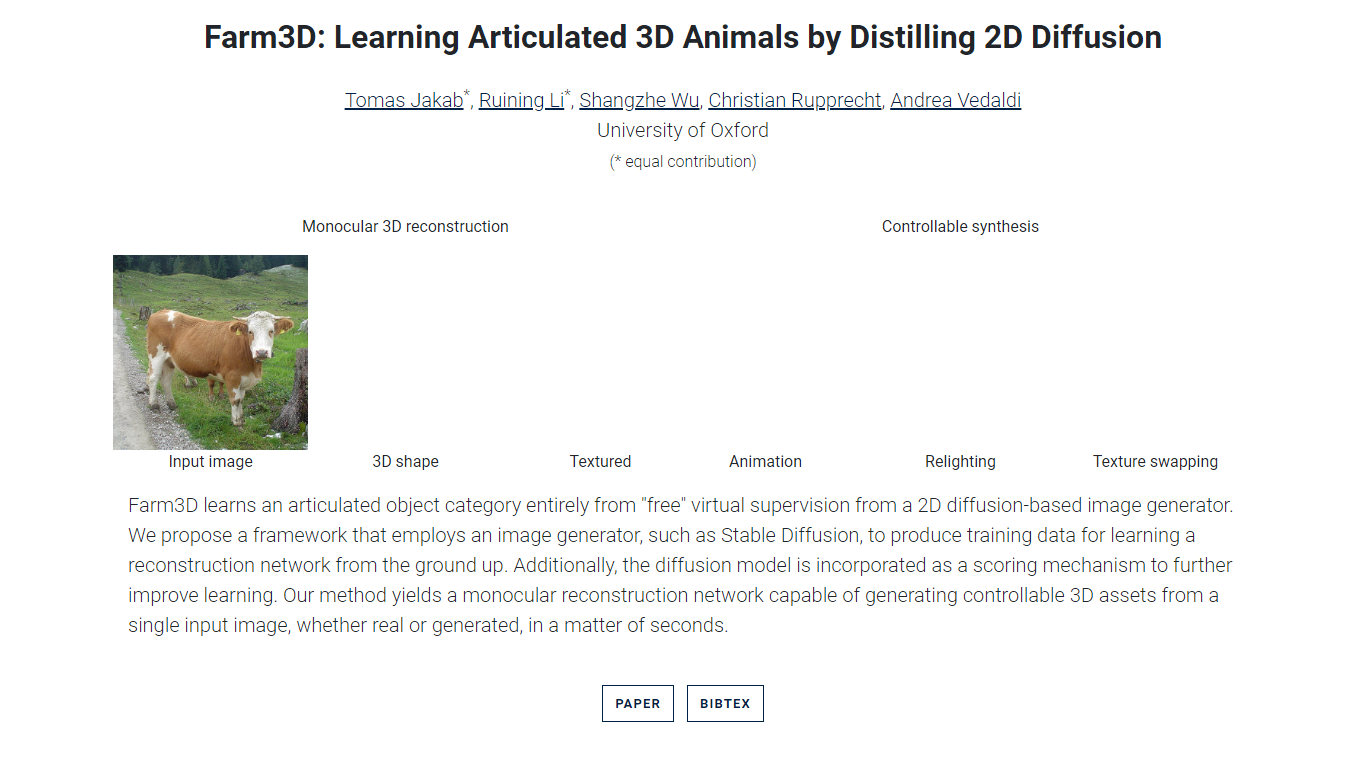
What does Farm3D do?
Farm3D is a research method for single-view 3D reconstruction of articulated animals, built at the University of Oxford and published at 3DV 2024. You feed it one photo of a horse, cow, or sheep and it returns a full 3D shape with texture in seconds, without training on real photographs. The project page documents the approach, shows reconstruction demos, and links to code and the Animodel benchmark dataset.
Most 3D generators need large labeled 3D datasets or multi-view captures. Farm3D trains entirely on synthetic views produced by Stable Diffusion, then uses the same diffusion model as a critic during learning. That lets it recover fine details like legs and ears on categories it never saw in real images, which is unusual for monocular reconstruction pipelines that rely on real-world supervision.
Researchers studying articulated 3D shape, computer vision engineers prototyping animal asset pipelines, and 3D artists exploring controllable synthesis will find the demos and open code useful. The method also supports relighting, texture swapping between same-category models, and skeletal animation once a shape is generated.
Reconstructs articulated 3D animal shapes from one input image in seconds
Trains without real photos by distilling virtual views from Stable Diffusion
Factorizes each instance into shape, albedo, diffuse and ambient lighting, viewpoint, and light direction
Supports relighting, texture swapping between same-category models, and skeletal animation on generated assets
Animodel benchmark ships textured meshes for horses, cows, and sheep with realistic articulated poses
Paper accepted at 3DV 2024; code and dataset published on GitHub under tomasjakab/animodel
Alpha3D
Why use Alpha3D? and how does it work?
Alpha3D turns a text prompt or product photo into a game-ready 3D model, then walks the asset through retopology, UV unwrapping, texturing, rigging, and export in one browser tab. You can start from Generate with a single image, up to eight reference angles, or a written description, and the mesh lands in your library in about one to three minutes. The whole pipeline lives in a web app, so you never hand the mesh off to a separate DCC tool mid-job.
Most AI 3D generators hand you a raw mesh and leave Blender cleanup to you. Alpha3D keeps the same asset in one tab for Smart Topology, UV Unwrapping, AI Texturing, AI Rigging, and Convert 3D, so the finished file is what your engine expects rather than a turntable demo. Workflows adds a node canvas to chain those steps and rerun them across batches.
Indie developers use it to skip DCC handoffs before Unity or Unreal import. E-commerce teams feed multi-view product photos and export GLB for model-viewer and AR Quick Look. Alphred, the built-in chat agent, drives the same tools from natural language when you would rather describe the asset than click through ten pages.
One-tab pipeline from prompt or photo through retopology, UV unwrap, texturing, rigging, and GLB, FBX, OBJ, or STL export
Alphred agent runs every tool from chat on a separate monthly Token balance from 1,000 on Tester to 32,000 on Creator Pro
High-res text or image to 3D with PBR materials costs 42 credits; Smart Topology retopology costs 60 credits per job
REST API and MCP connectors for Claude and ChatGPT ship on every plan, including the 5 euro Tester tier
Multi-view generation accepts up to 4 reference photos on Basic and up to 8 on Creator Pro
Workflows node canvas chains generation, retopo, UV, texturing, and rigging into reusable batch graphs
Neuralangelo Research Reconstructs 3D Scenes | NVIDIA
What is Neuralangelo Research Reconstructs 3D Scenes | NVIDIA? and how does it work?
Neuralangelo is an NVIDIA Research model that reconstructs detailed 3D objects and scenes from ordinary 2D video. Feed clips filmed from multiple angles and the system builds textured meshes of buildings, sculptures, vehicles, and interiors suitable for games, digital twins, and robotics sims.
Earlier neural reconstruction methods blurred fine textures like roof shingles, glass, and marble. Neuralangelo extends instant neural graphics primitives from NVIDIA Instant NeRF to capture those surfaces with higher fidelity, so smartphone footage can produce assets creative teams can import into design tools without a laser scan or manual modeling pass.
Researchers, game artists, and robotics engineers use Neuralangelo to digitize real-world objects from Michelangelo-scale statues to campus buildings. The project is open source on GitHub under nvlabs/neuralangelo with no commercial license fees for the research code itself.
Reconstructs 3D objects and large scenes from 2D video filmed at multiple angles
Captures fine textures like shingles, glass, and marble better than prior neural methods
Built on instant neural graphics primitives from NVIDIA Instant NeRF technology
Exports detailed meshes for game engines, VR, digital twins, and robotics pipelines
Open-source code published at github.com/nvlabs/neuralangelo
Demonstrated on statues, vehicles, and full building interiors from phone footage
Presented at CVPR 2023 alongside nearly 30 other NVIDIA Research projects
Krikey AI 3D Animation Editor
Why use Krikey AI 3D Animation Editor? and how does it work?
Krikey AI turns text prompts, photos, and blog posts into 3D animated videos with talking avatars, lip sync, and exportable MP4 or FBX files. You pick or generate a character, write a script, and the browser editor handles rigging and camera work without manual keyframing.
Most animation tools expect you to rig bones and set keyframes. Krikey skips that with automatic character rigging from an uploaded photo or a gallery pick. Talking avatar videos cost 8 credits each, custom 3D avatars cost 40 credits, and the Pro plan includes 165 monthly credits for about $15. That credit math makes short social clips affordable but custom characters eat the budget fast.
The editor also generates AI music videos, podcast-style clips from blog text, and motion from video uploads. Exports include MP4, GIF, PNG, and FBX for Unity or Unreal. Krikey is SOC2, FERPA, and COPPA compliant, which matters for schools using the EDU discount plan.
YouTubers, teachers, marketers, and small teams who need talking 3D characters without hiring a motion studio will get the most from Krikey. The free plan gives 20 one-time credits to test the workflow before upgrading.
Talking avatar videos cost 8 credits each with automatic lip sync
Upload a photo to generate a rigged 3D character in minutes
Pro plan at $15 per month includes 165 credits
Export MP4, GIF, PNG, and FBX files with unlimited downloads on paid plans
AI music video generator creates singing 3D characters from genre and topic prompts
Turn blog posts or text into animated podcast video clips
Teams plan at $30 per month for 3 people with 200 credits monthly
Sloyd
How does Sloyd work?
Sloyd turns text prompts, photos, or parametric templates into textured 3D models inside the browser. You can generate assets from a description, upload a JPG or PNG reference, or start from handcrafted templates with slider controls. Exports ship as GLB, FBX, OBJ, STL, USD, and other formats for game engines, DCC tools, and 3D printers.
Many 3D generators meter every prompt with tight credit caps. Sloyd markets unlimited text and image generation on paid plans, with Guest users getting one AI 3D generation per day and unlimited template customization in-browser. Plus and Pro tiers add plugin access for Unity, Unreal, and Blender, auto-rigging, AI animation, and commercial licensing.
The product fits game developers, indie studios, 3D printing hobbyists, e-commerce visualization teams, and architects who need fast iteration. Sloyd also ships a Roblox avatar creator, topology controls up to 500K triangles on Pro, and Discord community support. Paid support email is [email protected].
Text-to-3D and image-to-3D with unlimited generations on Plus and Pro plans
Guest plan includes 1 AI 3D generation per day and unlimited template editing
Exports GLB, FBX, OBJ, STL, USD, USDZ, BLEND, and 3MF for engines and printers
Plugins send assets to Unity, Unreal, and Blender in one click
Auto-rigging, AI animation, and topology control up to 500K triangles on Pro
Image uploads accept JPG, PNG, and WEBP files up to 20MB
3DAiLY AI
How does 3DAiLY AI work?
3DAiLY AI creates high-quality 3D models and collectible figurines from a single clear photo. It uses AI to generate an initial 3D preview and offers expert artist refinement to ensure print-ready, detailed models. Users can select from 12 distinct art styles, including photo-realistic, anime, chibi, and fantasy heroes, to customize their creations.
What sets 3DAiLY AI apart is its combination of instant AI previews with human artist enhancements, delivering polished models suitable for display or collectibles. It also provides physical prints in premium materials like multicolored resin and sandstone, shipped worldwide. This blend of technology and craftsmanship offers a unique balance between speed and quality.
The process is straightforward: upload one clear photo, choose an art style, review the instant AI-generated preview, and then approve or request artist refinements before printing. 3DAiLY AI supports bulk orders and maintains responsive customer service to assist users throughout creation and delivery.
With over a decade of experience inherited from My3DSelfie, 3DAiLY AI has a strong reputation for quality and customer satisfaction. Its offerings cater to collectors, gamers, artists, and gift buyers seeking personalized 3D creations that combine digital innovation with expert craftsmanship.
📸 Upload one clear photo to start your 3D creation easily
🎨 Choose from 12 unique art styles including photo-realistic and stylized designs
✨ Instant AI-generated 3D previews for quick review
🖌️ Artist refinement option for print-perfect quality
📦 Physical figurines printed in premium multicolored resin (3"–6") and sandstone (5"–12") shipped worldwide
💰 Optional low-cost print preview ($5) before full production
🌍 Ships to over 150 countries with tracking included
Mondial 3D
Why choose Mondial 3D? and how does it work?
Mondial 3D enables users to explore, purchase, and create detailed 3D models with the assistance of artificial intelligence. It offers tools to design interiors, exteriors, and immersive virtual environments without requiring any coding expertise. Users can customize and generate complex 3D scenes, making digital design accessible to a wide audience.
The platform combines a marketplace for buying and selling 3D assets with AI-powered creative tools that streamline the design process. It supports collaboration by allowing creators and businesses to showcase their work, find talent, and manage projects within a unified ecosystem. This integration enhances productivity and fosters innovation in digital content creation.
Mondial 3D caters to digital artists, architects, game developers, and metaverse creators by providing a no-code environment that lowers technical barriers. Businesses benefit from sourcing high-quality 3D models and commissioning custom designs, which helps accelerate workflows in various industries. The platform's AI algorithms assist in model generation and scene composition, improving both speed and quality.
With features aimed at metaverse development and spatial design, Mondial 3D expands creative possibilities by blending virtual and real-world elements. Its focus on ease of use and accessibility empowers users to bring their ideas to life, whether for visualization, gaming, or immersive experiences. Mondial 3D continues to evolve as a comprehensive hub for 3D creativity and digital design innovation.
🛒 Extensive 3D Marketplace: Browse and purchase diverse 3D models for various projects.
🤖 AI-Assisted Design: Create and customize 3D scenes easily without coding skills.
🌐 Metaverse World Building: Design immersive virtual environments for digital experiences.
🎨 No-Code Tools: Build interiors, exteriors, and virtual spaces with intuitive interfaces.
👥 Talent & Project Hub: Connect with creators and submit projects for collaboration.
Lumiere 3D
Why use Lumiere 3D? and how does it work?
Lumiere3D is a cutting-edge AI platform that enables businesses to create immersive cinematic videos for e-commerce and marketing just in minutes. Scan your product > We generate 3D model > Choose 3D Scene > Select AI operator sequence > Get your video!