ZenPrompts vs GET3D | Nvidia
Compare ZenPrompts vs GET3D | Nvidia and see which AI Model Generation tool is better when we compare features, reviews, pricing, alternatives, upvotes, etc.
Which one is better? ZenPrompts or GET3D | Nvidia?
When we compare ZenPrompts with GET3D | Nvidia, which are both AI-powered model generation tools, The upvote count reveals a draw, with both tools earning the same number of upvotes. You can help us determine the winner by casting your vote and tipping the scales in favor of one of the tools.
Want to flip the script? Upvote your favorite tool and change the game!
ZenPrompts

What is ZenPrompts?
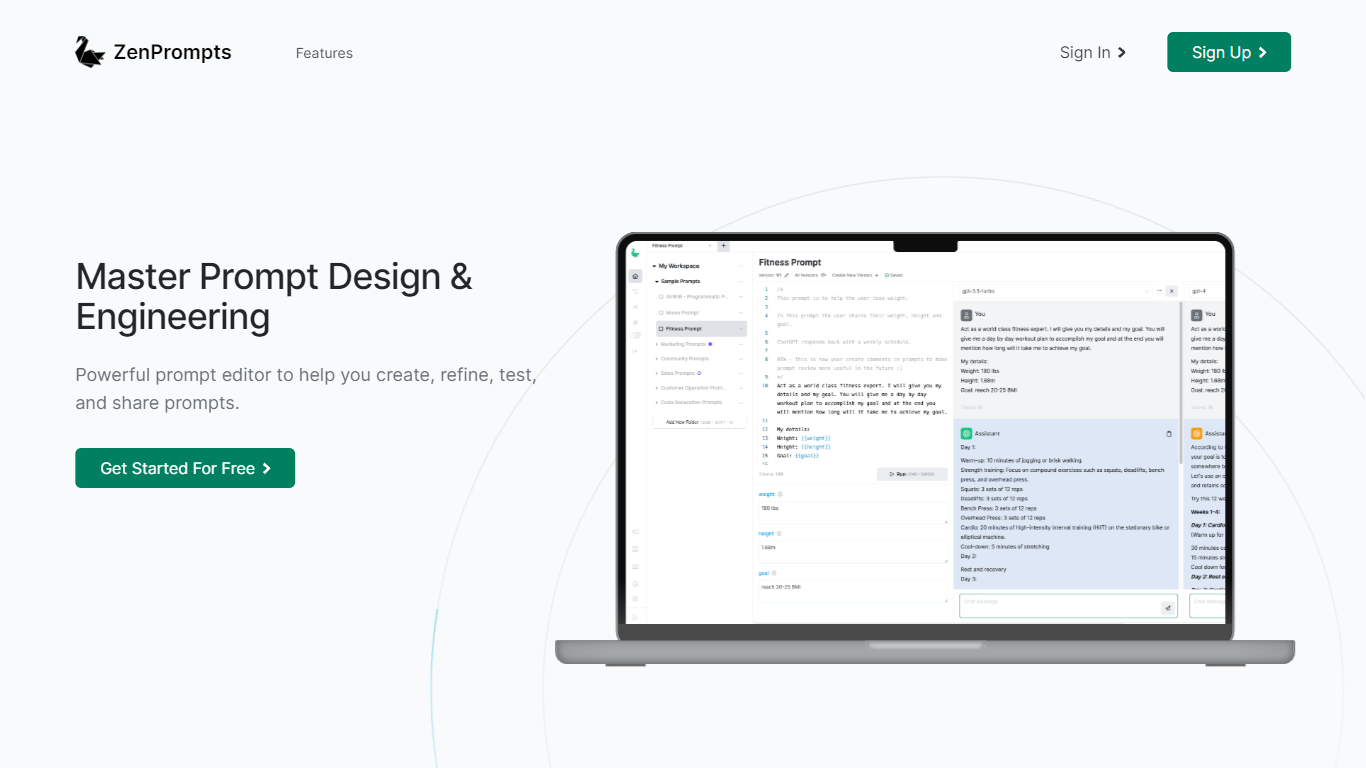
ZenPrompts is a cutting-edge platform designed to empower prompt engineers in the creation, refinement, testing, and sharing of sophisticated prompts for various OpenAI models. This user-friendly platform features a powerful prompt editor that makes it simple to compare prompts across multiple AI models, ensuring the selection of the most suitable one based on quality, cost, and performance. The service, which is free to use during its beta release, provides valuable tools for users to develop and showcase their prompt portfolio with a minimalist design that emphasizes their creativity.
With ZenPrompts, users can experiment with prompts without the concern of losing previous work, share their inventions with a broader community, and adopt the DRY (Don't Repeat Yourself) method for efficient prompt creation using dynamic variables. Additionally, users have the option to document prompts with comments for better organization and preservation of developmental insights. The platform's goal is to enhance the capabilities of prompt engineers and to display their skills in the era of Large Language Models and AI.
GET3D | Nvidia
What is GET3D | Nvidia?
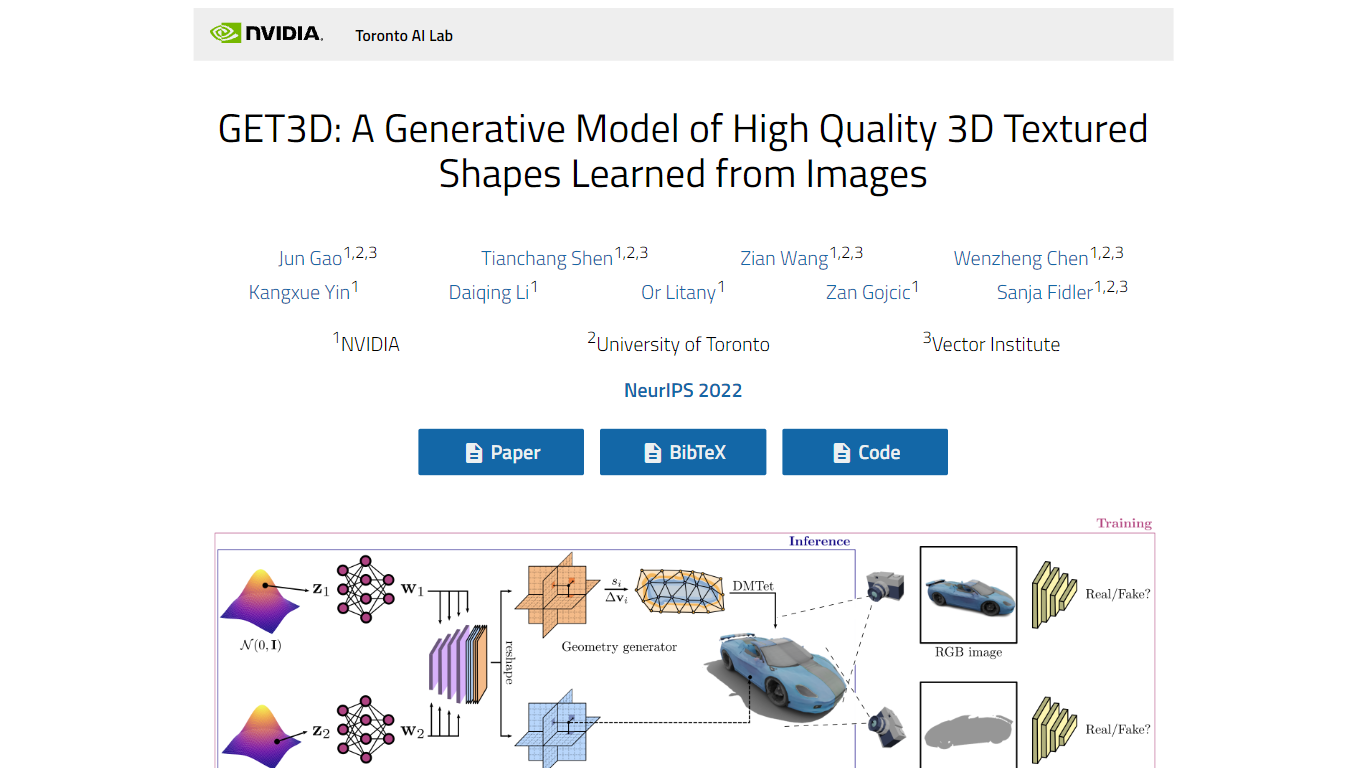
GET3D generates textured 3D mesh assets you can drop straight into a rendering engine, trained only from collections of 2D images. NVIDIA researchers built it to output explicit meshes with geometry and texture, not neural radiance fields that need custom renderers to use.
Most 3D generative models at the time either skipped textures, locked you into fixed topology, or required neural rendering pipelines to view results. GET3D uses differentiable marching tetrahedra (DMTet) plus adversarial losses on rasterized RGB images and silhouettes, so the output is a standard textured mesh. The trade-off is research-grade access: this is an NVIDIA Toronto AI Lab project from NeurIPS 2022, not a hosted SaaS with an upload button.
The model handles cars, chairs, animals, motorbikes, human characters, and buildings. It also supports text-guided shape generation via CLIP-based finetuning, similar to StyleGAN-NADA, and can disentangle geometry from texture through separate latent codes.
ZenPrompts Upvotes
GET3D | Nvidia Upvotes
ZenPrompts Top Features
Powerful Prompt Editor: A sophisticated editor to create refine test and share prompts efficiently.
Model Comparison: Ability to compare prompts across multiple OpenAI models to ensure the best fit for your needs.
Elegant Portfolio Presentation: A minimalist platform designed to showcase your prompt portfolio effectively.
Creative Experimentation: Experiment with prompts without the fear of losing previous versions.
Smart Use of Dynamic Variables: Utilize dynamic variables to streamline and make prompt structures more reusable with the DRY method.
GET3D | Nvidia Top Features
Outputs explicit textured 3D meshes usable in standard rendering engines
Trained from 2D image collections using adversarial losses on RGB and silhouettes
Generates cars, chairs, animals, motorbikes, humans, and buildings
Disentangles geometry and texture through separate latent codes
Supports text-guided shape generation via CLIP-based finetuning
Published at NeurIPS 2022 by NVIDIA, University of Toronto, and Vector Institute
ZenPrompts Category
- Model Generation
GET3D | Nvidia Category
- Model Generation
ZenPrompts Pricing Type
- Freemium
GET3D | Nvidia Pricing Type
- Free