OneOver vs Minerva
In the clash of OneOver vs Minerva, which AI Large Language Model (LLM) tool emerges victorious? We assess reviews, pricing, alternatives, features, upvotes, and more.
When we put OneOver and Minerva head to head, which one emerges as the victor?
Let's take a closer look at OneOver and Minerva, both of which are AI-driven large language model (llm) tools, and see what sets them apart. The upvote count is neck and neck for both OneOver and Minerva. The power is in your hands! Cast your vote and have a say in deciding the winner.
Disagree with the result? Upvote your favorite tool and help it win!
OneOver
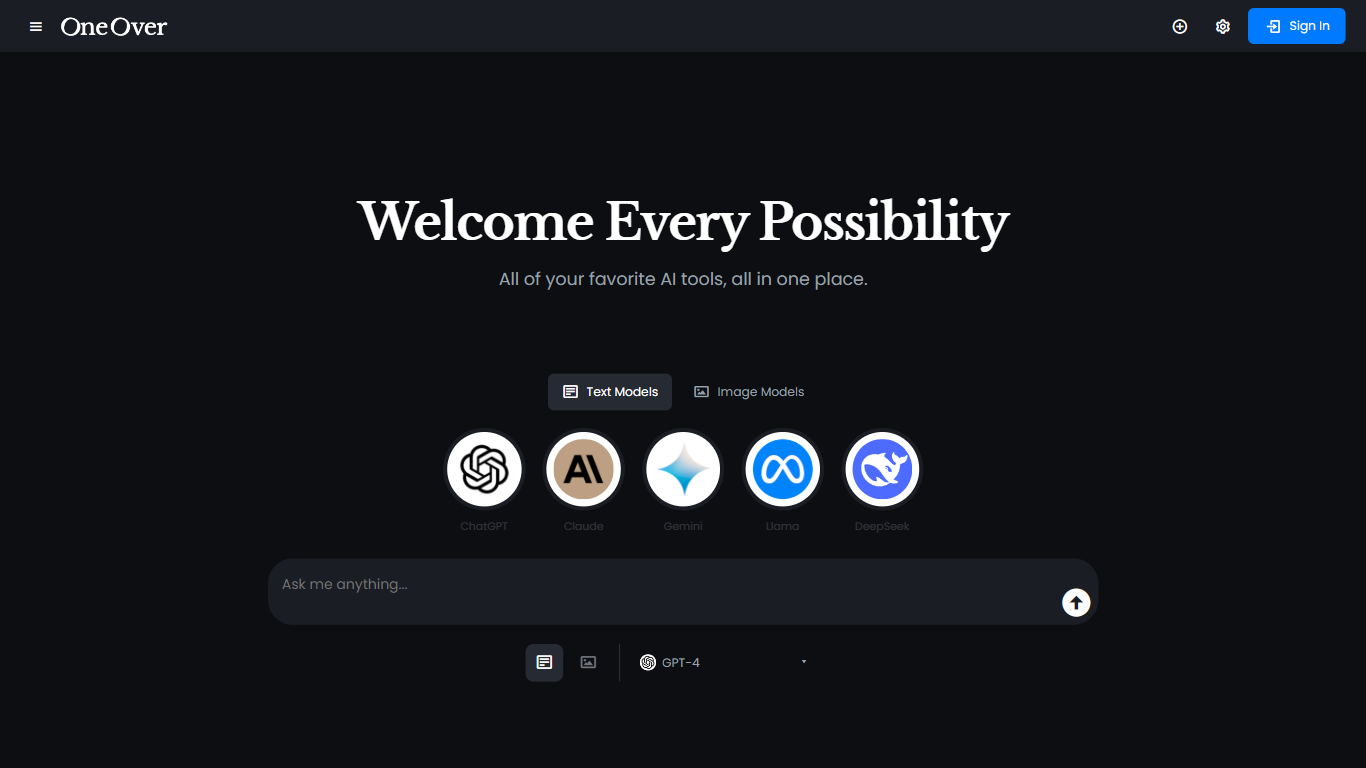

What is OneOver?
OneOver is a creative studio that puts multi-model chat, image generation, video, voice, and music in one browser workspace. You can run GPT, Claude, Gemini, Grok, and dozens of other models in a single thread, attach PDFs and images, flip on web search, and swap models without losing context. Guests get five chat messages before signup, and new accounts receive 50 one-time starter credits.
Where most tools make you pick one provider and buy separate subscriptions for images or video, OneOver routes everything through one shared credit balance. Subscription refills, plan bonuses, and pay-as-you-go packs all spend across chat, diffusion, video, speech, music, and playground mini apps. Switching from GPT-5.4 Nano to Claude Opus 5 is a dropdown change in the same conversation, not a copy-paste hop between sites.
Creators and marketers use OneOver to draft copy, iterate visuals, and turn prompts or photos into short clips from one library. Developers can hit the same model routes through a REST API with streaming support. Pro and Studio also ship seat-based team plans that pool monthly credits with member soft limits and one invoice.
Minerva
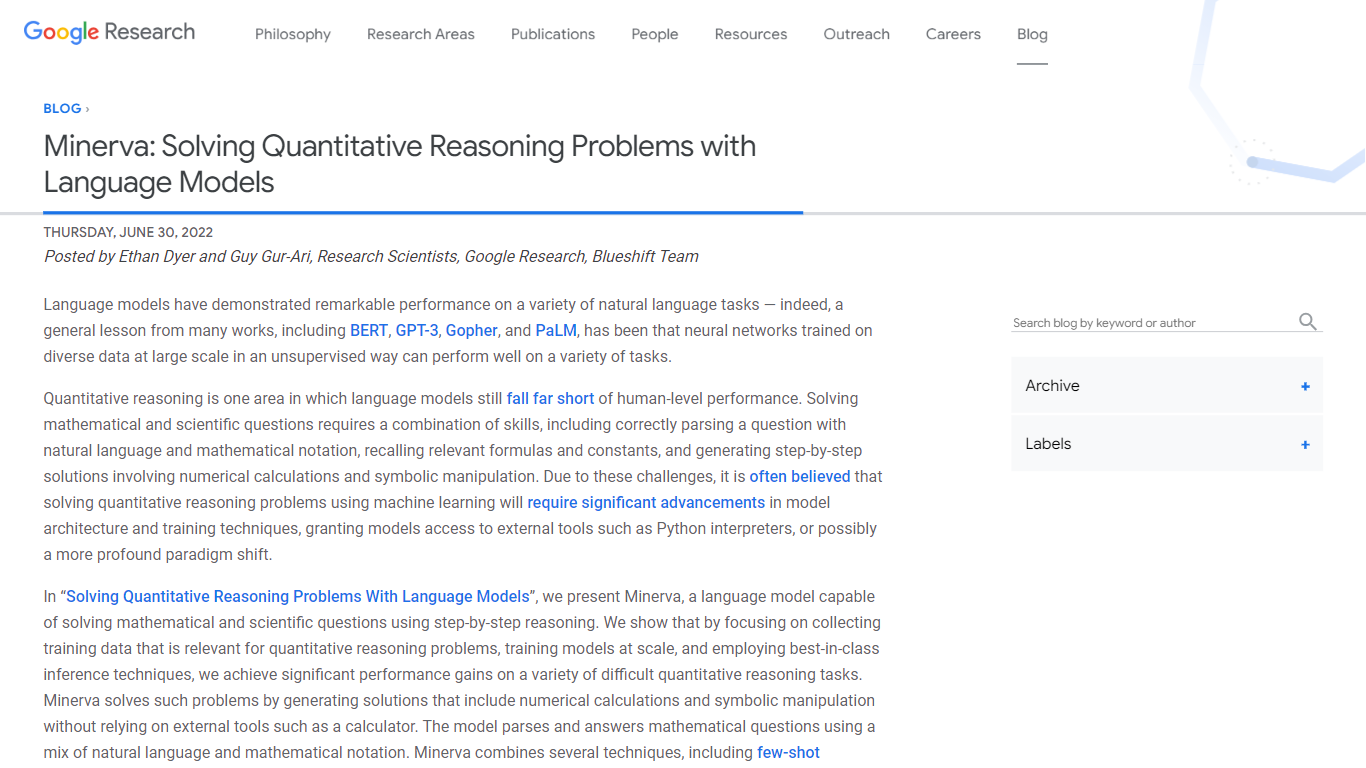
What is Minerva?
Minerva is a large language model from Google Research built to solve math and science questions through step-by-step written reasoning. It reads problems that mix plain English with LaTeX notation, then writes out solutions involving arithmetic, algebra, and symbolic steps. The model was trained on scientific papers and web pages where mathematical formatting was kept intact, rather than stripped during preprocessing.
Most math-capable models lean on external tools like Python interpreters or calculators at inference time. Minerva takes the opposite bet: it generates full worked solutions from the model weights alone, using chain-of-thought prompting and majority voting across multiple sampled answers. That informal approach covers a wider range of problem types than formal theorem provers, but the trade-off is answers cannot be machine-verified the way Coq or Lean proofs can.
Researchers studying quantitative reasoning in language models use Minerva as a reference point for STEM benchmark performance. The public sample explorer hosts 110 solved problems across algebra, physics, chemistry, and other topics, so anyone can read through how the model arrived at each answer. Educators and ML engineers reviewing benchmark methodology will find the published MATH, MMLU-STEM, GSM8k, and OCWCourses scores useful for comparing against newer models.
OneOver Upvotes
Minerva Upvotes
OneOver Top Features
Switch between GPT-5.6 Sol, Claude Opus 5, Gemini 3.6 Flash, and Grok 4.6 in one thread without losing context
Pro includes 1,400 credits per month (1,000 base plus 400 bonus) for chat, images, and short video work
Text-to-speech and text-to-music generators sit beside image and video studios in the same credit pool
Pay-as-you-go packs start at $5 for 500 credits that never expire and stack with subscription balances
REST API covers chat, image generation, and usage metering with streaming and one-field model swaps
Ten playground mini apps include Meme Generator, Upscaler, and Homework Helper with costs from 1 credit
Minerva Top Features
Built on PaLM with 118GB of arXiv papers and math-formatted web pages in training data
Scores 50.3% on the MATH benchmark at 540B parameters, up from a prior best of 6.9%
Generates solutions with arithmetic and symbolic steps without calling a calculator or Python interpreter
Uses chain-of-thought prompting, few-shot examples, and majority voting across sampled outputs
Public sample explorer shows 110 worked problems across 11 topics including algebra, physics, and chemistry
Reaches 75% on MMLU-STEM and 78.5% on GSM8k, both ahead of published prior state of the art
OneOver Category
- Large Language Model (LLM)
Minerva Category
- Large Language Model (LLM)
OneOver Pricing Type
- Freemium
Minerva Pricing Type
- Free