OpenChatKit vs Monster API
In the clash of OpenChatKit vs Monster API, which AI Large Language Model (LLM) tool emerges victorious? We assess reviews, pricing, alternatives, features, upvotes, and more.
When we put OpenChatKit and Monster API head to head, which one emerges as the victor?
Let's take a closer look at OpenChatKit and Monster API, both of which are AI-driven large language model (llm) tools, and see what sets them apart. Both tools have received the same number of upvotes from aitools.fyi users. You can help us determine the winner by casting your vote and tipping the scales in favor of one of the tools.
Not your cup of tea? Upvote your preferred tool and stir things up!
OpenChatKit

What is OpenChatKit?
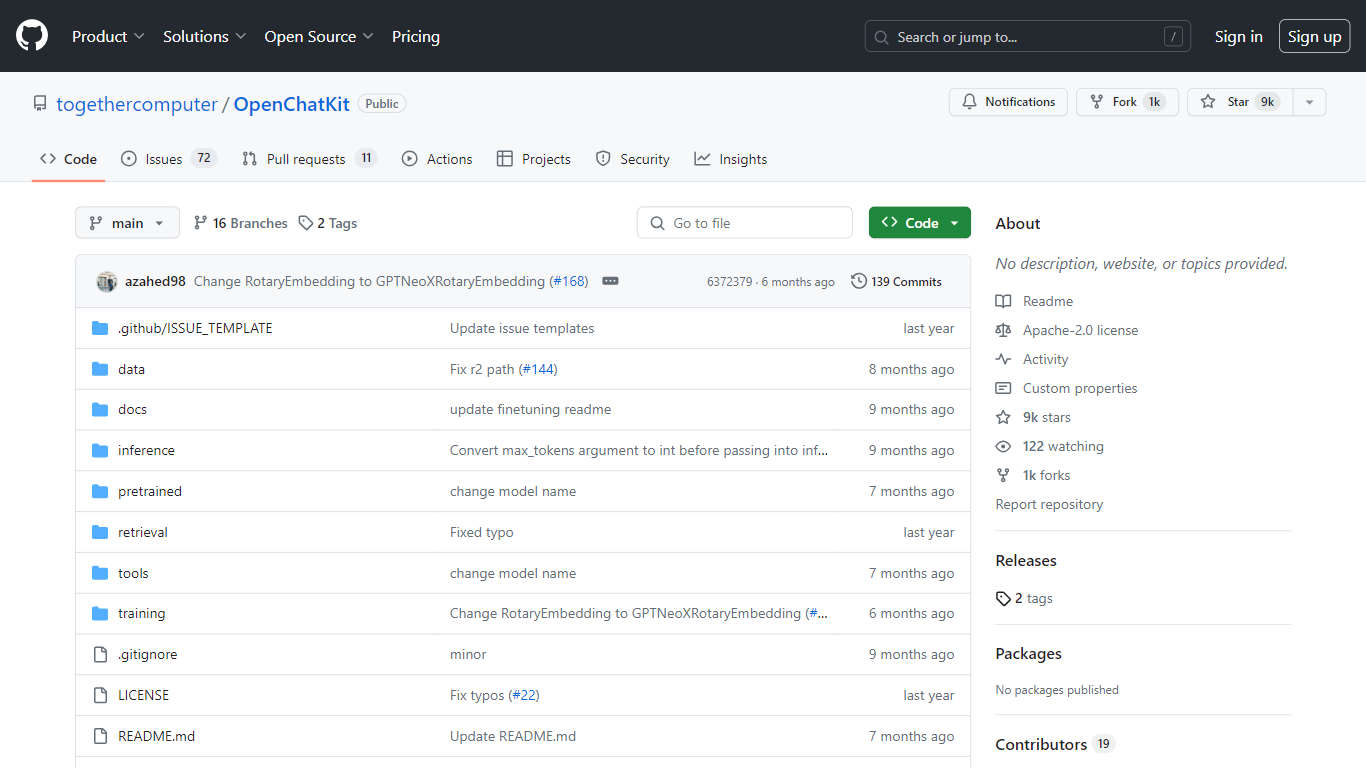
OpenChatKit provides tools and models for building conversational AI applications that can understand and respond to user instructions. It offers instruction-tuned language models, a moderation system to filter unsafe content, and a retrieval system that enables the AI to access external data for up-to-date answers.
What distinguishes OpenChatKit is its combination of large-scale pre-trained models like GPT-NeoXT-Chat-Base-20B and fine-tuning support for models such as Llama-2-7B-32K-beta. It also integrates a flexible retrieval mechanism to augment responses with relevant external information, which is not common in many open-source alternatives.
The toolkit supports training, fine-tuning, and inference workflows, with monitoring options through tools like Weights & Biases. It is designed for developers and researchers who want customizable conversational AI solutions with transparent, open-source code and collaborative development.
OpenChatKit includes detailed documentation and environment setup instructions to facilitate use. Its models are trained on the OIG-43M dataset, created through collaboration between Together, LAION, and Ontocord.ai, ensuring a robust foundation for dialogue applications.
Overall, OpenChatKit enables the creation of specialized or general-purpose chatbots with safety features and the ability to incorporate real-time data through retrieval-augmented generation techniques.
Monster API
What is Monster API?
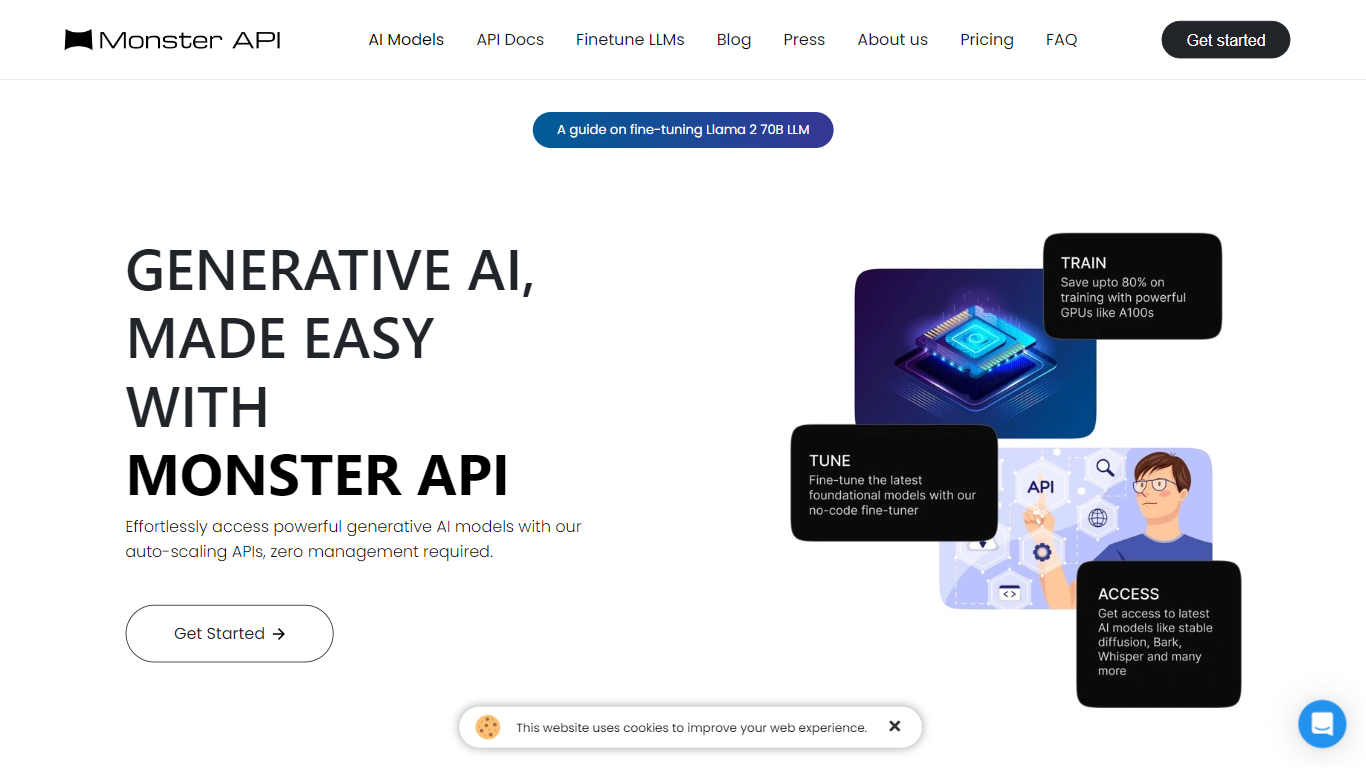
The Monster API is a robust, multi-functional interface that empowers developers and businesses to streamline their processes and integrate with the Monster job platform. Designed for ease of use and efficiency, the Monster API serves as a conduit for automating job postings, searching for resumes, and accessing a wide range of employment-related data. With its SEO-friendly features, the API helps to enhance the visibility of job listings, ensuring that they reach the most suitable candidates. The detailed documentation and responsive support make integration a breeze, allowing businesses to focus on their core operations while optimizing their recruitment strategy.
OpenChatKit Upvotes
Monster API Upvotes
OpenChatKit Top Features
Instruction-Tuned Models: Includes models like Pythia-Chat-Base-7B and GPT-NeoXT-Chat-Base-20B trained on the OIG-43M dataset.
Moderation Model: Filters inappropriate content to maintain safe conversations.
Retrieval System: Supports integration with external data sources such as a Wikipedia Faiss index for up-to-date responses.
Fine-Tuning Support: Provides scripts for fine-tuning models like Llama-2-7B-32K-beta on custom datasets.
Monitoring Integrations: Compatible with Weights & Biases and Loguru for training monitoring and logging.
Monster API Top Features
Automated Job Postings: Enables automated posting of job listings to streamline recruitment.
Resume Search Capability: Provides advanced search features to access a vast database of resumes.
Employment-Related Data Access: Offers comprehensive access to a wide range of employment data.
SEO-Friendly: Designed to enhance the visibility of job listings on search engines.
Efficient Integration: User-friendly API with detailed documentation for easy integration.
OpenChatKit Category
- Large Language Model (LLM)
Monster API Category
- Large Language Model (LLM)
OpenChatKit Pricing Type
- Freemium
Monster API Pricing Type
- Paid