
Last updated 07-29-2026
Category:
Reviews:
Join thousands of AI enthusiasts in the World of AI!
OpenChatKit
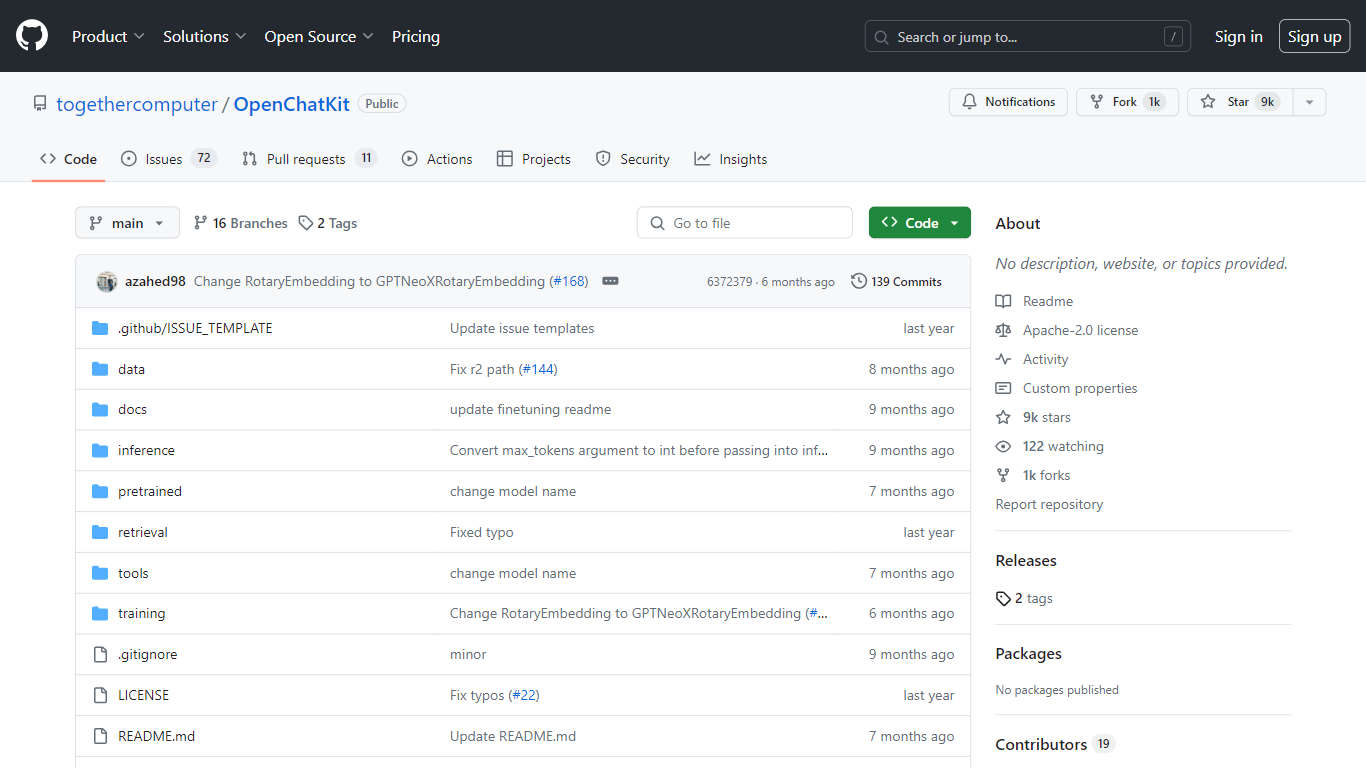
OpenChatKit provides tools and models for building conversational AI applications that can understand and respond to user instructions. It offers instruction-tuned language models, a moderation system to filter unsafe content, and a retrieval system that enables the AI to access external data for up-to-date answers.
What distinguishes OpenChatKit is its combination of large-scale pre-trained models like GPT-NeoXT-Chat-Base-20B and fine-tuning support for models such as Llama-2-7B-32K-beta. It also integrates a flexible retrieval mechanism to augment responses with relevant external information, which is not common in many open-source alternatives.
The toolkit supports training, fine-tuning, and inference workflows, with monitoring options through tools like Weights & Biases. It is designed for developers and researchers who want customizable conversational AI solutions with transparent, open-source code and collaborative development.
OpenChatKit includes detailed documentation and environment setup instructions to facilitate use. Its models are trained on the OIG-43M dataset, created through collaboration between Together, LAION, and Ontocord.ai, ensuring a robust foundation for dialogue applications.
Overall, OpenChatKit enables the creation of specialized or general-purpose chatbots with safety features and the ability to incorporate real-time data through retrieval-augmented generation techniques.
Instruction-Tuned Models: Includes models like Pythia-Chat-Base-7B and GPT-NeoXT-Chat-Base-20B trained on the OIG-43M dataset.
Moderation Model: Filters inappropriate content to maintain safe conversations.
Retrieval System: Supports integration with external data sources such as a Wikipedia Faiss index for up-to-date responses.
Fine-Tuning Support: Provides scripts for fine-tuning models like Llama-2-7B-32K-beta on custom datasets.
Monitoring Integrations: Compatible with Weights & Biases and Loguru for training monitoring and logging.
Open-source with transparent code and detailed documentation.
Supports training and fine-tuning of large language models including GPT-NeoXT and Llama-2 variants.
Includes moderation tools to ensure safe conversational AI interactions.
Flexible retrieval system enables augmentation with external, up-to-date data.
Collaborative development involving multiple AI research organizations.
Requires technical expertise to set up and operate effectively.
No hosted or turnkey solution; users must manage their own infrastructure.
Limited out-of-the-box user interface; primarily code and models for developers.
How can I start using OpenChatKit models?
You can start using OpenChatKit by downloading pre-trained models like Pythia-Chat-Base-7B from Hugging Face and running inference with the provided command-line tools after setting up the environment.
What models are included in OpenChatKit?
OpenChatKit includes models such as GPT-NeoXT-Chat-Base-20B, Pythia-Chat-Base-7B, and supports fine-tuning Llama-2-7B-32K-beta for long context tasks.
Does OpenChatKit support fine-tuning?
Yes, OpenChatKit provides code and instructions to fine-tune models like Llama-2-7B-32K-beta and Pythia-Chat-Base-7B on custom datasets.
What is the OIG-43M dataset used by OpenChatKit?
The OIG-43M dataset is a large instruction-tuning dataset created collaboratively by Together, LAION, and Ontocord.ai, used to train OpenChatKit's language models.
Can OpenChatKit models access real-time information?
Yes, OpenChatKit includes an experimental retrieval system that augments model responses with relevant, up-to-date information from external data repositories.
Is there a moderation system included in OpenChatKit?
OpenChatKit includes a moderation model designed to filter unsafe or inappropriate content during conversations.
What are the system requirements to run OpenChatKit?
To run OpenChatKit, you need to install PyTorch, Git LFS, and create a conda environment with dependencies specified in the repository's environment.yml file.