Pickles vs Unreal Speech
In the contest of Pickles vs Unreal Speech, which AI Text to Speech (TTS) tool is the champion? We evaluate pricing, alternatives, upvotes, features, reviews, and more.
If you had to choose between Pickles and Unreal Speech, which one would you go for?
When we examine Pickles and Unreal Speech, both of which are AI-enabled text to speech (tts) tools, what unique characteristics do we discover? With more upvotes, Unreal Speech is the preferred choice. The number of upvotes for Unreal Speech stands at 9, and for Pickles it's 6.
Feeling rebellious? Cast your vote and shake things up!
Pickles

What is Pickles?
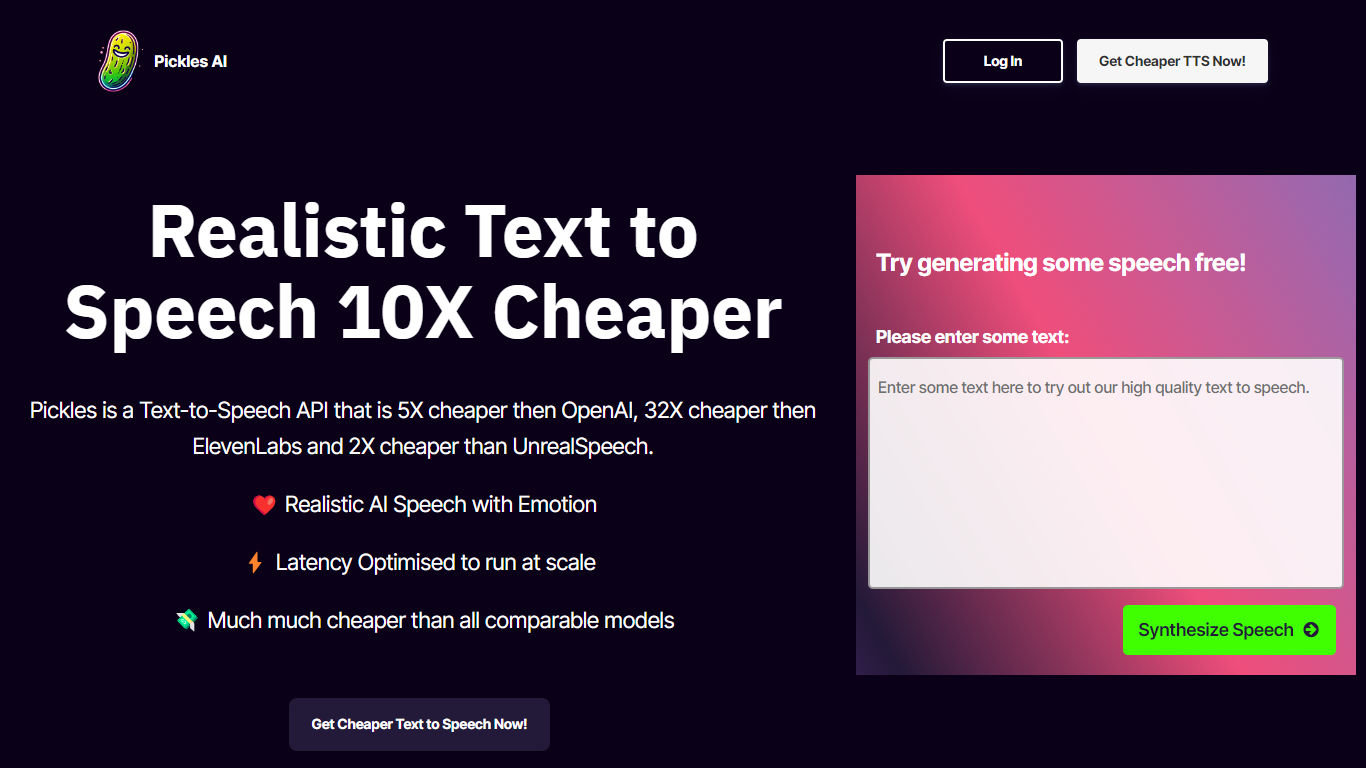
Pickles is a text-to-speech API built for developers who need realistic synthesized speech without paying premium voice-model rates. You send text over a simple HTTPS call and get back a hosted WAV file ready to play or store. It fits teams wiring voice into apps, bots, audiobook pipelines, or any product where cost per character is the main constraint.
Pickles leads with unit economics. The homepage claims roughly 5x lower cost than OpenAI TTS, 32x lower than ElevenLabs, and 2x lower than UnrealSpeech on comparable usage. Sample clips on the site generate in 0.1 to 0.2 seconds, which signals a latency-first design for near-real-time apps. You trade the big voice libraries and studio polish of consumer TTS brands for a stripped-down API and volume-based monthly plans.
Indie developers and early-stage startups can start on the Hobby plan at $9 per month for 1 million characters (about 200 hours of speech). Teams shipping at scale have Growth at $79 for 10 million characters or Enterprise at $599 for 100 million. Checkout runs through Stripe with one-click cancel, and the Discord community handles integration questions.
Unreal Speech
What is Unreal Speech?
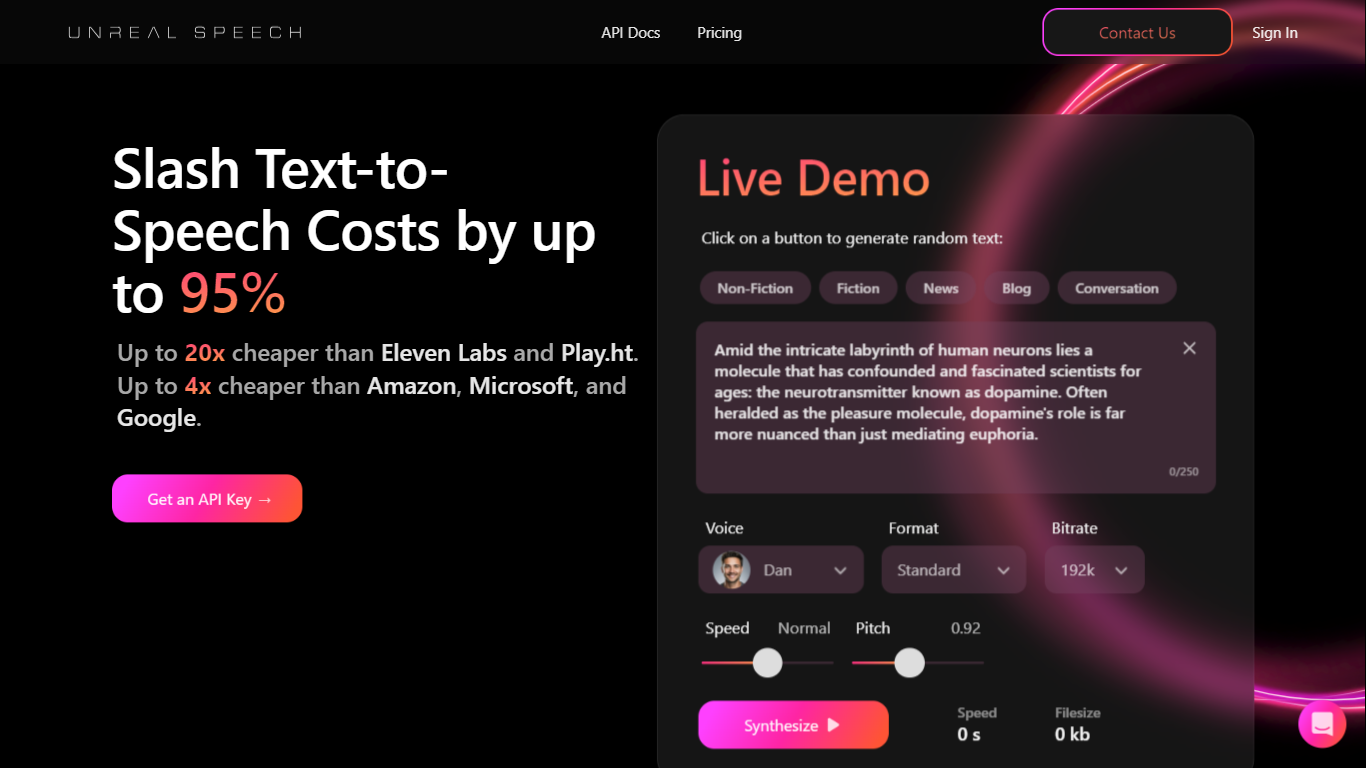
Unreal Speech is a production-ready text-to-speech API built on the open-source Kokoro TTS engine. It gives developers and businesses natural speech synthesis at a fraction of the cost of ElevenLabs, Amazon Polly, Google Cloud, and Microsoft Azure. The API streams audio in about 300 milliseconds and supports long-form jobs up to 10 hours per request.
Kokoro runs on an 82-million-parameter decoder-only model that blends ideas from StyleTTS 2 and iSTFTNet. You get 48 voices across eight languages, including US and UK English, Mandarin, Hindi, Spanish, Portuguese, Japanese, French, and Italian. Per-word timestamps let apps highlight text in sync with playback, which helps with accessibility, karaoke-style UIs, and interactive readers.
The REST API exposes four endpoints: /stream for sub-second synthesis of up to 1,000 characters, /speech for up to 3,000 characters with timestamp URLs, /synthesisTasks for async jobs up to 500,000 characters, and a websocket /streamWithTimestamps route for live audio plus word timing. SDKs ship for Python, Node.js, and React Native, with sample code on the homepage.
Kokoro TTS Studio on unrealspeech.com offers a free browser demo to test voices before signing up. Paid plans remove attribution requirements for commercial audio. Enterprise customers on the platform process billions of characters monthly with 99.9% uptime.
Pickles Upvotes
Unreal Speech Upvotes
Pickles Top Features
Hobby plan includes 1 million characters per month for $9
Sample Forrest Gump clip generated in 0.1 seconds on the homepage
HTTPS API returns a hosted WAV file with no client-side audio processing
Growth tier offers 10 million characters per month for $79
Enterprise tier supports 100 million characters per month for $599
Stripe checkout with one-click subscription cancel
Unreal Speech Top Features
Streams up to 1,000 characters in about 300ms via /stream
Async synthesis tasks handle up to 500,000 characters per request
Per-word timestamps sync text highlighting with audio output
48 voices across eight languages with speed and pitch controls
Websocket /streamWithTimestamps delivers live audio plus timing data
Python, Node.js, and React Native SDKs ship with code samples
Single synthesis jobs can produce up to 10 hours of audio
Pickles Category
- Text to Speech (TTS)
Unreal Speech Category
- Text to Speech (TTS)
Pickles Pricing Type
- Paid
Unreal Speech Pricing Type
- Freemium