Prompt Mixer vs mshumer/gpt-prompt-engineer - GitHub
Compare Prompt Mixer vs mshumer/gpt-prompt-engineer - GitHub and see which AI Model Generation tool is better when we compare features, reviews, pricing, alternatives, upvotes, etc.
Which one is better? Prompt Mixer or mshumer/gpt-prompt-engineer - GitHub?
When we compare Prompt Mixer with mshumer/gpt-prompt-engineer - GitHub, which are both AI-powered model generation tools, The upvote count reveals a draw, with both tools earning the same number of upvotes. Your vote matters! Help us decide the winner among aitools.fyi users by casting your vote.
Want to flip the script? Upvote your favorite tool and change the game!
Prompt Mixer


What is Prompt Mixer?
Prompt Mixer is a desktop application and collaborative workspace for building, testing, and managing AI prompt chains. Engineers, managers, and data experts use it to design prompts together, version changes, and evaluate outputs across multiple LLM providers.
You can chain prompts that pass context between steps, build multi-step workflows through a form-based interface, and connect to OpenAI, Anthropic, Google Gemini, Ollama, and other services via connectors. The open-source Community Edition (MIT license) runs locally on macOS, Windows, and Linux.
Teams get version control with rollback, commenting, and review workflows. Prompt Mixer lets you test prompts against different models before deploying them to production applications.
mshumer/gpt-prompt-engineer - GitHub
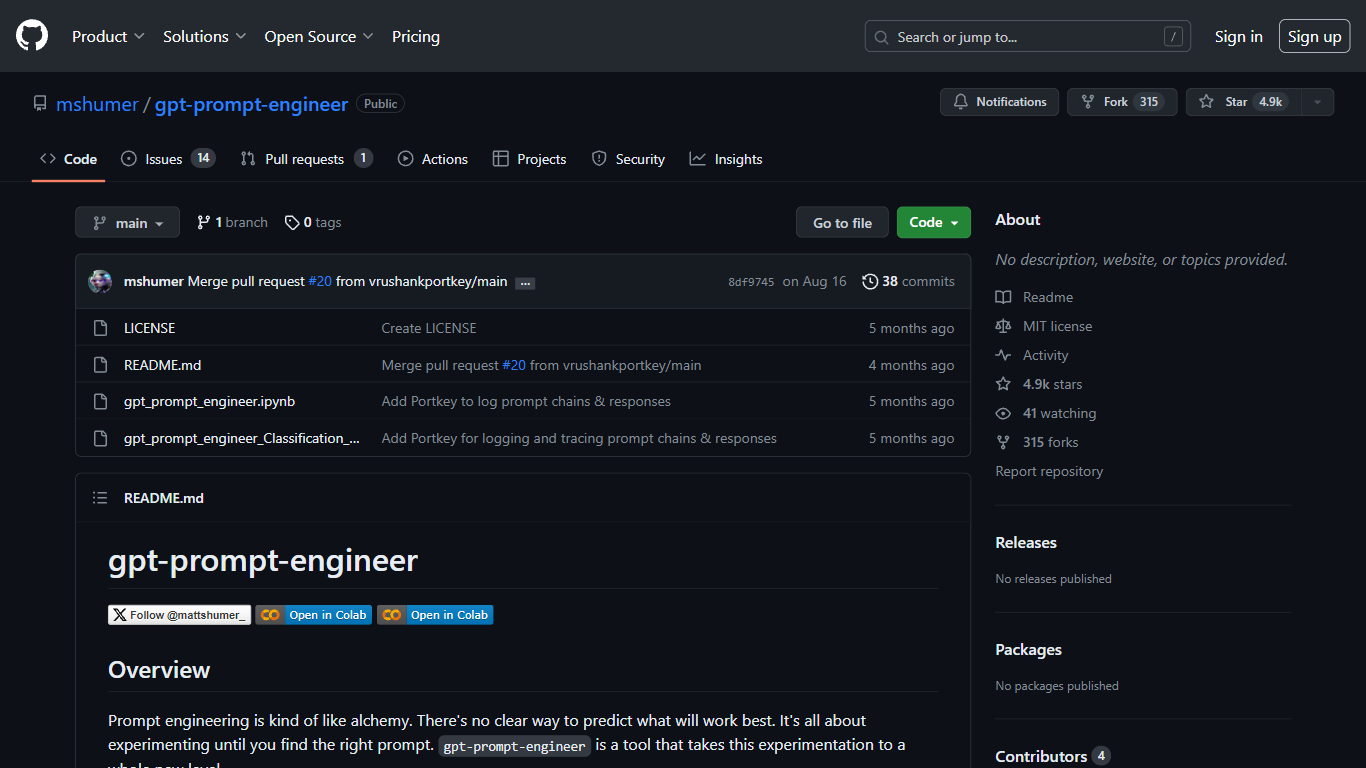
What is mshumer/gpt-prompt-engineer - GitHub?
mshumer/gpt-prompt-engineer is an open source prompt engineering toolkit that generates, tests, and ranks candidate prompts for a task you define. You describe the use case, supply test cases, and the notebooks create multiple prompt variants, run them against every test case, and sort results with an ELO rating system starting at 1200. It ships as Jupyter notebooks you can run in Google Colab or locally.
Most prompt tools help you write one prompt at a time. gpt-prompt-engineer treats prompt selection like a tournament: dozens of candidates compete on your test cases, and the highest ELO scores surface the winners. Separate notebooks cover classification tasks, Claude 3 Opus with auto-generated test cases, and Opus-to-Haiku conversion for cheaper inference. Optional Weights & Biases and Portkey logging trace each run.
ML engineers, prompt engineers, and AI developers use it when they need reproducible prompt tuning instead of manual trial and error. The repo has 9.7k GitHub stars and runs on your own OpenAI or Anthropic API keys. It is free under the MIT license.
Prompt Mixer Upvotes
mshumer/gpt-prompt-engineer - GitHub Upvotes
Prompt Mixer Top Features
Build and version prompt chains with collaborative editing and review workflows
Test prompts across OpenAI, Anthropic, Gemini, Ollama, and custom connectors
Create multi-step analysis workflows with a form-based interface
Open-source Community Edition available under MIT license
Compare LLM outputs side by side before production deployment
mshumer/gpt-prompt-engineer - GitHub Top Features
Generates multiple prompt candidates from a task description and user-supplied test cases
Ranks prompts with an ELO rating system starting at 1200 per candidate
Supports GPT-4, GPT-3.5-Turbo, and Claude 3 Opus model backends
Classification notebook scores true/false test cases and prints a results table
Claude 3 notebook auto-generates test cases from input variable definitions
Opus-to-Haiku conversion notebook cuts latency and cost while preserving output quality
Optional Weights & Biases and Portkey logging for experiment tracking
Prompt Mixer Category
- Model Generation
mshumer/gpt-prompt-engineer - GitHub Category
- Model Generation
Prompt Mixer Pricing Type
- Freemium
mshumer/gpt-prompt-engineer - GitHub Pricing Type
- Free