Readdy vs TryOnDiffusion
Compare Readdy vs TryOnDiffusion and see which AI Design tool is better when we compare features, reviews, pricing, alternatives, upvotes, etc.
Which one is better? Readdy or TryOnDiffusion?
When we compare Readdy with TryOnDiffusion, which are both AI-powered design tools, There's no clear winner in terms of upvotes, as both tools have received the same number. The power is in your hands! Cast your vote and have a say in deciding the winner.
Think we got it wrong? Cast your vote and show us who's boss!
Readdy

What is Readdy?
Readdy is a no-code AI website builder that turns a text prompt, template, screenshot, or reference URL into a full multi-page site in minutes. You describe what you want, and it generates layouts, copy, images, and navigation with responsive design baked in from the start.
What sets it apart from a typical page builder is the end-to-end stack. Readdy covers generation, a visual editor with Selector Mode, hosting, custom domains, SEO controls, form storage, and integrations like Stripe, Shopify, Calendly, and Supabase without wiring up separate tools.
It fits solo creators, small businesses, and web agencies that need to ship business sites, portfolios, blogs, landing pages, or storefronts fast. Agency tiers add white-label delivery, lead finding, outreach campaigns, and client management under your own brand.
TryOnDiffusion
What is TryOnDiffusion?
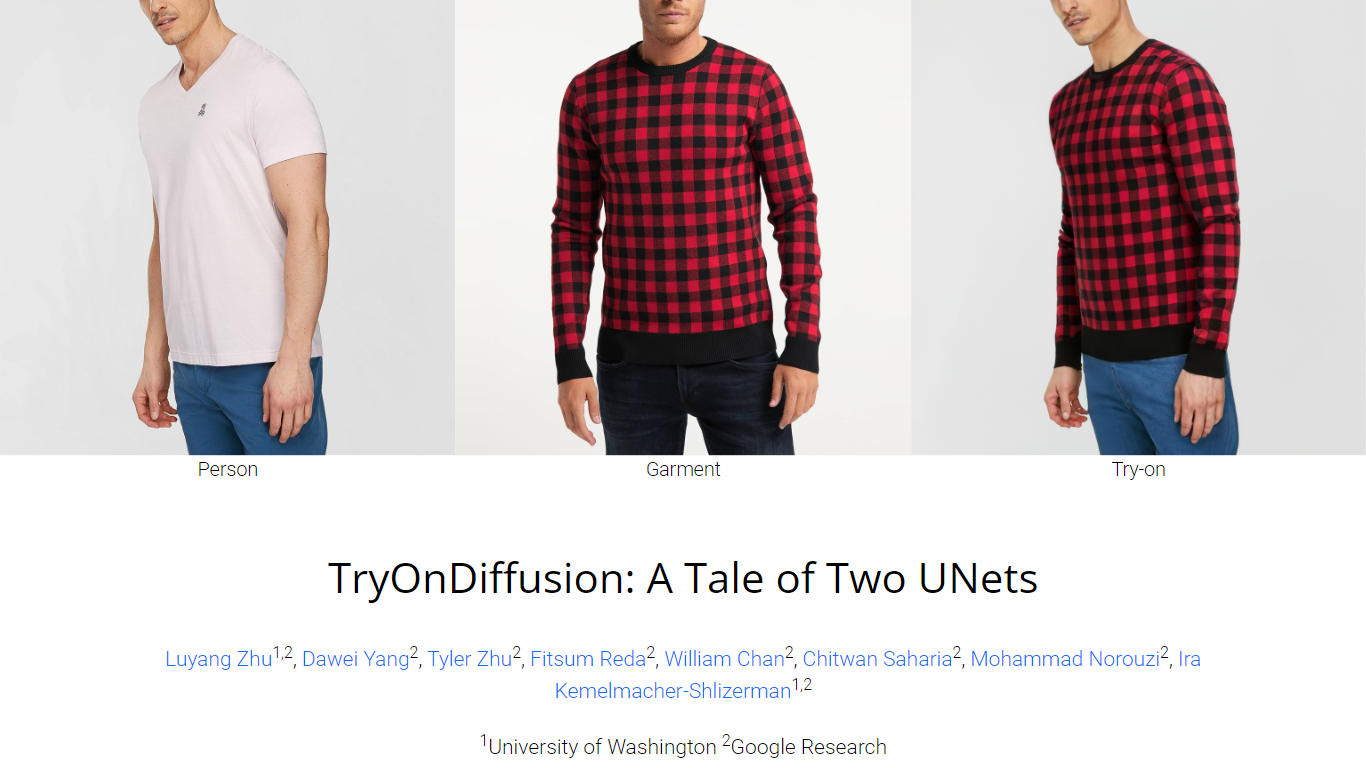
TryOnDiffusion generates a photorealistic image of how a garment would look on a target person from two inputs: a photo of the person and a photo of someone wearing the garment. The CVPR 2023 research project from University of Washington and Google Research uses a diffusion model with two parallel UNets to preserve fabric detail while warping the clothing across different body poses and shapes. Output runs through 128x128 and 256x256 stages before super-resolution to 1024x1024.
Earlier virtual try-on systems split garment warping and blending into separate steps, which often traded detail for pose flexibility. TryOnDiffusion warps garments implicitly through cross-attention in a Parallel-UNet and fuses warp and blend in one pass. On its test set it reports FID 13.447 and KID 6.964, beating TryOnGAN, SDAFN, and HR-VITON, with 92.72% user preference on random inputs and 95.80% on challenging pose cases.
Fashion researchers, computer vision teams, and e-commerce developers use the project page demo to preview upper-body try-ons interactively. The authors note limitations: upper-body clothing only, reliance on segmentation and pose preprocessing, mostly clean backgrounds in training data, and visualization without fit guarantees.
Readdy Upvotes
TryOnDiffusion Upvotes
Readdy Top Features
Generates complete websites from a text prompt, screenshot, reference URL, or 500+ industry templates
Selector Mode lets you click any element to edit text, colors, spacing, or AI-generated backgrounds in real time
One-click publish with hosting, SSL, custom domains, sitemap.xml, and Google Search Console verification
Built-in form backend stores submissions in Supabase with no external database setup
Connects Stripe, Shopify, Calendly, Mailchimp, and Google Analytics from the same dashboard
Agency plans add white-label portals, AI lead finder, batch demo sites, and cold email outreach campaigns
TryOnDiffusion Top Features
Parallel-UNet fuses garment warping and person blending in one diffusion network
Pipeline outputs 128x128, 256x256, then super-resolves to 1024x1024 images
Reports FID 13.447 and KID 6.964 on the project test set, below HR-VITON at 18.705 FID
Cross-attention warps segmented garment features onto the clothing-agnostic person image
Interactive demo on the project page for person-garment try-on previews
User study shows 92.72% preference on random inputs versus three prior methods
Pose embeddings modulate both UNets via FiLM across all scales
Readdy Category
- Design
TryOnDiffusion Category
- Design
Readdy Pricing Type
- Freemium
TryOnDiffusion Pricing Type
- Free