Scale vs STRING
In the contest of Scale vs STRING, which AI Data Science tool is the champion? We evaluate pricing, alternatives, upvotes, features, reviews, and more.
If you had to choose between Scale and STRING, which one would you go for?
When we examine Scale and STRING, both of which are AI-enabled data science tools, what unique characteristics do we discover? The upvote count reveals a draw, with both tools earning the same number of upvotes. Join the aitools.fyi users in deciding the winner by casting your vote.
Feeling rebellious? Cast your vote and shake things up!
Scale
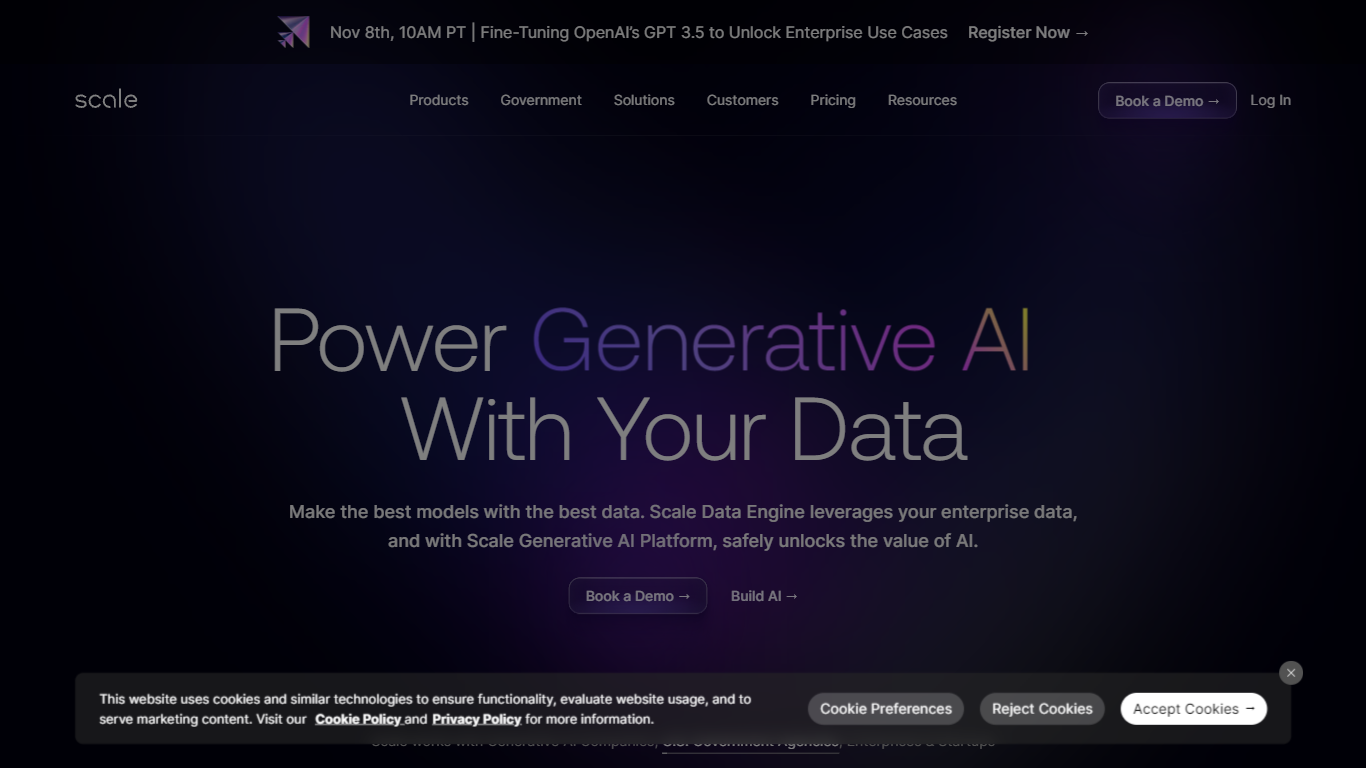

What is Scale?
Scale AI supplies training data, model evaluations, and applied AI systems for labs, enterprises, and governments building machine learning products. The company runs the Scale Data Engine for annotation and RLHF, the GenAI Platform for full-stack generative workflows, and Donovan for defense-oriented intelligence work. Customers include Meta, TIME, Instacart, and public sector agencies that need audited, high-volume data pipelines rather than ad hoc labeling spreadsheets.
Where many labeling vendors focus on a single modality or outsource quality control entirely, Scale combines ML-assisted pre-labeling with layered human review across text, image, video, and 3D sensor fusion including LiDAR. Its Generative AI Data Engine adds prompt generation, red teaming, and benchmark evaluations in one loop, so teams can train, stress-test, and compare frontier models without stitching together separate vendors.
Scale fits ML teams shipping self-driving perception, document NLP, generative assistants, and government programs that demand traceable data provenance. Teams book a demo for custom contracts because pricing is enterprise sales only, not a self-serve checkout page.
STRING
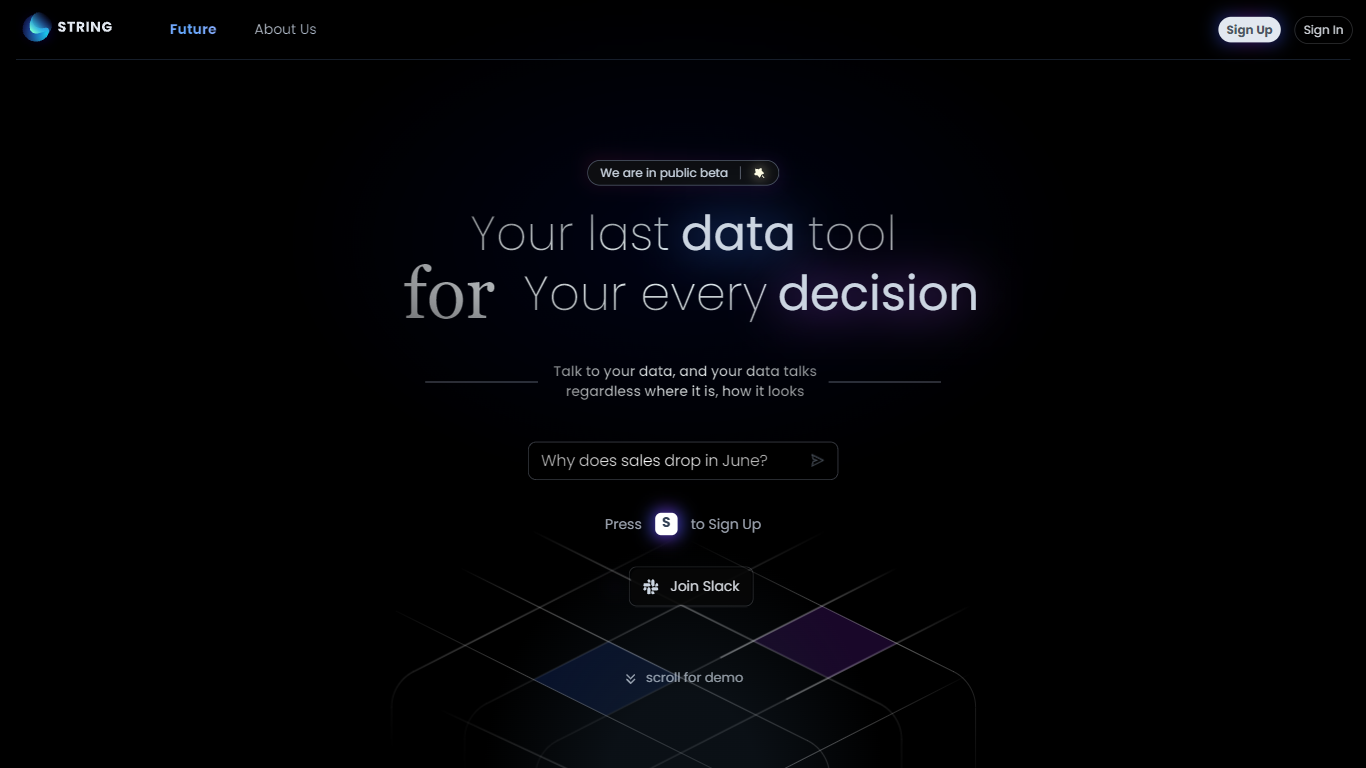
What is STRING?
STRING lets you talk to your data through a conversational analytics interface marketed as your last data tool. You sign up for the public beta, connect sources wherever they live, and ask questions in natural language instead of building dashboards first. The product pitch centers on decisions: your data answers back regardless of format or location.
Legacy BI stacks expect hours of SQL and chart assembly before you get a useful answer. STRING's team, with backgrounds at Google, Uber, CMU, and UW, frames the product around AGI-style analytics that listens, understands unstructured text, and takes initiative beyond rigid queries. The Future page contrasts this with older tools that crunch structured tables slowly.
Data analysts, product managers, and operators who want quick answers without standing up a full BI project fit STRING best. It is still in public beta with Slack community access, so teams should expect evolving features rather than a finished enterprise contract page.
Scale Upvotes
STRING Upvotes
Scale Top Features
15 billion human decisions logged for training AI models
Annotation pipelines cover text, image, video, and 3D LiDAR sensor fusion
Generative AI Data Engine handles RLHF, red teaming, and model evaluation in one workflow
Supports projects from small experiments to high-volume production labeling
Trusted by Meta, Instacart, and TIME for production-scale data needs
Documentation covers GenAI Platform, GenAI Data Engine, and automotive workflows
STRING Top Features
Natural language interface to query data without pre-built dashboard workflows
Public beta signup with Slack community invite for early users
Designed to handle structured databases and unstructured sources like docs and notes
Team includes alumni from Google, Uber, Carnegie Mellon, and University of Washington
Slack community invite linked on homepage for public beta testers
Future roadmap targets proactive analytics that initiates insights beyond user prompts
Scale Category
- Data Science
STRING Category
- Data Science
Scale Pricing Type
- Paid
STRING Pricing Type
- Freemium