scite.ai vs Semantic Scholar
In the contest of scite.ai vs Semantic Scholar, which AI Research tool is the champion? We evaluate pricing, alternatives, upvotes, features, reviews, and more.
If you had to choose between scite.ai and Semantic Scholar, which one would you go for?
When we examine scite.ai and Semantic Scholar, both of which are AI-enabled research tools, what unique characteristics do we discover? The upvote count shows a clear preference for Semantic Scholar. Semantic Scholar has attracted 18 upvotes from aitools.fyi users, and scite.ai has attracted 6 upvotes.
Does the result make you go "hmm"? Cast your vote and turn that frown upside down!
scite.ai
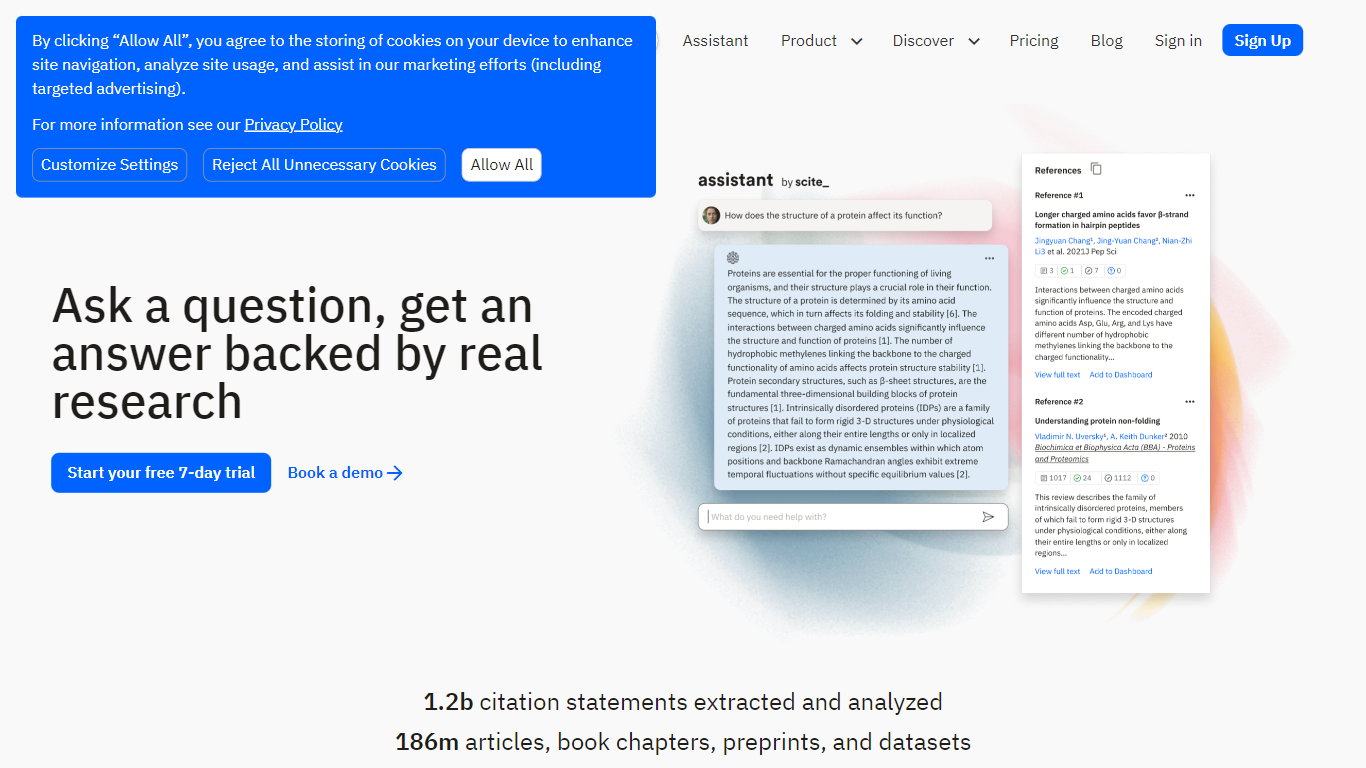

What is scite.ai?
Scite helps research teams ask literature questions and get answers tied to full-text papers, not abstract snippets alone. Its Assistant searches across 280M+ full-text scholarly articles, and Smart Citations show whether later work supported, contradicted, or mentioned a finding.
General research chatbots guess when paywalls block the PDF. Scite licenses content from Wiley, SAGE, and 40+ other publishers, so it reads inside the paper and links each claim to a specific sentence you can verify in one click. That evidence-first design targets literature reviews where you need to know if a result still holds, not just that it exists.
Grad students run disputed-or-affirmed checks before citing a paper. R&D teams trace grants, clinical trials, and patents in one search. Pro users get API access, 2,500 MCP credits per month, and collections up to 10,000 papers. Scite also plugs into Claude, ChatGPT, and Zotero so answers show up inside existing workflows.
Semantic Scholar
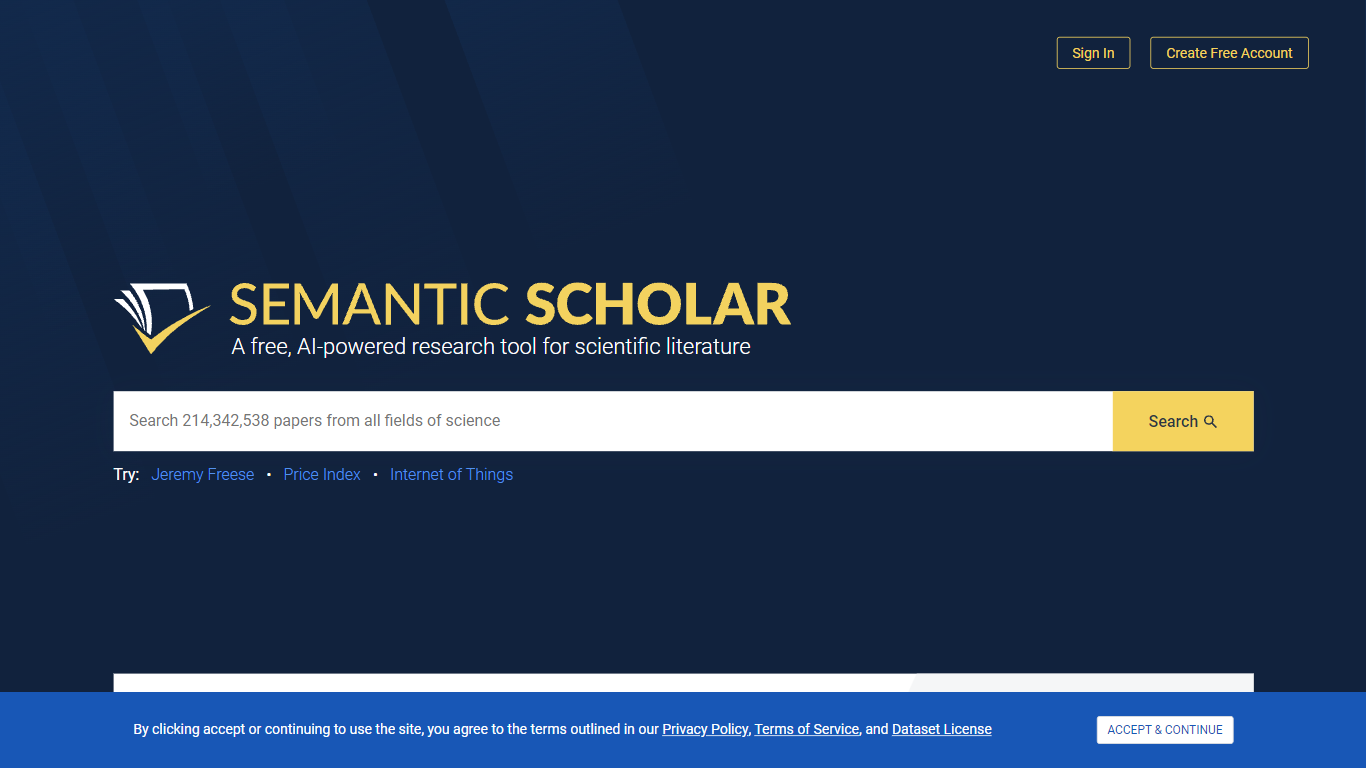
What is Semantic Scholar?
Semantic Scholar searches more than 236 million academic papers across every scientific field and surfaces citations, authors, and related work from one free interface. Built by the Allen Institute for AI (Ai2), it extracts meaning from papers so you can scan abstracts, follow citation chains, and open PDFs without jumping between databases.
Google Scholar indexes broadly but leaves connection-finding to you. Semantic Scholar adds AI-classified paper metadata, a Semantic Reader beta for in-browser annotation, and a public Academic Graph API with 214 million papers and 2.49 billion citations for developers. The S2AG and S2ORC datasets are also published as open JSON archives for NLP research.
Graduate students, faculty, librarians, and research engineers use it for literature reviews, citation tracking, and building scholarly apps. The API is free with optional keys for higher rate limits, and the platform partners with 50+ publishers to keep the index current.
scite.ai Upvotes
Semantic Scholar Upvotes
scite.ai Top Features
Search across 280M+ full-text scholarly articles plus patents, trials, grants, and preprints
Smart Citations classify later papers as supporting, contrasting, or mentioning a source
Basic plan includes 250 MCP credits per month and ChatGPT and Claude integrations
Pro plan adds API access, 2,500 MCP credits per month, and collections up to 10,000 papers
Publisher agreements with Wiley, SAGE, and 40+ partners for licensed full-text access
7-day free trial on paid plans before subscription billing begins
Database cites 1.6B+ citations indexed across 300M+ scholarly sources
Semantic Scholar Top Features
Search 236,851,843 papers indexed across all fields of science from one homepage
Semantic Reader beta adds in-browser annotations and contextual overlays on select papers
Academic Graph API covers 214 million papers, 2.49 billion citations, and 79 million authors
S2AG and S2ORC datasets ship as free JSON archives for NLP and text mining projects
Paper recommendations surface related studies based on citation and content similarity
Partners with 50+ publishers and scholarly societies to ingest new academic content
scite.ai Category
- Research
Semantic Scholar Category
- Research
scite.ai Pricing Type
- Freemium
Semantic Scholar Pricing Type
- Free