
Last updated 07-30-2026
Category:
Reviews:
Join thousands of AI enthusiasts in the World of AI!
Semantic Scholar
Semantic Scholar searches more than 236 million academic papers across every scientific field and surfaces citations, authors, and related work from one free interface. Built by the Allen Institute for AI (Ai2), it extracts meaning from papers so you can scan abstracts, follow citation chains, and open PDFs without jumping between databases.
Google Scholar indexes broadly but leaves connection-finding to you. Semantic Scholar adds AI-classified paper metadata, a Semantic Reader beta for in-browser annotation, and a public Academic Graph API with 214 million papers and 2.49 billion citations for developers. The S2AG and S2ORC datasets are also published as open JSON archives for NLP research.
Graduate students, faculty, librarians, and research engineers use it for literature reviews, citation tracking, and building scholarly apps. The API is free with optional keys for higher rate limits, and the platform partners with 50+ publishers to keep the index current.
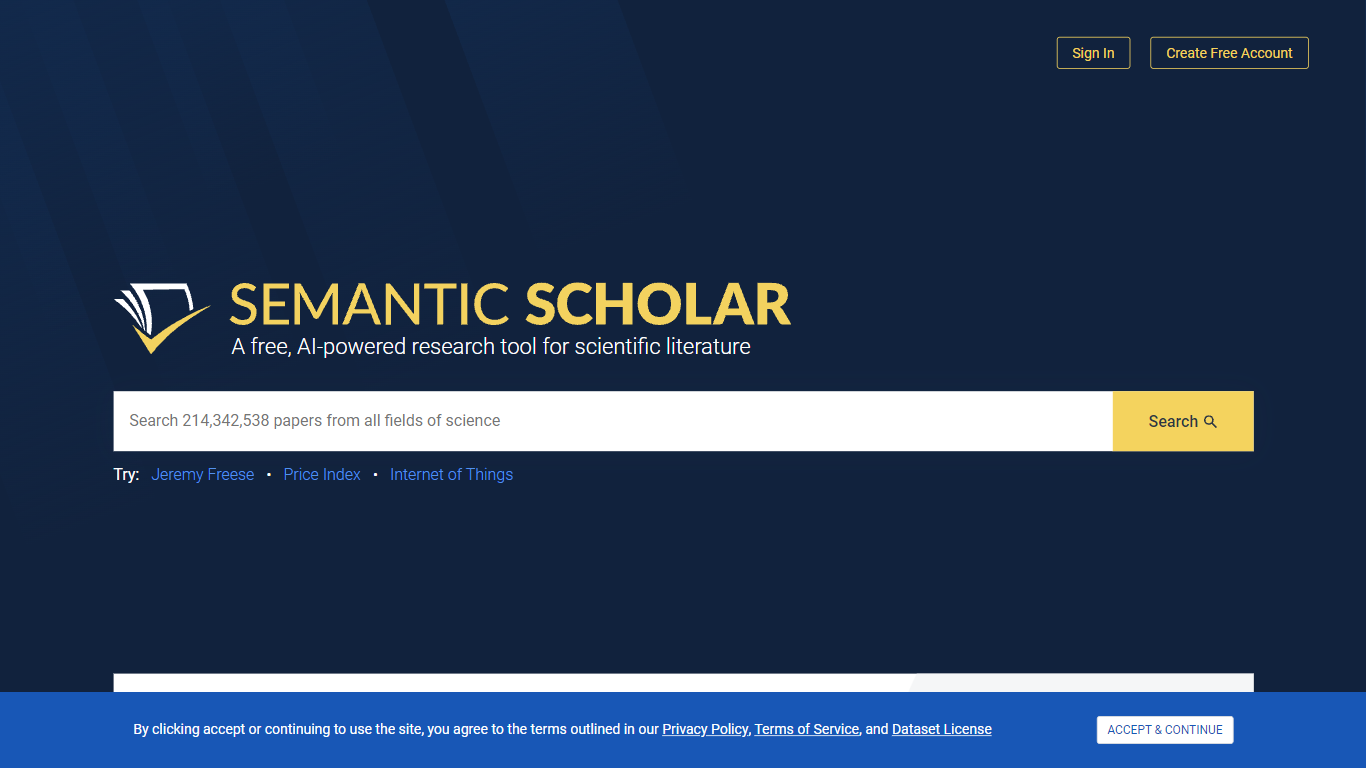
Search 236,851,843 papers indexed across all fields of science from one homepage
Semantic Reader beta adds in-browser annotations and contextual overlays on select papers
Academic Graph API covers 214 million papers, 2.49 billion citations, and 79 million authors
S2AG and S2ORC datasets ship as free JSON archives for NLP and text mining projects
Paper recommendations surface related studies based on citation and content similarity
Partners with 50+ publishers and scholarly societies to ingest new academic content
Indexes over 236 million papers with AI-extracted metadata and citation links
Free API and open S2AG/S2ORC datasets for developer and NLP projects
Semantic Reader beta adds contextual in-browser paper annotations
Backed by the nonprofit Allen Institute for AI with publisher partnerships
API keys start at a 1 request per second rate limit on authenticated endpoints
Semantic Reader is still in beta and limited to select papers
Unauthenticated API traffic shares a 1,000 requests per second pool across all users
What is Semantic Scholar?
Semantic Scholar is a free research search engine built by the Allen Institute for AI. Semantic Scholar indexes over 236 million academic papers and uses AI to extract meaning, citations, and connections from scientific literature.
Is Semantic Scholar free to use?
Yes. Semantic Scholar is free for scholars and the public. The Academic Graph API is also free, with optional API keys raising rate limits from the shared 1,000 requests per second cap to 1 request per second per key.
What is Semantic Reader on Semantic Scholar?
Semantic Reader is Semantic Scholar's augmented PDF reader in beta. It adds contextual overlays and accessibility features so you can understand a paper's arguments without leaving the browser.
Does Semantic Scholar have an API?
Yes. Semantic Scholar offers a REST API with Academic Graph, Recommendations, and Datasets services. Developers can query authors, papers, citations, venues, and SPECTER2 embeddings, or download the S2AG bulk dataset.
Who built Semantic Scholar?
Semantic Scholar was launched in 2015 by the Allen Institute for AI (Ai2), a nonprofit founded by Microsoft co-founder Paul Allen. The product team publishes NLP and information retrieval research alongside the search platform.
How many papers does Semantic Scholar index?
Semantic Scholar's homepage reports 236,851,843 searchable papers, while the API documentation cites 214 million papers with 2.49 billion citation links and 79 million author records in the academic graph.