Seth's Blog AI vs Semantic Scholar
Explore the showdown between Seth's Blog AI vs Semantic Scholar and find out which AI Research tool wins. We analyze upvotes, features, reviews, pricing, alternatives, and more.
When comparing Seth's Blog AI and Semantic Scholar, which one rises above the other?
When we contrast Seth's Blog AI with Semantic Scholar, both of which are exceptional AI-operated research tools, and place them side by side, we can spot several crucial similarities and divergences. The community has spoken, Semantic Scholar leads with more upvotes. The number of upvotes for Semantic Scholar stands at 18, and for Seth's Blog AI it's 6.
Not your cup of tea? Upvote your preferred tool and stir things up!
Seth's Blog AI
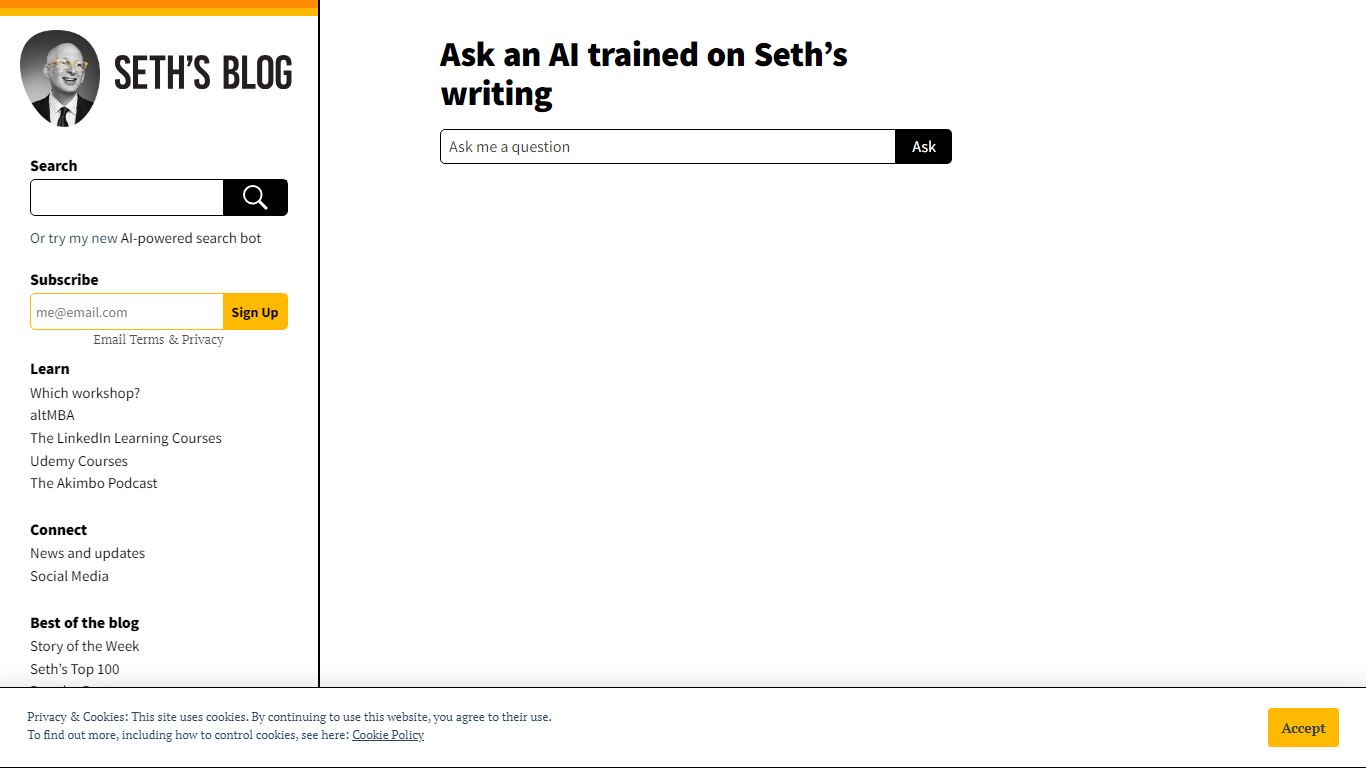

What is Seth's Blog AI?
Seth's Blog AI lets you query Seth Godin's blog archive through a chat window trained on his published writing. You type a question about marketing, tribes, or leadership and get an answer drawn from decades of posts on seths.blog. The bot page also links from the main blog search box as an alternative to keyword search.
Most general chatbots answer from the whole web. Seth's Blog AI is scoped to one author's body of work, so responses reflect Seth Godin's specific frameworks on permission marketing, remarkability, and trust rather than generic business advice. That narrow corpus is the trade-off: deep on Seth's ideas, useless for unrelated topics.
Marketers, entrepreneurs, and longtime blog readers use it to research concepts before a meeting, find the post behind a half-remembered idea, or test how Seth might frame a problem. Copy Response is built in, and thumbs-up or thumbs-down feedback helps refine answers after each query.
Semantic Scholar
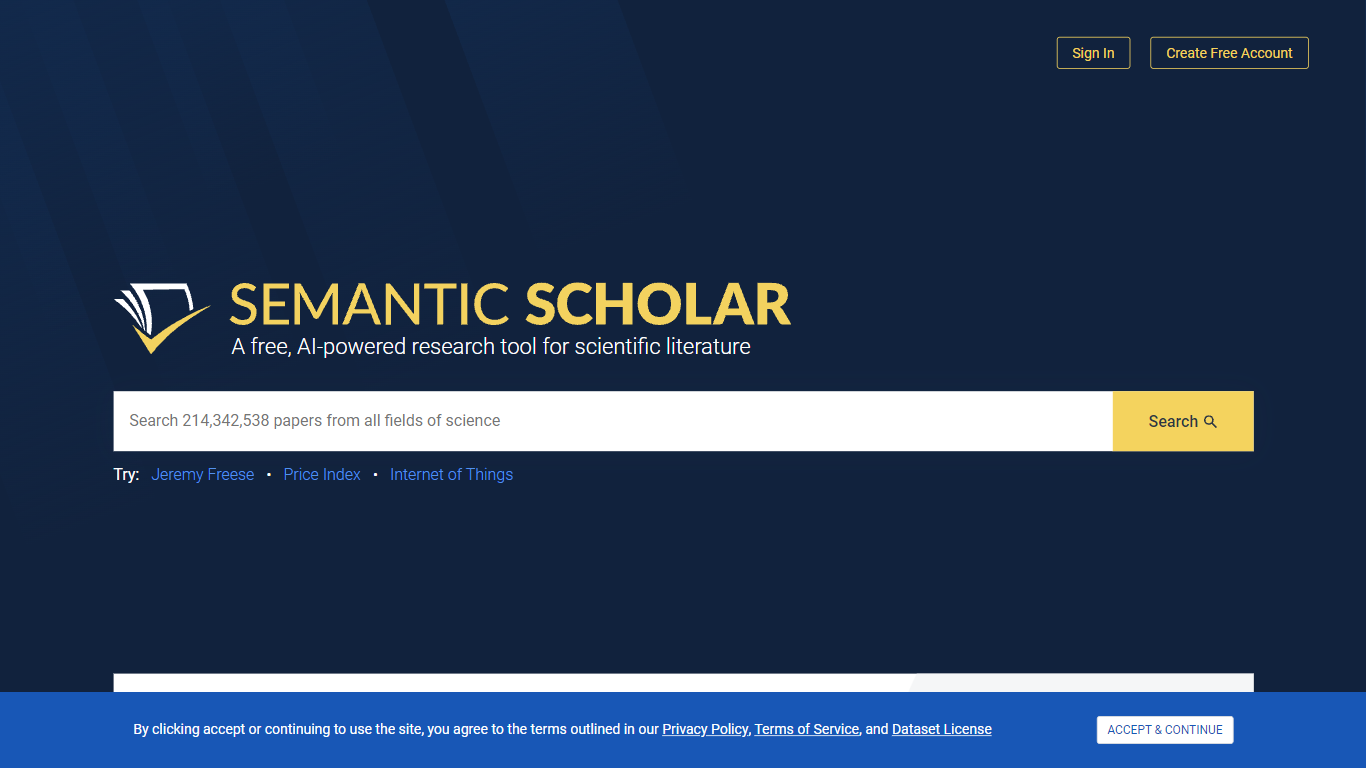
What is Semantic Scholar?
Semantic Scholar searches more than 236 million academic papers across every scientific field and surfaces citations, authors, and related work from one free interface. Built by the Allen Institute for AI (Ai2), it extracts meaning from papers so you can scan abstracts, follow citation chains, and open PDFs without jumping between databases.
Google Scholar indexes broadly but leaves connection-finding to you. Semantic Scholar adds AI-classified paper metadata, a Semantic Reader beta for in-browser annotation, and a public Academic Graph API with 214 million papers and 2.49 billion citations for developers. The S2AG and S2ORC datasets are also published as open JSON archives for NLP research.
Graduate students, faculty, librarians, and research engineers use it for literature reviews, citation tracking, and building scholarly apps. The API is free with optional keys for higher rate limits, and the platform partners with 50+ publishers to keep the index current.
Seth's Blog AI Upvotes
Semantic Scholar Upvotes
Seth's Blog AI Top Features
Trained on Seth Godin's published posts at seths.blog as its sole source corpus
Live at seths.blog/bot/ and linked from the main blog Search sidebar
Copy Response button exports the full answer in one click
Thumbs up and thumbs down controls with optional written feedback per answer
No account signup or payment step on the bot page
Semantic Scholar Top Features
Search 236,851,843 papers indexed across all fields of science from one homepage
Semantic Reader beta adds in-browser annotations and contextual overlays on select papers
Academic Graph API covers 214 million papers, 2.49 billion citations, and 79 million authors
S2AG and S2ORC datasets ship as free JSON archives for NLP and text mining projects
Paper recommendations surface related studies based on citation and content similarity
Partners with 50+ publishers and scholarly societies to ingest new academic content
Seth's Blog AI Category
- Research
Semantic Scholar Category
- Research
Seth's Blog AI Pricing Type
- Free
Semantic Scholar Pricing Type
- Free