Sixth vs PSEUDO.AI
In the face-off between Sixth vs PSEUDO.AI, which AI Developer tool takes the crown? We scrutinize features, alternatives, upvotes, reviews, pricing, and more.
In a face-off between Sixth and PSEUDO.AI, which one takes the crown?
If we were to analyze Sixth and PSEUDO.AI, both of which are AI-powered developer tools, what would we find? The upvote count favors Sixth, making it the clear winner. Sixth has received 9 upvotes from aitools.fyi users, while PSEUDO.AI has received 7 upvotes.
Want to flip the script? Upvote your favorite tool and change the game!
Sixth
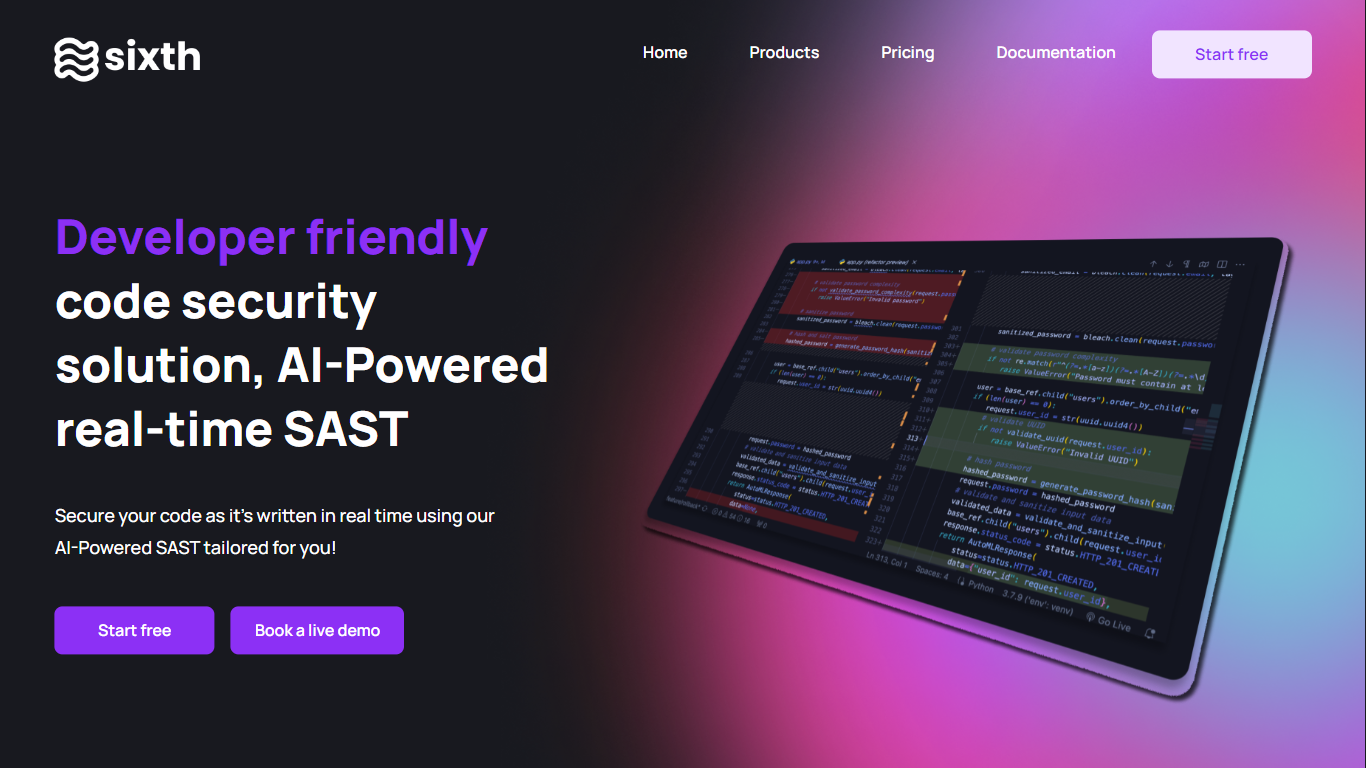

What is Sixth?
Sixth is a developer-focused coding agent that plans, writes, and debugs software inside your editor and through chat. It ships as a web app and a Visual Studio Code extension, and it routes work across frontier models from Anthropic, Google, and OpenAI instead of locking you to one provider.
Where many assistants jump straight to autocomplete, Sixth emphasizes orchestration. Deep Planning Mode drafts a step-by-step strategy before code changes, sub-agents run research and validation in parallel, and Telegram remote control lets you approve tasks from a phone. Paid tiers add MCP server access, with Pro+ listing more than 1,000 integrations.
Individual developers can start on the free tier with monthly agent and completion limits. Pro, Pro+, Ultra, and Teams plans raise usage caps, model access, and support levels, while the Enterprise page adds SOC 2 Type II compliance, SSO, and optional private deployment for regulated teams.
PSEUDO.AI
What is PSEUDO.AI?
PSEUDO.AI turns source code into human-readable pseudocode in your browser. You enter a prompt or code snippet, pick a language, and the app returns plain-language steps that read like structured pseudocode rather than raw syntax. It runs on the web at pseudoai.vercel.app with no install, and targets teams who need to explain implementation details to people who do not read code daily.
Most code explainers summarize what a snippet does in prose. PSEUDO.AI keeps the output closer to pseudocode structure, which makes handoffs to designers, product owners, or junior developers easier to scan. The trade-off is focus: it is built for pseudocode conversion, not debugging, testing, or repo-wide documentation. That narrow scope is the point when the goal is shared comprehension, not a full IDE workflow.
Software developers use it to translate tricky logic before code reviews or stakeholder meetings. Computer science students and instructors lean on it when a textbook example needs a readable walkthrough. Product managers and mentors who sit in technical discussions but do not write production code get a format they can follow without parsing braces and semicolons.
Sixth Upvotes
PSEUDO.AI Upvotes
Sixth Top Features
Deep Planning Mode maps a step-by-step coding strategy before the agent edits files
Sub-agents run research, writing, and validation tasks in parallel during one session
Free tier includes 50 agent or chat requests and 2,000 completions per month
Pro+ unlocks 1,000+ MCP servers plus models such as GPT-5.6 sol and Gemini 3.6
Telegram remote control lets you monitor, approve, and steer agent work from a phone
Enterprise page lists SOC 2 Type II compliance, SSO, and a 99.99% uptime SLA
PSEUDO.AI Top Features
Choose from 12 languages on the converter page, including C, C++, C#, Java, Python 3, JavaScript, Node.js, PHP, Kotlin, Swift, and SQL.
Runs entirely in the browser at pseudoai.vercel.app with no downloads required, per the homepage FAQ.
Uses an OpenAI-trained GPT model to generate pseudocode from your code input, according to the site FAQ.
Three-step workflow on the converter: enter a prompt or topic, pick a language, then click GO and copy the output.
Homepage FAQ lists Java, Python, C++, and JavaScript among supported languages, with a broader list on the live converter.
Sixth Category
- Developer
PSEUDO.AI Category
- Developer
Sixth Pricing Type
- Freemium
PSEUDO.AI Pricing Type
- Free