slAItor vs DeepL Translate
In the face-off between slAItor vs DeepL Translate, which AI Translation tool takes the crown? We scrutinize features, alternatives, upvotes, reviews, pricing, and more.
When we put slAItor and DeepL Translate head to head, which one emerges as the victor?
If we were to analyze slAItor and DeepL Translate, both of which are AI-powered translation tools, what would we find? The upvote count is neck and neck for both slAItor and DeepL Translate. Since other aitools.fyi users could decide the winner, the ball is in your court now to cast your vote and help us determine the winner.
Feeling rebellious? Cast your vote and shake things up!
slAItor

What is slAItor?
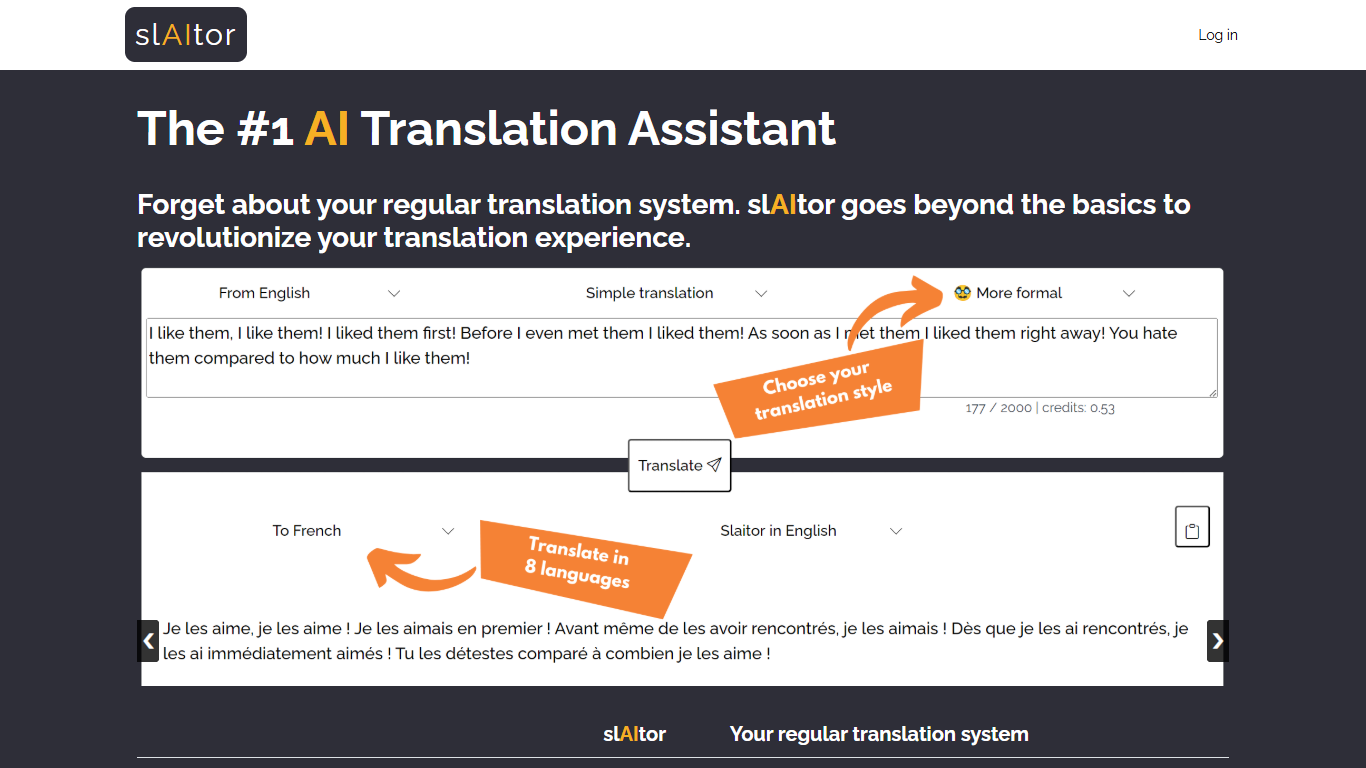
slAItor is an online translation assistant built around large language models from the GPT family, combined with standard machine translation pipelines. Instead of returning a single translated string, it is designed for people who want more context around a translation: explanations, alternatives, style adjustments, and error checking.
The product targets language learners, translators, and professionals who need more than a quick paste-and-go result. Benjamin Marie, who holds a Ph.D. in machine translation and has spent more than a decade in MT research, built slAItor to explore what becomes possible when GPT-style models sit at the center of a translation workflow.
slAItor supports 28 language pairs across Chinese, English, French, German, Italian, Japanese, Portuguese, and Spanish. The site is upfront that raw translation quality can trail established systems in some cases, but positions itself on price and on features like step-by-step explanations, paraphrasing, and a checker mode that reviews your own drafts.
DeepL Translate
What is DeepL Translate?
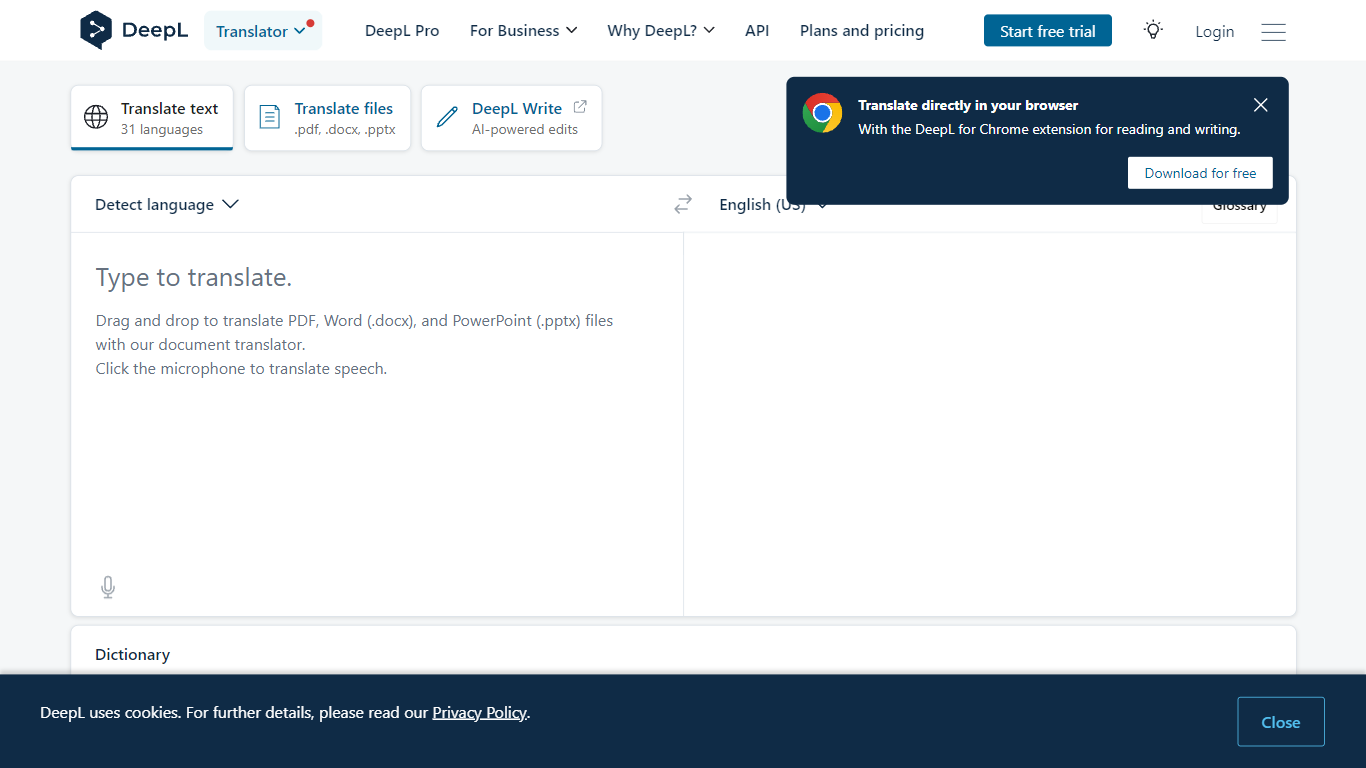
DeepL Translate converts text and documents between 100+ languages through a browser, desktop app, or API. Paste copy, upload PDF, Word, or PowerPoint files, or route speech through DeepL Voice, and the output keeps formatting on document jobs. The free web translator needs no account for basic text, while DeepL Pro adds glossaries, style rules, and higher monthly character quotas.
Google Translate wins on breadth and zero-friction mobile use. DeepL bets on nuance: its own language model, trained on proprietary data with human linguist input, targets natural phrasing in European and Asian language pairs. Pro glossaries with up to 30,000 entries across 16 languages and translation memory matter more to localization teams than to someone translating a restaurant menu once.
Freelance translators, legal and finance teams, customer support desks, and developers embedding the API use it for client deliverables, contract review, multilingual tickets, and product localization. Enterprise customers cite 86% faster document translation workflows and 10% higher customer satisfaction when support replies ship in the customer's language faster.
slAItor Upvotes
DeepL Translate Upvotes
slAItor Top Features
Translates across 28 language pairs spanning eight major languages
Step-by-step and checker modes cost 3 credits per 1,000 characters
Monthly plan lists at $25 for 800 credits with commercial-use rights
Paraphraser and style calibrator offer up to five alternative phrasings
Minimum query cost is 0.1 credit per translation request
DeepL Translate Top Features
100+ languages including Arabic, Japanese, Korean, and Swiss German
Drag-and-drop PDF, Word (.docx), and PowerPoint (.pptx) file translation
Glossaries support up to 30,000 entries across 16 languages on enterprise accounts
Pro plans include style rules, formality toggle, and Clarify rewrite suggestions
Desktop apps for Windows and Mac plus Chrome and Firefox extensions
DeepL API and Translation Flow for developer and enterprise automation
slAItor Category
- Translation
DeepL Translate Category
- Translation
slAItor Pricing Type
- Paid
DeepL Translate Pricing Type
- Freemium