Sloyd vs Text-To-4D
Compare Sloyd vs Text-To-4D and see which AI 3D Generation tool is better when we compare features, reviews, pricing, alternatives, upvotes, etc.
Which one is better? Sloyd or Text-To-4D?
When we compare Sloyd with Text-To-4D, which are both AI-powered 3d generation tools, Text-To-4D stands out as the clear frontrunner in terms of upvotes. Text-To-4D has been upvoted 26 times by aitools.fyi users, and Sloyd has been upvoted 6 times.
Think we got it wrong? Cast your vote and show us who's boss!
Sloyd

What is Sloyd?
Sloyd turns text prompts, photos, or parametric templates into textured 3D models inside the browser. You can generate assets from a description, upload a JPG or PNG reference, or start from handcrafted templates with slider controls. Exports ship as GLB, FBX, OBJ, STL, USD, and other formats for game engines, DCC tools, and 3D printers.
Many 3D generators meter every prompt with tight credit caps. Sloyd markets unlimited text and image generation on paid plans, with Guest users getting one AI 3D generation per day and unlimited template customization in-browser. Plus and Pro tiers add plugin access for Unity, Unreal, and Blender, auto-rigging, AI animation, and commercial licensing.
The product fits game developers, indie studios, 3D printing hobbyists, e-commerce visualization teams, and architects who need fast iteration. Sloyd also ships a Roblox avatar creator, topology controls up to 500K triangles on Pro, and Discord community support. Paid support email is [email protected].
Text-To-4D
What is Text-To-4D?
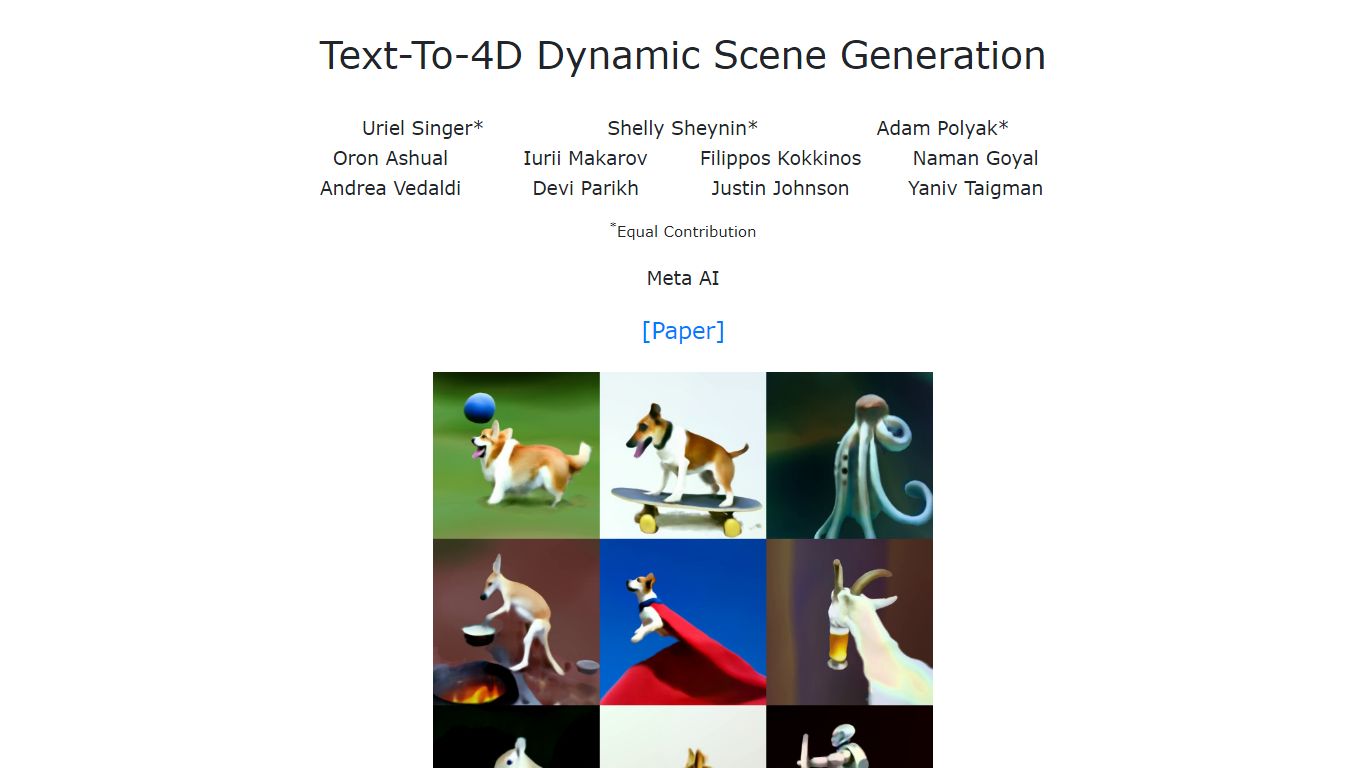
Text-To-4D is a Meta AI research project (MAV3D) that generates three-dimensional dynamic scenes from text descriptions. The method uses a 4D dynamic Neural Radiance Field optimized for appearance, density, and motion consistency by querying a text-to-video diffusion model.
Unlike static 3D generators that output a single mesh, Text-To-4D produces scenes you can view from any camera angle and composite into other 3D environments. The approach needs no 3D or 4D training data; the underlying text-to-video model trains only on text-image pairs and unlabeled videos.
The project page hosts demo samples for text-to-4D prompts like "a corgi playing with a ball" and image-to-4D conversions from still photos. It is a research showcase, not a commercial product with a public API or signup. Researchers and 3D artists interested in NeRF-based dynamic scene generation can explore the paper and sample outputs on the site.
Sloyd Upvotes
Text-To-4D Upvotes
Sloyd Top Features
Text-to-3D and image-to-3D with unlimited generations on Plus and Pro plans
Guest plan includes 1 AI 3D generation per day and unlimited template editing
Exports GLB, FBX, OBJ, STL, USD, USDZ, BLEND, and 3MF for engines and printers
Plugins send assets to Unity, Unreal, and Blender in one click
Auto-rigging, AI animation, and topology control up to 500K triangles on Pro
Image uploads accept JPG, PNG, and WEBP files up to 20MB
Text-To-4D Top Features
Generates 3D dynamic scenes from text prompts via MAV3D (Make-A-Video3D)
4D dynamic NeRF optimized for appearance, density, and motion consistency
View generated scenes from any camera location and angle
Image-to-4D mode converts still photos into dynamic video scenes
Trained only on text-image pairs and unlabeled videos, no 3D/4D data required
Published research paper on arXiv (2301.11280) with interactive demo samples
Sloyd Category
- 3D Generation
Text-To-4D Category
- 3D Generation
Sloyd Pricing Type
- Freemium
Text-To-4D Pricing Type
- Free