TLM Playground vs mshumer/gpt-prompt-engineer - GitHub
Dive into the comparison of TLM Playground vs mshumer/gpt-prompt-engineer - GitHub and discover which AI Model Generation tool stands out. We examine alternatives, upvotes, features, reviews, pricing, and beyond.
In a comparison between TLM Playground and mshumer/gpt-prompt-engineer - GitHub, which one comes out on top?
When we compare TLM Playground and mshumer/gpt-prompt-engineer - GitHub, two exceptional model generation tools powered by artificial intelligence, and place them side by side, several key similarities and differences come to light. Neither tool takes the lead, as they both have the same upvote count. Be a part of the decision-making process. Your vote could determine the winner.
Does the result make you go "hmm"? Cast your vote and turn that frown upside down!
TLM Playground
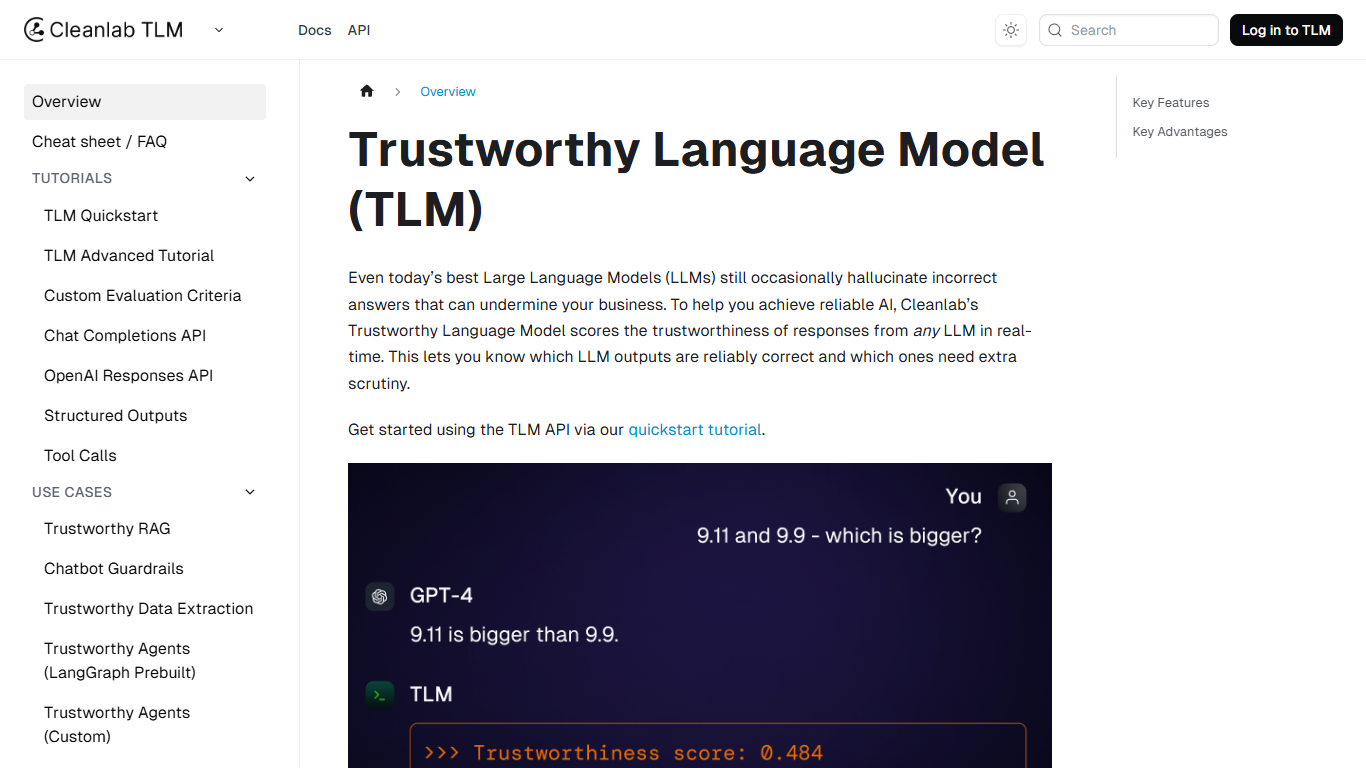

What is TLM Playground?
TLM Playground is Cleanlab's documentation hub for the Trustworthy Language Model (TLM), a model generation API that scores how reliable any LLM response is in real time. Each answer gets a trustworthiness score between 0 and 1, flagging hallucinations and reasoning errors before they reach users. Install the Python client with pip install cleanlab-tlm, set a CLEANLAB_TLM_API_KEY, and call TLM.prompt() to generate scored responses or get_trustworthiness_score() to audit outputs from your existing stack.
Most hallucination detectors focus on faithfulness to retrieved context. Metrics like RAGAS check whether an answer matches source documents but miss factual errors when the context is thin or confusing. TLM uses model uncertainty estimation rather than LLM-as-judge prompting, and Cleanlab publishes benchmarks showing 3x greater precision than RAGAS in RAG workflows. It needs no labeled training data on your domain, which sidesteps the drift problem that breaks custom evaluators.
ML and AI engineers building RAG pipelines, chatbots, and agent systems use TLM to gate low-confidence outputs, route them to humans, or swap in fallback answers. The API covers structured outputs, tool calls, classification labels, and multi-turn conversations, not just plain text completions.
mshumer/gpt-prompt-engineer - GitHub
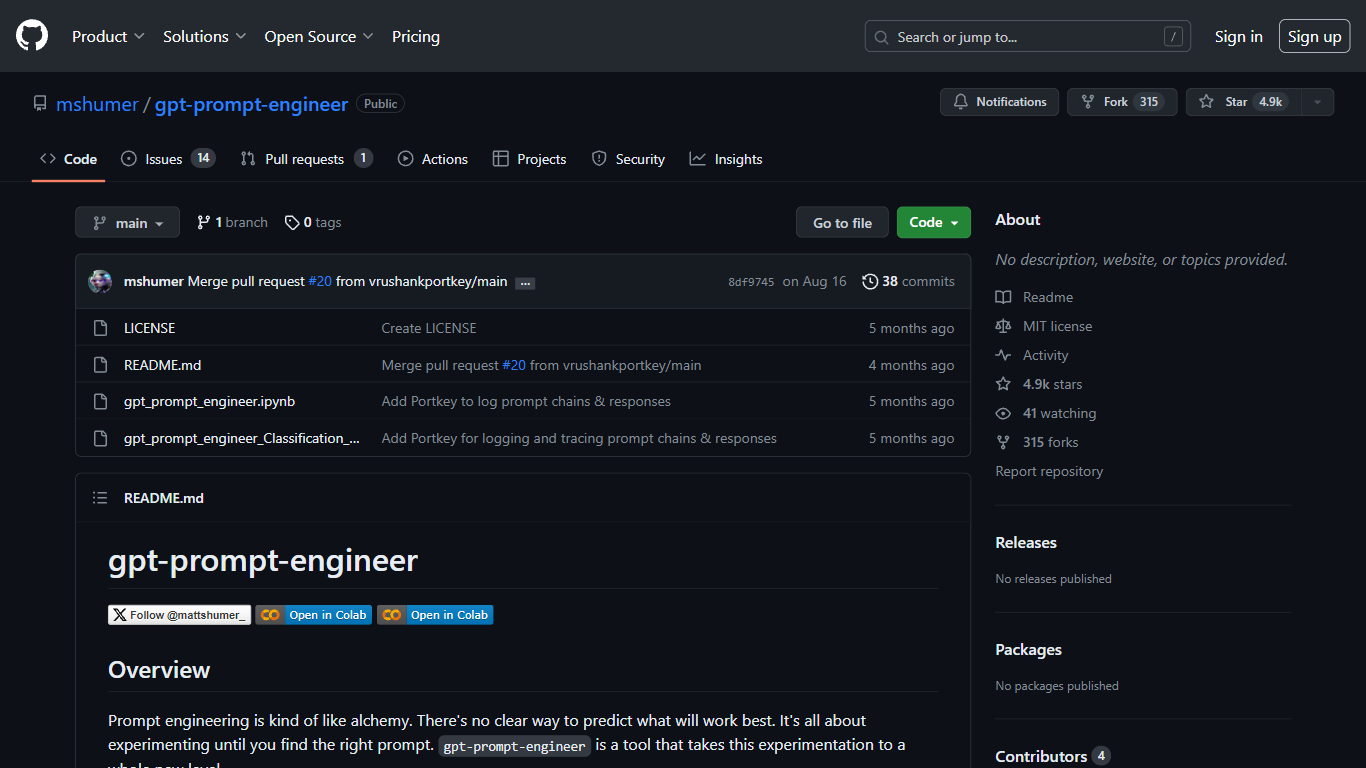
What is mshumer/gpt-prompt-engineer - GitHub?
mshumer/gpt-prompt-engineer is an open source prompt engineering toolkit that generates, tests, and ranks candidate prompts for a task you define. You describe the use case, supply test cases, and the notebooks create multiple prompt variants, run them against every test case, and sort results with an ELO rating system starting at 1200. It ships as Jupyter notebooks you can run in Google Colab or locally.
Most prompt tools help you write one prompt at a time. gpt-prompt-engineer treats prompt selection like a tournament: dozens of candidates compete on your test cases, and the highest ELO scores surface the winners. Separate notebooks cover classification tasks, Claude 3 Opus with auto-generated test cases, and Opus-to-Haiku conversion for cheaper inference. Optional Weights & Biases and Portkey logging trace each run.
ML engineers, prompt engineers, and AI developers use it when they need reproducible prompt tuning instead of manual trial and error. The repo has 9.7k GitHub stars and runs on your own OpenAI or Anthropic API keys. It is free under the MIT license.
TLM Playground Upvotes
mshumer/gpt-prompt-engineer - GitHub Upvotes
TLM Playground Top Features
Every response returns a 0 to 1 trustworthiness score computed via uncertainty estimation
get_trustworthiness_score() scores outputs from any LLM without changing your inference code
TLM.prompt() returns both a response and score in one API call, defaulting to gpt-4.1-mini as the base model
Benchmarks report 27% fewer incorrect GPT-4o responses and 3x better RAG error detection than RAGAS
Quality presets from low to high, plus TLM Lite, let you trade latency and cost against scoring depth
TrustworthyRAG Evals score groundedness, abstention, and context sufficiency alongside trustworthiness
mshumer/gpt-prompt-engineer - GitHub Top Features
Generates multiple prompt candidates from a task description and user-supplied test cases
Ranks prompts with an ELO rating system starting at 1200 per candidate
Supports GPT-4, GPT-3.5-Turbo, and Claude 3 Opus model backends
Classification notebook scores true/false test cases and prints a results table
Claude 3 notebook auto-generates test cases from input variable definitions
Opus-to-Haiku conversion notebook cuts latency and cost while preserving output quality
Optional Weights & Biases and Portkey logging for experiment tracking
TLM Playground Category
- Model Generation
mshumer/gpt-prompt-engineer - GitHub Category
- Model Generation
TLM Playground Pricing Type
- Freemium
mshumer/gpt-prompt-engineer - GitHub Pricing Type
- Free