TLM Playground vs Prompt Mixer
In the clash of TLM Playground vs Prompt Mixer, which AI Model Generation tool emerges victorious? We assess reviews, pricing, alternatives, features, upvotes, and more.
If you had to choose between TLM Playground and Prompt Mixer, which one would you go for?
Let's take a closer look at TLM Playground and Prompt Mixer, both of which are AI-driven model generation tools, and see what sets them apart. The upvote count reveals a draw, with both tools earning the same number of upvotes. Every vote counts! Cast yours and contribute to the decision of the winner.
Don't agree with the result? Cast your vote and be a part of the decision-making process!
TLM Playground

What is TLM Playground?
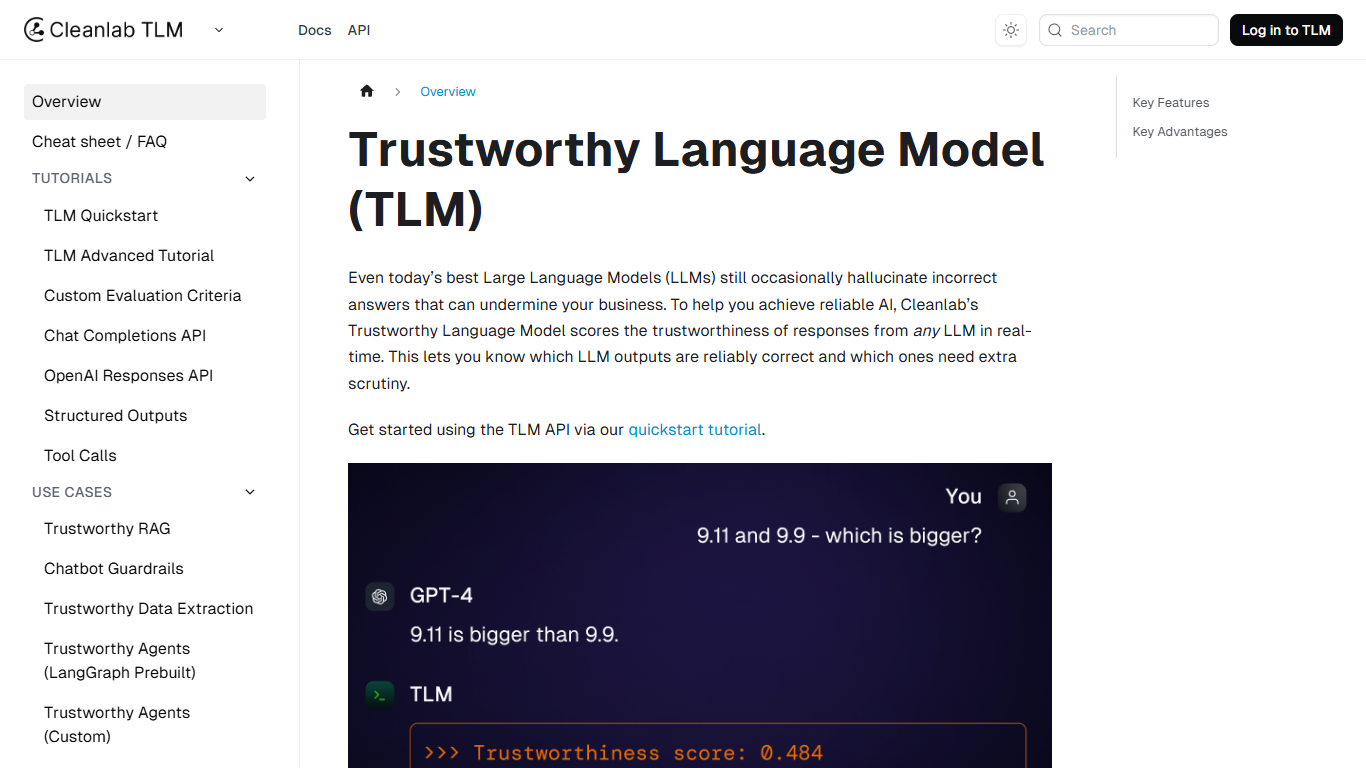
TLM Playground is Cleanlab's documentation hub for the Trustworthy Language Model (TLM), a model generation API that scores how reliable any LLM response is in real time. Each answer gets a trustworthiness score between 0 and 1, flagging hallucinations and reasoning errors before they reach users. Install the Python client with pip install cleanlab-tlm, set a CLEANLAB_TLM_API_KEY, and call TLM.prompt() to generate scored responses or get_trustworthiness_score() to audit outputs from your existing stack.
Most hallucination detectors focus on faithfulness to retrieved context. Metrics like RAGAS check whether an answer matches source documents but miss factual errors when the context is thin or confusing. TLM uses model uncertainty estimation rather than LLM-as-judge prompting, and Cleanlab publishes benchmarks showing 3x greater precision than RAGAS in RAG workflows. It needs no labeled training data on your domain, which sidesteps the drift problem that breaks custom evaluators.
ML and AI engineers building RAG pipelines, chatbots, and agent systems use TLM to gate low-confidence outputs, route them to humans, or swap in fallback answers. The API covers structured outputs, tool calls, classification labels, and multi-turn conversations, not just plain text completions.
Prompt Mixer

What is Prompt Mixer?
Prompt Mixer is a desktop application and collaborative workspace for building, testing, and managing AI prompt chains. Engineers, managers, and data experts use it to design prompts together, version changes, and evaluate outputs across multiple LLM providers.
You can chain prompts that pass context between steps, build multi-step workflows through a form-based interface, and connect to OpenAI, Anthropic, Google Gemini, Ollama, and other services via connectors. The open-source Community Edition (MIT license) runs locally on macOS, Windows, and Linux.
Teams get version control with rollback, commenting, and review workflows. Prompt Mixer lets you test prompts against different models before deploying them to production applications.
TLM Playground Upvotes
Prompt Mixer Upvotes
TLM Playground Top Features
Every response returns a 0 to 1 trustworthiness score computed via uncertainty estimation
get_trustworthiness_score() scores outputs from any LLM without changing your inference code
TLM.prompt() returns both a response and score in one API call, defaulting to gpt-4.1-mini as the base model
Benchmarks report 27% fewer incorrect GPT-4o responses and 3x better RAG error detection than RAGAS
Quality presets from low to high, plus TLM Lite, let you trade latency and cost against scoring depth
TrustworthyRAG Evals score groundedness, abstention, and context sufficiency alongside trustworthiness
Prompt Mixer Top Features
Build and version prompt chains with collaborative editing and review workflows
Test prompts across OpenAI, Anthropic, Gemini, Ollama, and custom connectors
Create multi-step analysis workflows with a form-based interface
Open-source Community Edition available under MIT license
Compare LLM outputs side by side before production deployment
TLM Playground Category
- Model Generation
Prompt Mixer Category
- Model Generation
TLM Playground Pricing Type
- Freemium
Prompt Mixer Pricing Type
- Freemium