U-xer vs QA.tech
In the clash of U-xer vs QA.tech, which AI Automation tool emerges victorious? We assess reviews, pricing, alternatives, features, upvotes, and more.
When we put U-xer and QA.tech head to head, which one emerges as the victor?
Let's take a closer look at U-xer and QA.tech, both of which are AI-driven automation tools, and see what sets them apart. The upvote count favors QA.tech, making it the clear winner. The number of upvotes for QA.tech stands at 8, and for U-xer it's 6.
Want to flip the script? Upvote your favorite tool and change the game!
U-xer


What is U-xer?
U-xer is an AI-powered automation assistant designed to simplify task automation across multiple platforms including Windows, Mac, browsers, iOS, and Android. It uses advanced computer vision and natural language processing to automate tasks by recognizing visual elements on the screen, eliminating the need for complex coding or selectors like CSS or XPath. Users can create automation scenarios using simple commands or everyday language, making it accessible for both non-technical users and developers who prefer scripting.
The tool learns from each interaction, becoming smarter and more personalized over time. It supports modular automation, allowing users to combine multiple scenarios into flexible workflows. U-xer also offers features like a built-in AI assistant called AskUxer for dynamic data scraping and task assistance, code editor mode for script customization, and command line integration for advanced control.
U-xer is designed for a wide range of users including small business owners, startups, freelancers, digital agencies, e-commerce businesses, IT professionals, and QA engineers. It supports local and remote execution, scheduled automation, unlimited user collaboration, and detailed execution reports with screenshot verification. The platform independence and reusable scripts across devices ensure consistent automation experiences.
Additional capabilities include custom image detection with screen scraping, starting automation on existing windows without reloading apps, using the user's own browser for automation, and automatic retry for element detection to improve reliability. U-xer also provides open APIs for integration with other tools and systems, enhancing workflow automation and compatibility.
Overall, U-xer stands out as a user-friendly, flexible, and intelligent automation assistant that lowers the barrier to entry for automation while offering powerful features for advanced users.
QA.tech
What is QA.tech?
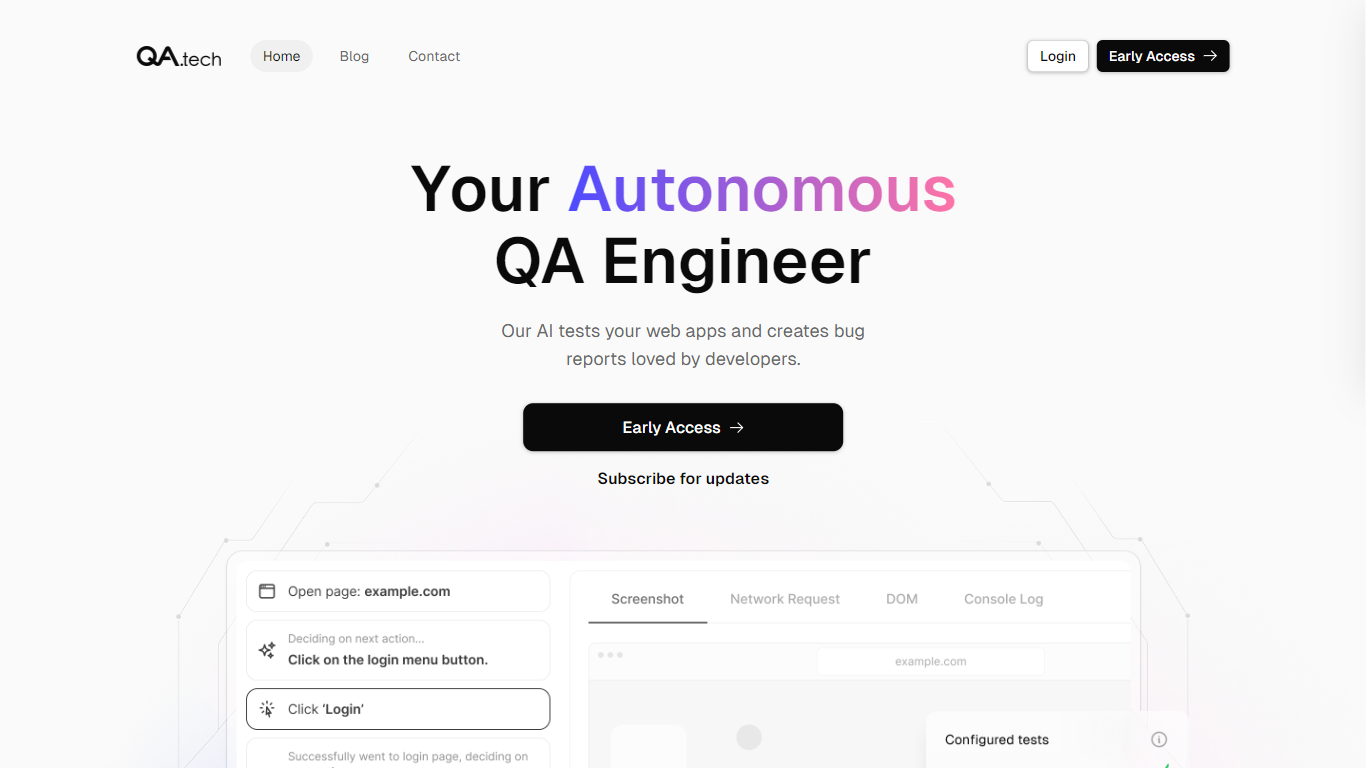
QA.tech is an autonomous AI testing platform designed to keep pace with fast-moving development teams by continuously validating software quality across the entire software development lifecycle. Its AI agents test web applications, mobile apps, and pull requests by intent rather than brittle scripts, adapting dynamically to UI changes and evolving product flows. This approach reduces maintenance overhead and helps teams avoid flaky tests that slow down releases.
The platform targets engineering teams, product managers, and QA professionals who need reliable, fast feedback on every code change without the usual manual testing bottlenecks. It supports web, mobile (iOS and Android), and API testing, enabling cross-platform user journey validation with a single test scenario.
QA.tech integrates tightly with GitHub and other CI/CD tools, automatically running regression and exploratory tests on every pull request in preview environments. It provides detailed debugging insights including screenshots, logs, and network activity, helping developers quickly identify and fix issues before merging.
The platform runs entirely in the cloud, requiring no infrastructure setup or source code access, which simplifies adoption and enterprise security reviews. It is SOC 2 Type 2 compliant and supports SSO and SAML for enterprise-grade security.
QA.tech’s AI agents build a knowledge graph of the application by crawling it and learning flows over time, so test coverage compounds and improves with each release. Users can write tests in plain English, describe goals, and let the AI generate and maintain tests automatically.
Additional features include automated accessibility (WCAG) testing, dynamic test data generation, and support for complex workflows like multi-user scenarios, feature flag testing, and localization. The platform aims to replace manual QA and scripted tests with a reliable, scalable validation layer that frees developers to focus on building features.
U-xer Upvotes
QA.tech Upvotes
U-xer Top Features
🤖 AskUxer AI assistant answers questions and scrapes on-screen data to enhance automation.
🖥️ Cross-platform support automates tasks on Windows, Mac, browsers, iOS, and Android seamlessly.
📝 Simple natural language commands let anyone automate tasks without coding knowledge.
🔄 Modular automation combines multiple scenarios for flexible and scalable workflows.
📊 Detailed execution reports with screenshots help verify and troubleshoot automation steps.
QA.tech Top Features
Describe test goals in plain English and let agents generate and run workflows without brittle scripts
Run regression and exploratory tests on every pull request with pass or fail feedback in GitHub
Validate journeys across web, mobile (iOS and Android), and APIs in one scenario
Get screenshots, logs, network activity, and agent reasoning for every failed step
SOC 2 Type 2 compliance with SSO and SAML, testing without source code access
U-xer Category
- Automation
QA.tech Category
- Automation
U-xer Pricing Type
- Freemium
QA.tech Pricing Type
- Paid