
Last updated 07-26-2026
Category:
Reviews:
Join thousands of AI enthusiasts in the World of AI!
QA.tech
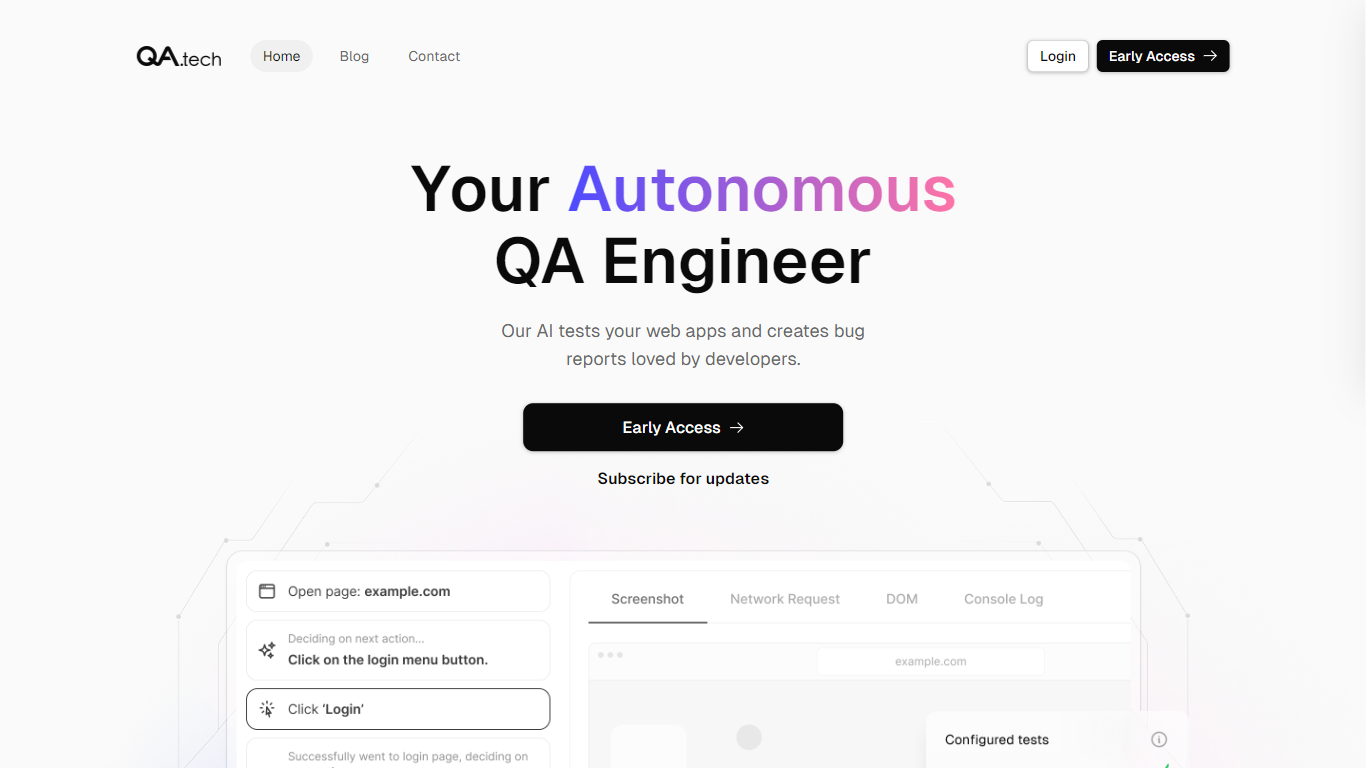
QA.tech is an autonomous AI testing platform designed to keep pace with fast-moving development teams by continuously validating software quality across the entire software development lifecycle. Its AI agents test web applications, mobile apps, and pull requests by intent rather than brittle scripts, adapting dynamically to UI changes and evolving product flows. This approach reduces maintenance overhead and helps teams avoid flaky tests that slow down releases.
The platform targets engineering teams, product managers, and QA professionals who need reliable, fast feedback on every code change without the usual manual testing bottlenecks. It supports web, mobile (iOS and Android), and API testing, enabling cross-platform user journey validation with a single test scenario.
QA.tech integrates tightly with GitHub and other CI/CD tools, automatically running regression and exploratory tests on every pull request in preview environments. It provides detailed debugging insights including screenshots, logs, and network activity, helping developers quickly identify and fix issues before merging.
The platform runs entirely in the cloud, requiring no infrastructure setup or source code access, which simplifies adoption and enterprise security reviews. It is SOC 2 Type 2 compliant and supports SSO and SAML for enterprise-grade security.
QA.tech’s AI agents build a knowledge graph of the application by crawling it and learning flows over time, so test coverage compounds and improves with each release. Users can write tests in plain English, describe goals, and let the AI generate and maintain tests automatically.
Additional features include automated accessibility (WCAG) testing, dynamic test data generation, and support for complex workflows like multi-user scenarios, feature flag testing, and localization. The platform aims to replace manual QA and scripted tests with a reliable, scalable validation layer that frees developers to focus on building features.
Describe test goals in plain English and let agents generate and run workflows without brittle scripts
Run regression and exploratory tests on every pull request with pass or fail feedback in GitHub
Validate journeys across web, mobile (iOS and Android), and APIs in one scenario
Get screenshots, logs, network activity, and agent reasoning for every failed step
SOC 2 Type 2 compliance with SSO and SAML, testing without source code access
Runs autonomous tests that adapt to UI changes, reducing maintenance
Integrates with GitHub for automatic PR testing and fast feedback
Supports web, mobile, and API testing with cross-platform scenarios
Provides detailed debugging info including screenshots and logs
Enterprise-ready with SOC 2 Type 2 compliance and SSO support
Pricing details require direct contact for exact costs
Enterprise features and customizations may require negotiation
No open-source or self-hosted option available
Can QA.tech create tests without writing code?
Yes, QA.tech uses AI agents that perform manual testing workflows based on natural language descriptions, eliminating the need for scripting.
Does QA.tech integrate with CI/CD pipelines?
Yes, it connects with GitHub and other tools to automatically run tests on pull requests and post results before merges.
Can QA.tech test mobile apps on iOS and Android?
Yes, it supports native mobile testing on emulators, simulators, and real devices using the same natural language prompts.
Is QA.tech secure for enterprise use?
Yes, it is SOC 2 Type 2 compliant, supports SSO and SAML, and does not require source code access for testing.
How does QA.tech handle UI changes?
Its AI agents test by intent and visually interact with the UI, adapting automatically to redesigns and framework changes without breaking tests.
Can QA.tech scale with large test volumes?
Yes, it runs many agents in parallel to complete large test suites quickly and scales smoothly with your needs.
Is there a trial or proof of concept available?
QA.tech offers a free proof of concept where they help build tests for your critical journeys to demonstrate value before commitment.