
Last updated 08-31-2026
Category:
Reviews:
Join thousands of AI enthusiasts in the World of AI!
Packmind
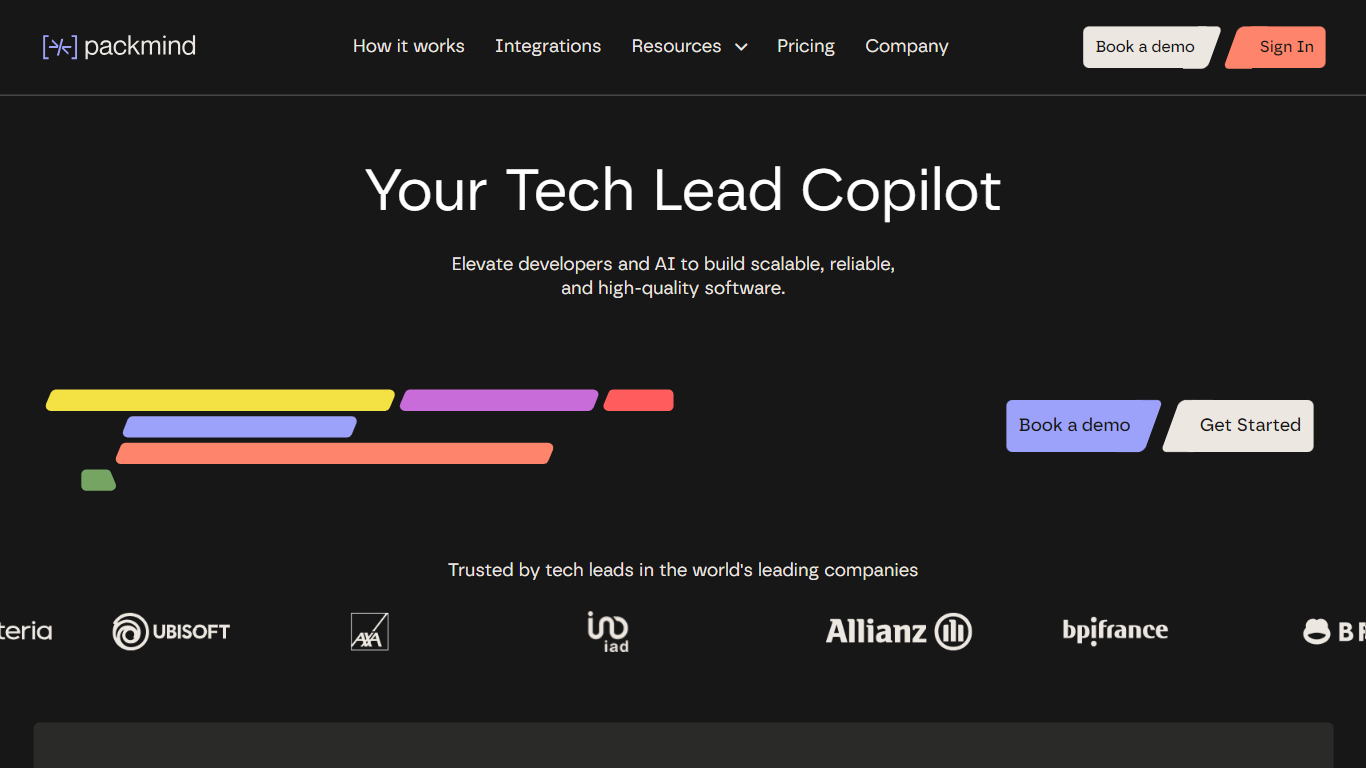
Packmind captures and governs your engineering playbook so AI coding agents across your repositories follow your team's standards instead of guessing from generic training data. It turns scattered decisions, patterns, and conventions into a versioned playbook, then distributes that context to assistants like Copilot, Cursor, Claude Code, and Gemini Code Assist.
Where generic assistants guess from training data, Packmind feeds them your team's rules. Its CLI can open pull requests that update copilot-instructions.md, AGENTS.md, and Cursor rules files, and its MCP server lets developers capture standards while coding. Violations show up in the IDE, CLI, or pre-commit with optional auto-fix before review.
Engineering leaders and platform teams use Packmind to scale agentic coding without losing consistency. The open source edition is free with unlimited developers and repositories; enterprise tiers add RBAC, SSO, SCIM, and audit trails. SOC 2 Type II certified since 2024, with public cloud or self-hosted Kubernetes deployment including air-gapped options.
Open source core is free with unlimited developers and repositories on GitHub and GitLab
CLI syncs standards to copilot-instructions.md, AGENTS.md, and Cursor rules via pull request
Imports standards from ADRs or Git docs, or captures rules via MCP while you code
Flags violations in VS Code, JetBrains, Visual Studio, CLI, or pre-commit with auto-fix
Distributes playbook context to Copilot, Cursor, Claude Code, Gemini Code Assist, and Junie
SOC 2 Type II certified since 2024 with cloud or self-hosted Kubernetes deployment
Open source core is free with unlimited developers and repositories.
Integrates with major AI coding assistants, IDEs, GitHub, and GitLab.
SOC 2 Type II certified with cloud or self-hosted deployment options.
Goes beyond linters by supplying team-specific context to AI agents.
Enterprise features like SSO, RBAC, and advanced governance require a custom paid plan.
Building and maintaining a useful playbook takes upfront effort from engineering teams.
Best suited for organizations with established coding standards, not solo hobby projects.
What programming languages does Packmind support?
Packmind supports all major programming languages, including Python, JavaScript, TypeScript, Java, C#, C++, PHP, Ruby, Scala, YAML, and Terraform.
How does Packmind work with AI coding assistants?
Packmind structures your engineering playbook, keeps AI assistants aligned with your team's rules, and governs adoption at scale. It complements tools like Copilot and Cursor by supplying team-specific context and guardrails.
Is Packmind open source?
Yes. Packmind's core platform is open source and free, with unlimited developers and repositories. Paid enterprise editions add enforcement, governance, SSO, SCIM, and RBAC for larger organizations.
How is Packmind different from linters like ESLint or SonarLint?
Linters catch predefined code issues. Packmind helps teams define contextual coding standards and distributes that context to AI assistants, so generated code aligns with your practices rather than generic patterns.
Does Packmind offer cloud and on-premise deployment?
Yes. Packmind offers public cloud hosting and on-premise Kubernetes-ready deployment, including air-gapped options for organizations with strict security requirements.
Is Packmind SOC 2 certified?
Yes. Packmind has been SOC 2 Type II certified since 2024, and the platform offers both public cloud and self-hosted Kubernetes deployment for organizations with strict security requirements.