UL2 vs Stellaris AI
Compare UL2 vs Stellaris AI and see which AI Large Language Model (LLM) tool is better when we compare features, reviews, pricing, alternatives, upvotes, etc.
Which one is better? UL2 or Stellaris AI?
When we compare UL2 with Stellaris AI, which are both AI-powered large language model (llm) tools, Both tools are equally favored, as indicated by the identical upvote count. The power is in your hands! Cast your vote and have a say in deciding the winner.
Disagree with the result? Upvote your favorite tool and help it win!
UL2

What is UL2?
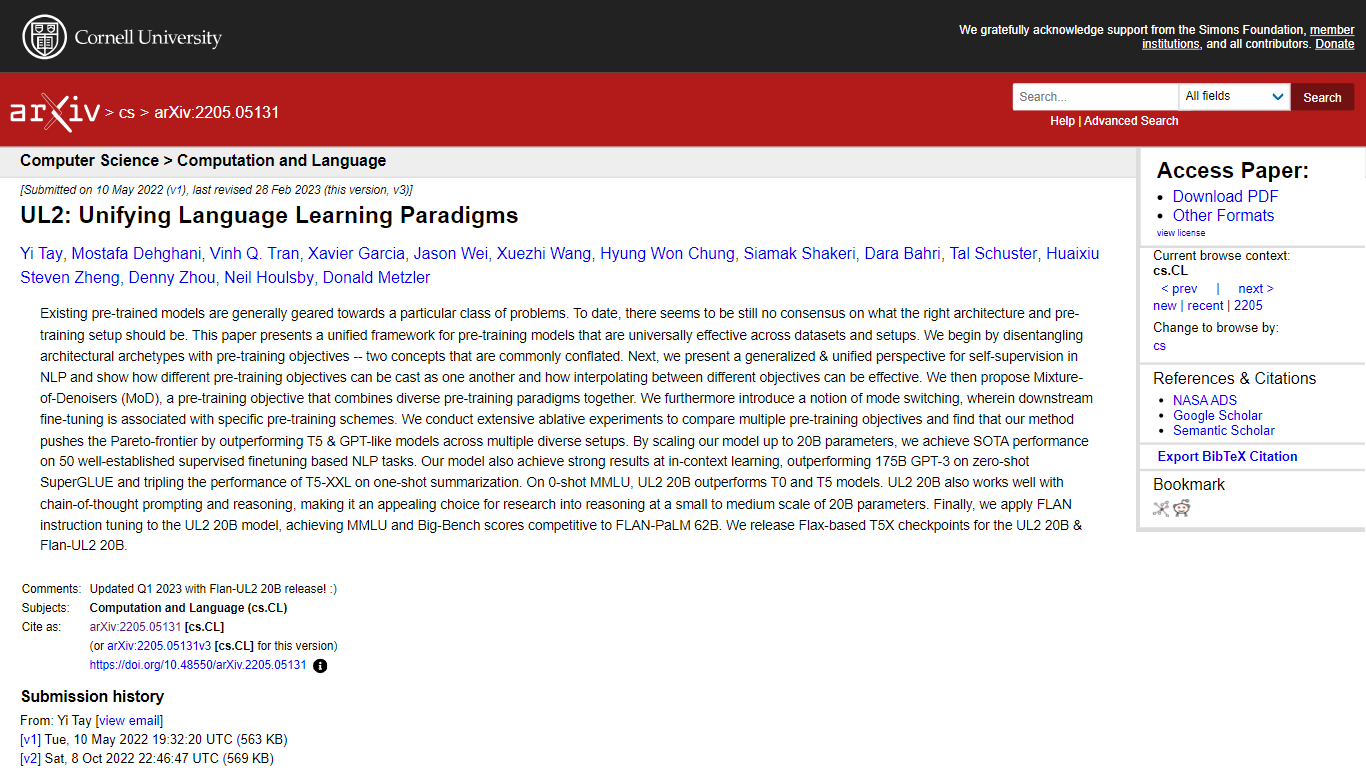
UL2 is a unified framework for pre-training language models that perform well across a wide range of natural language processing tasks. It separates model architecture from training objectives, allowing flexible combinations of self-supervised learning methods. The core innovation is the Mixture-of-Denoisers (MoD) objective, which blends multiple denoising tasks to improve generalization. UL2 introduces mode switching, linking downstream fine-tuning to specific pre-training modes for better task adaptation. Scaled up to 20 billion parameters, UL2 achieves state-of-the-art results on over 50 NLP benchmarks, including language understanding, generation, reasoning, and knowledge grounding. It also excels at in-context learning, outperforming larger models like GPT-3 on zero-shot and one-shot tasks. The framework supports instruction tuning (Flan-UL2), further enhancing performance on complex reasoning and multitask benchmarks. Open-source Flax-based T5X checkpoints for UL2 and Flan-UL2 20B models are publicly available, facilitating research and application development.
Stellaris AI
What is Stellaris AI?
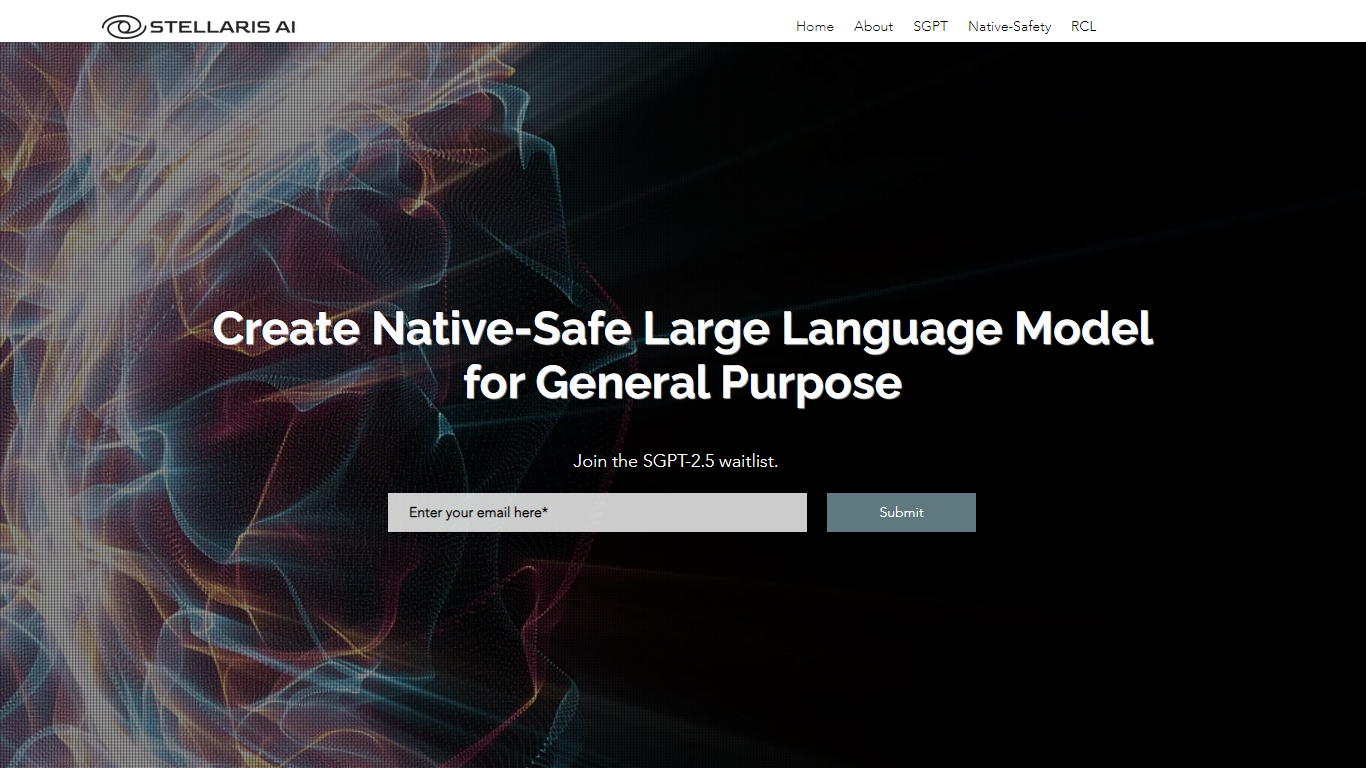
Stellaris AI builds large language models marketed around native safety and human-like reasoning for real-world tasks. Its flagship SGPT line targets text and code generation, knowledge Q&A, logical reasoning, and analytics at a scale the company describes as hundreds of billions of parameters. The public site centers on a waitlist for SGPT-4.5 rather than a self-serve chat product you can open today.
Where many LLM labs bolt safety filters on after training, Stellaris AI frames safety as part of the model stack through strict source referencing and harm minimization in the architecture. It also highlights Real-time Context Learning (RCL) for adapting answers with live knowledge, a combination aimed at teams that want cited outputs instead of unchecked generation.
Researchers, enterprise AI teams, and early adopters join the SGPT-4.5 waitlist for first access. The company cites 10+ years of research and three core product pillars: Stellaris GPT, Native Safety, and RCL.
UL2 Upvotes
Stellaris AI Upvotes
UL2 Top Features
🌐 Universal pre-training framework adapts to many NLP tasks
🔄 Mixture-of-Denoisers blends diverse training objectives for better learning
⚙️ Mode switching links pre-training to fine-tuning for task-specific gains
🚀 Scalable to 20B parameters with state-of-the-art benchmark performance
📂 Open-source Flax-based checkpoints enable easy research and deployment
Stellaris AI Top Features
SGPT models described at 100B+ parameters for text, code, and reasoning tasks
Native Safety framework with strict source referencing and harm minimization
Real-time Context Learning (RCL) for live knowledge integration
Three product pillars: Stellaris GPT, Native Safety, and RCL
SGPT-4.5 waitlist open for early access signups on the homepage
UL2 Category
- Large Language Model (LLM)
Stellaris AI Category
- Large Language Model (LLM)
UL2 Pricing Type
- Freemium
Stellaris AI Pricing Type
- Freemium