wav2vec 2.0 vs LlamaIndex
Dive into the comparison of wav2vec 2.0 vs LlamaIndex and discover which AI Large Language Model (LLM) tool stands out. We examine alternatives, upvotes, features, reviews, pricing, and beyond.
When comparing wav2vec 2.0 and LlamaIndex, which one rises above the other?
When we compare wav2vec 2.0 and LlamaIndex, two exceptional large language model (llm) tools powered by artificial intelligence, and place them side by side, several key similarities and differences come to light. The upvote count is neck and neck for both wav2vec 2.0 and LlamaIndex. You can help us determine the winner by casting your vote and tipping the scales in favor of one of the tools.
Disagree with the result? Upvote your favorite tool and help it win!
wav2vec 2.0

What is wav2vec 2.0?
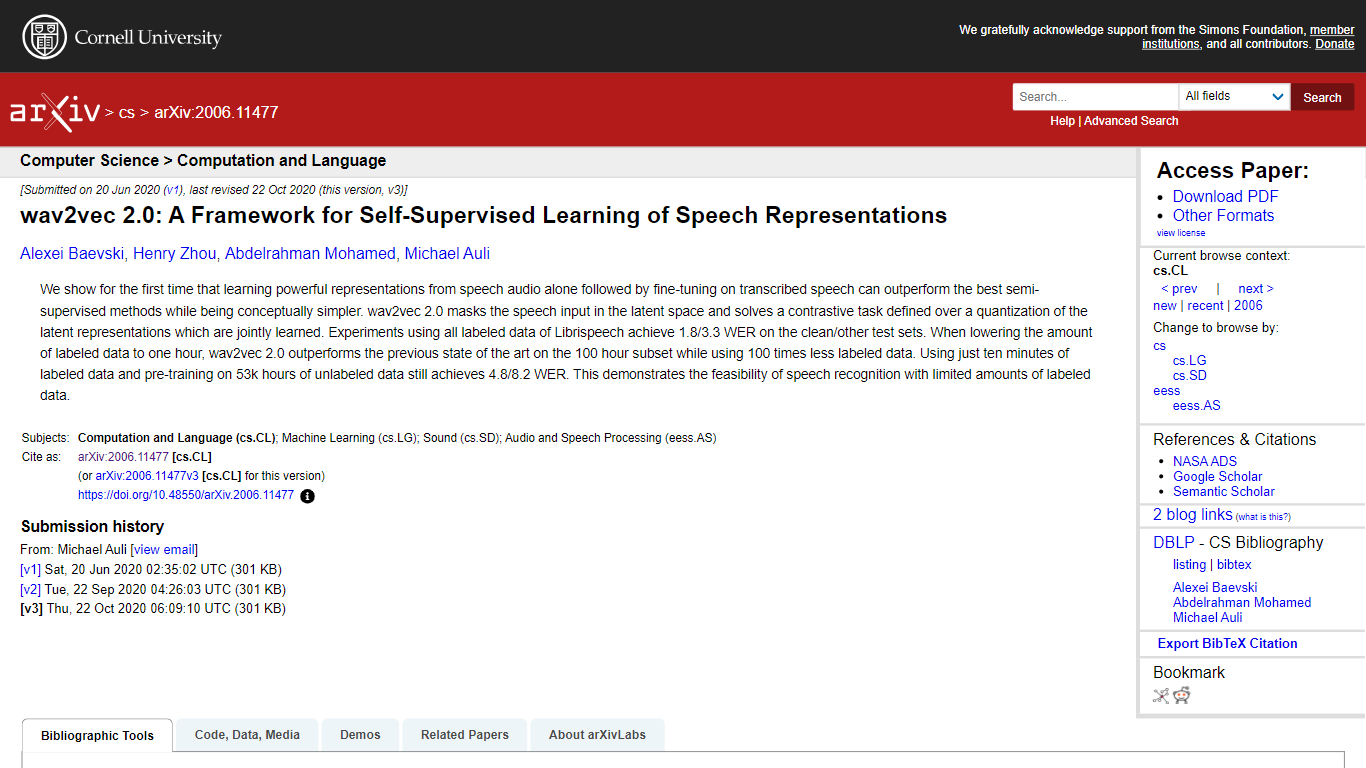
wav2vec 2.0 is a self-supervised learning framework that learns speech representations directly from raw audio. It masks portions of the speech input in a latent space and solves a contrastive task over quantized latent representations, which are learned jointly with the model. This approach allows the model to leverage large amounts of unlabeled speech data effectively. After pre-training, wav2vec 2.0 can be fine-tuned on small amounts of labeled speech data to achieve state-of-the-art speech recognition performance. The model has demonstrated strong results even when fine-tuned with just minutes of labeled audio, making it highly efficient for low-resource scenarios.
The framework simplifies speech recognition by removing the need for complex semi-supervised pipelines, relying instead on a single end-to-end model. It achieves impressive word error rates on standard benchmarks like Librispeech and TIMIT, outperforming previous methods that require much more labeled data. The quantization of latent speech representations enables the model to learn discrete speech units, which improves robustness and generalization.
wav2vec 2.0 targets researchers and developers working on speech recognition, especially those interested in leveraging unlabeled audio data to reduce annotation costs. Its ability to perform well with limited labeled data opens opportunities for building speech systems in low-resource languages or domains. The model architecture is based on convolutional feature encoders and Transformer networks, allowing it to capture both local and global speech patterns.
Technically, wav2vec 2.0 combines contrastive learning with a masking strategy applied in the latent space, which differs from previous approaches that mask input audio directly. This design choice improves the quality of learned representations. The model is trained on large unlabeled datasets, such as 53,000 hours of speech, and fine-tuned on smaller labeled subsets. This two-stage training process balances scalability and accuracy.
Overall, wav2vec 2.0 represents a significant advance in self-supervised speech representation learning. It reduces reliance on labeled data, simplifies training pipelines, and achieves competitive or superior performance compared to fully supervised or semi-supervised methods. The release of code and pretrained models supports adoption and further research in speech technology.
LlamaIndex
What is LlamaIndex?
Developers building LLM apps use LlamaIndex to parse messy documents before retrieval or agent steps. LlamaParse turns PDFs, scans, tables, charts, and handwritten notes into structured markdown and JSON, then adds schema-based extraction, classification, splitting, and indexing on top. Open-source LlamaIndex and Workflows libraries cover the same RAG building blocks for teams that want to self-host pieces of the stack.
Where generic OCR tools stop at plain text, LlamaParse routes pages through task-specific agents with auto-correction loops, so messy layouts survive as clean markdown or JSON without custom templates. Auto Mode picks a parse tier per page and can cut credit spend by up to 80%, which matters when you are processing invoices, claims, or technical manuals at volume rather than one-off uploads.
Teams in finance, insurance, manufacturing, and healthcare use LlamaIndex to feed LLMs and document agents with citation-backed fields instead of brittle copy-paste. Developers get Python and TypeScript SDKs, a REST API, and optional VPC deployment when SaaS data residency is not enough.
wav2vec 2.0 Upvotes
LlamaIndex Upvotes
wav2vec 2.0 Top Features
Self-supervised pretraining on raw audio 🎧 enables learning from unlabeled speech data
Latent space masking 🎭 improves model focus on context and robustness
Contrastive task over quantized representations 🔄 helps learn discrete speech units
Fine-tuning with minimal labeled data 📝 achieves strong speech recognition accuracy
Transformer-based architecture 🔗 captures long-range speech dependencies effectively
LlamaIndex Top Features
Free tier includes 10,000 credits per month, roughly 1,000 pages at basic parse rates
Parses 130+ file types including PDF, Office docs, spreadsheets, and images
Agentic parse tiers with Auto Mode routing that can save up to 80% on credits
LlamaExtract returns field-level confidence scores and citations tied to source pages
Enterprise plans support VPC deployment with SOC 2, HIPAA, and GDPR compliance
Open-source LiteParse runs locally with no cloud tokens for PDF and Office parsing
Concurrent parse jobs scale from 5 on Free to 100 on Enterprise plans
wav2vec 2.0 Category
- Large Language Model (LLM)
LlamaIndex Category
- Large Language Model (LLM)
wav2vec 2.0 Pricing Type
- Freemium
LlamaIndex Pricing Type
- Freemium