wav2vec 2.0 vs Stellaris AI
When comparing wav2vec 2.0 vs Stellaris AI, which AI Large Language Model (LLM) tool shines brighter? We look at pricing, alternatives, upvotes, features, reviews, and more.
In a comparison between wav2vec 2.0 and Stellaris AI, which one comes out on top?
When we put wav2vec 2.0 and Stellaris AI side by side, both being AI-powered large language model (llm) tools, There's no clear winner in terms of upvotes, as both tools have received the same number. Your vote matters! Help us decide the winner among aitools.fyi users by casting your vote.
Does the result make you go "hmm"? Cast your vote and turn that frown upside down!
wav2vec 2.0
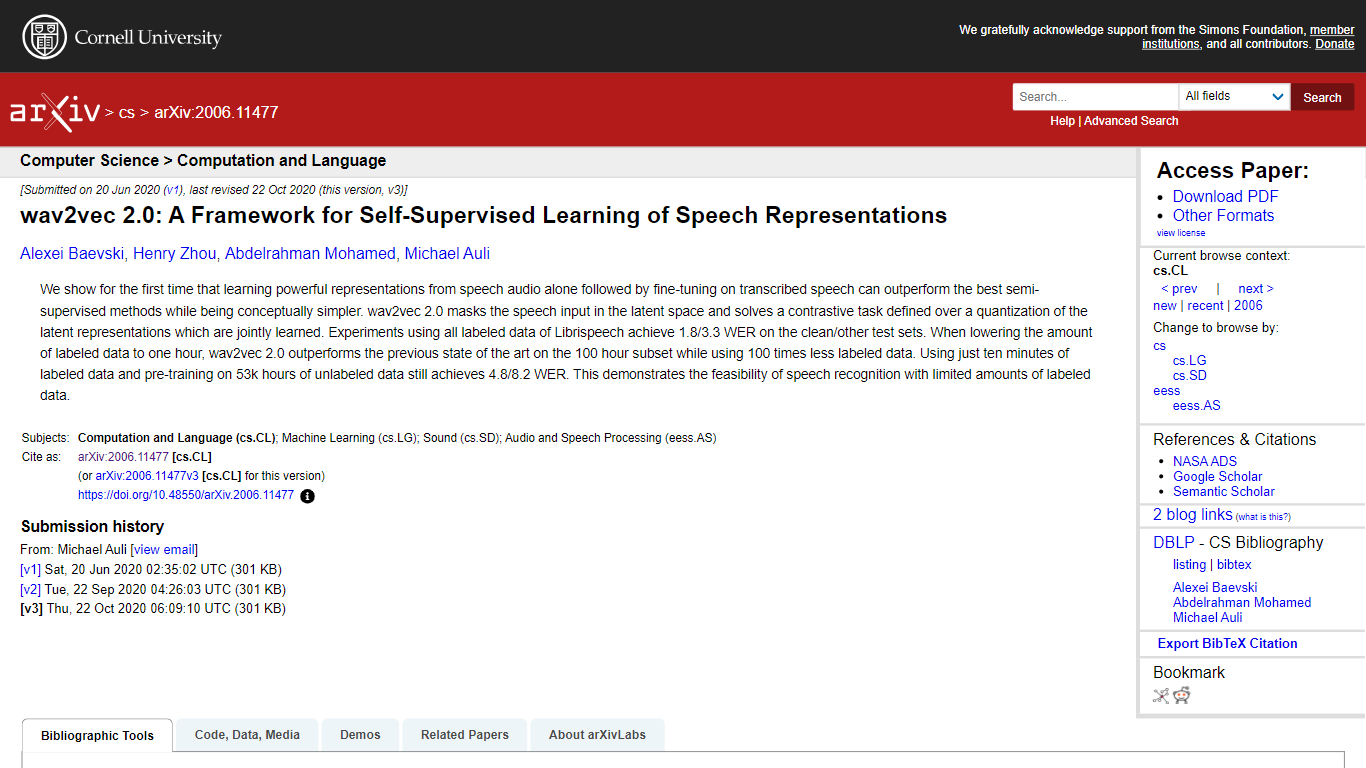

What is wav2vec 2.0?
wav2vec 2.0 is a self-supervised learning framework that learns speech representations directly from raw audio. It masks portions of the speech input in a latent space and solves a contrastive task over quantized latent representations, which are learned jointly with the model. This approach allows the model to leverage large amounts of unlabeled speech data effectively. After pre-training, wav2vec 2.0 can be fine-tuned on small amounts of labeled speech data to achieve state-of-the-art speech recognition performance. The model has demonstrated strong results even when fine-tuned with just minutes of labeled audio, making it highly efficient for low-resource scenarios.
The framework simplifies speech recognition by removing the need for complex semi-supervised pipelines, relying instead on a single end-to-end model. It achieves impressive word error rates on standard benchmarks like Librispeech and TIMIT, outperforming previous methods that require much more labeled data. The quantization of latent speech representations enables the model to learn discrete speech units, which improves robustness and generalization.
wav2vec 2.0 targets researchers and developers working on speech recognition, especially those interested in leveraging unlabeled audio data to reduce annotation costs. Its ability to perform well with limited labeled data opens opportunities for building speech systems in low-resource languages or domains. The model architecture is based on convolutional feature encoders and Transformer networks, allowing it to capture both local and global speech patterns.
Technically, wav2vec 2.0 combines contrastive learning with a masking strategy applied in the latent space, which differs from previous approaches that mask input audio directly. This design choice improves the quality of learned representations. The model is trained on large unlabeled datasets, such as 53,000 hours of speech, and fine-tuned on smaller labeled subsets. This two-stage training process balances scalability and accuracy.
Overall, wav2vec 2.0 represents a significant advance in self-supervised speech representation learning. It reduces reliance on labeled data, simplifies training pipelines, and achieves competitive or superior performance compared to fully supervised or semi-supervised methods. The release of code and pretrained models supports adoption and further research in speech technology.
Stellaris AI
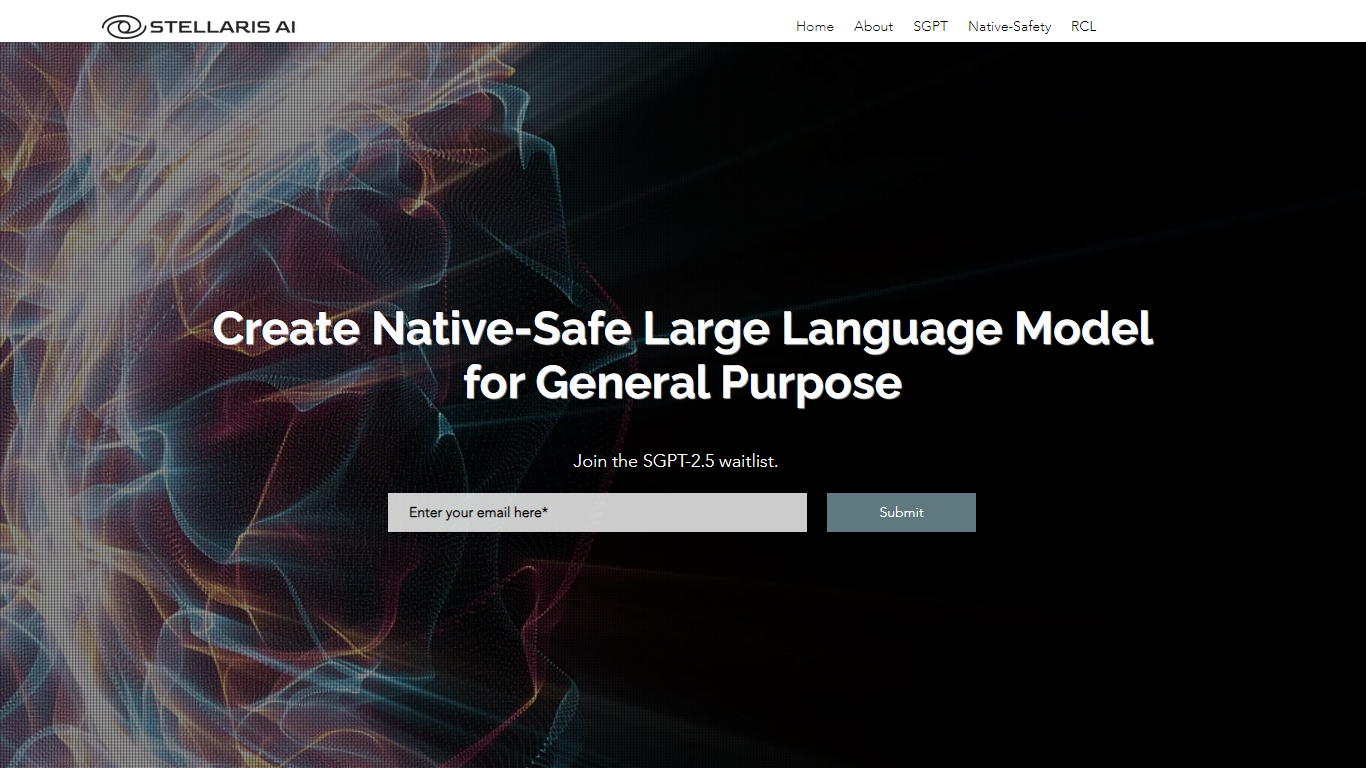
What is Stellaris AI?
Stellaris AI builds large language models marketed around native safety and human-like reasoning for real-world tasks. Its flagship SGPT line targets text and code generation, knowledge Q&A, logical reasoning, and analytics at a scale the company describes as hundreds of billions of parameters. The public site centers on a waitlist for SGPT-4.5 rather than a self-serve chat product you can open today.
Where many LLM labs bolt safety filters on after training, Stellaris AI frames safety as part of the model stack through strict source referencing and harm minimization in the architecture. It also highlights Real-time Context Learning (RCL) for adapting answers with live knowledge, a combination aimed at teams that want cited outputs instead of unchecked generation.
Researchers, enterprise AI teams, and early adopters join the SGPT-4.5 waitlist for first access. The company cites 10+ years of research and three core product pillars: Stellaris GPT, Native Safety, and RCL.
wav2vec 2.0 Upvotes
Stellaris AI Upvotes
wav2vec 2.0 Top Features
Self-supervised pretraining on raw audio 🎧 enables learning from unlabeled speech data
Latent space masking 🎭 improves model focus on context and robustness
Contrastive task over quantized representations 🔄 helps learn discrete speech units
Fine-tuning with minimal labeled data 📝 achieves strong speech recognition accuracy
Transformer-based architecture 🔗 captures long-range speech dependencies effectively
Stellaris AI Top Features
SGPT models described at 100B+ parameters for text, code, and reasoning tasks
Native Safety framework with strict source referencing and harm minimization
Real-time Context Learning (RCL) for live knowledge integration
Three product pillars: Stellaris GPT, Native Safety, and RCL
SGPT-4.5 waitlist open for early access signups on the homepage
wav2vec 2.0 Category
- Large Language Model (LLM)
Stellaris AI Category
- Large Language Model (LLM)
wav2vec 2.0 Pricing Type
- Freemium
Stellaris AI Pricing Type
- Freemium