Web on Demand vs Theneo
Dive into the comparison of Web on Demand vs Theneo and discover which AI Web Apps tool stands out. We examine alternatives, upvotes, features, reviews, pricing, and beyond.
When comparing Web on Demand and Theneo, which one rises above the other?
When we compare Web on Demand and Theneo, two exceptional web apps tools powered by artificial intelligence, and place them side by side, several key similarities and differences come to light. The upvote count is neck and neck for both Web on Demand and Theneo. You can help us determine the winner by casting your vote and tipping the scales in favor of one of the tools.
You don't agree with the result? Cast your vote to help us decide!
Web on Demand


What is Web on Demand?
Web on Demand is a no-code web apps builder for agencies, freelancers, and resellers who need client sites without PHP backends or plugin stacks. It combines drag-and-drop layouts, spreadsheet-style database editing, e-commerce tools, and an AI generator for blogs, product descriptions, and SEO metadata. Sites run on HTML and CSS, and edits happen on the live page through embedded controls instead of a separate admin dashboard.
Where WordPress or Webflow charge monthly subscriptions and hide editing behind a backend, Web on Demand sells one-time licenses starting at $1,000 and lets you click text on the published page to change it. That fits white-label workflows where clients expect to update copy themselves. The trade-off is the upfront license cost and the HTML/CSS skills needed for fully custom layouts.
Freelancers, design studios, and ISP partners use it to ship e-commerce stores, landing pages, and branded website storefronts. The AI generator helps teams draft SEO-friendly blog posts and product copy without hiring a writer for every SKU. Resellers on the Storefront plan can earn a 20% share of client hosting fees sold through their store.
Theneo
What is Theneo?
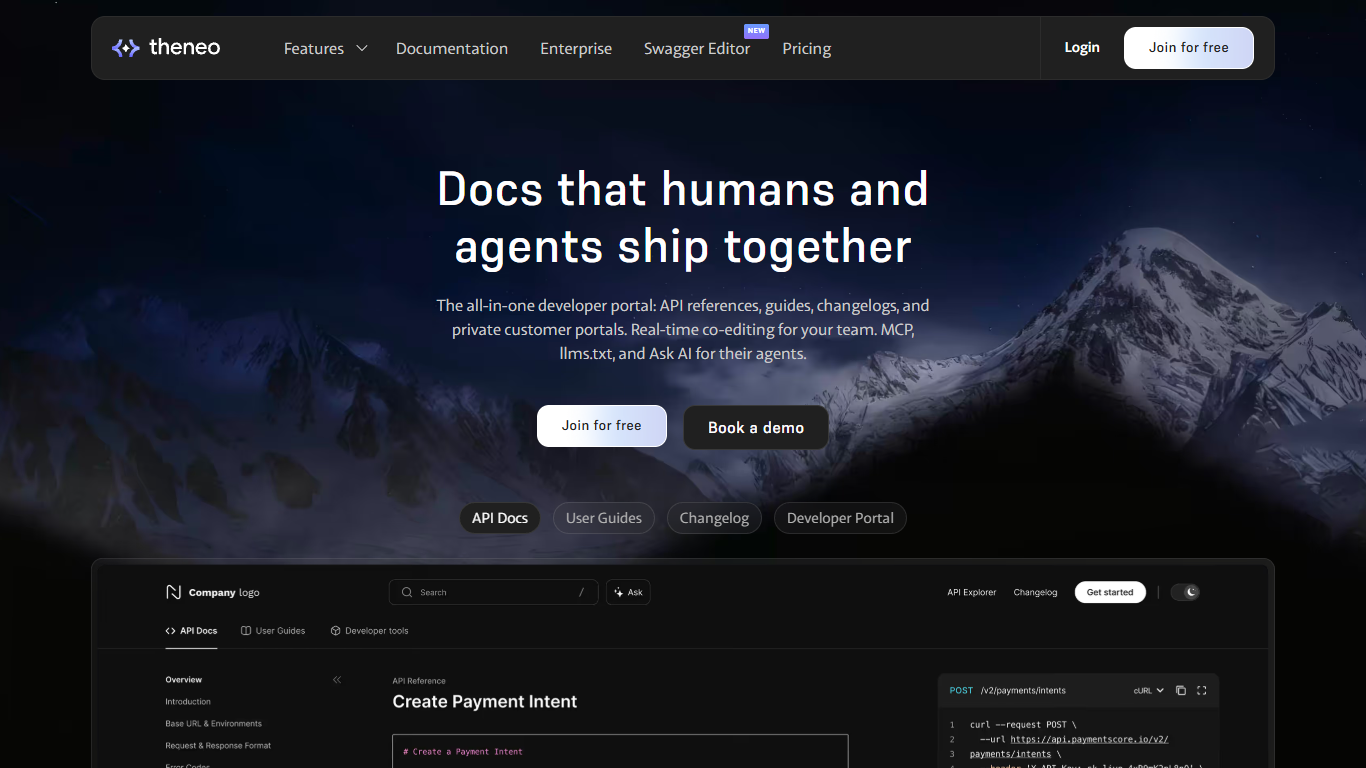
Theneo is a developer portal and API documentation web app where your team publishes references, guides, changelogs, and private customer hubs from one workspace. Upload OpenAPI, Postman, or GraphQL specs, or connect GitHub, GitLab, or Bitbucket, and Theneo generates interactive reference pages with code samples and a built-in Try-it console. More than 15,000 teams use it for docs that stay tied to the API instead of drifting in a separate writing tool.
Most API doc stacks split engineers and writers across export cycles: specs leave the repo, copy lands in a docs CMS, and nobody updates both when the API changes. Theneo keeps engineers, writers, PMs, and coding agents in the same documents with live cursors, inline comments, and version history. It also ships MCP server support, llms.txt, and Ask AI so customer agents can query your docs, not just humans reading static pages.
B2B API companies use Theneo when one public docs site is not enough. You can spin up authenticated portals per customer, restrict which APIs each account sees, and apply custom branding per segment. Enterprise teams pick it for SOC 2 Type II coverage, SAML SSO, optional self-hosting on AWS, Azure, or Google Cloud, and breaking-change alerts tied to CI deploys.
Web on Demand Upvotes
Theneo Upvotes
Web on Demand Top Features
Basic license costs $1,000 as a one-time payment with no recurring platform subscription
AI generator drafts full blog posts from a short prompt and suggests keywords plus meta descriptions from a page title
Edit content on the live site with embedded controls instead of logging into a backend admin panel
Import e-commerce inventory from Google Sheets or Microsoft Excel in one click
Supports 64 languages with LTR and RTL layouts on published sites
Hosting runs on AWS with HTTPS encryption included on every business plan
Theneo Top Features
Free Starter plan includes 1 public project, 2 private projects, and up to 20 team members
Generates docs from OpenAPI 2.0/3.x, Postman collections, GraphQL schemas, or Git repos on GitHub, GitLab, and Bitbucket
Business plan at $120 per month on annual billing supports up to 7 projects and 5,000 API endpoints
Multi-language code samples in cURL, Python, JavaScript, Go, Java, Ruby, and PHP
MCP server and llms.txt expose documentation to coding agents alongside human readers
Enterprise adds SAML SSO, OAuth 2.0, and optional self-hosting on Kubernetes
Web on Demand Category
- Web Apps
Theneo Category
- Web Apps
Web on Demand Pricing Type
- Paid
Theneo Pricing Type
- Freemium