
Last updated 07-30-2026
Category:
Reviews:
Join thousands of AI enthusiasts in the World of AI!
Theneo
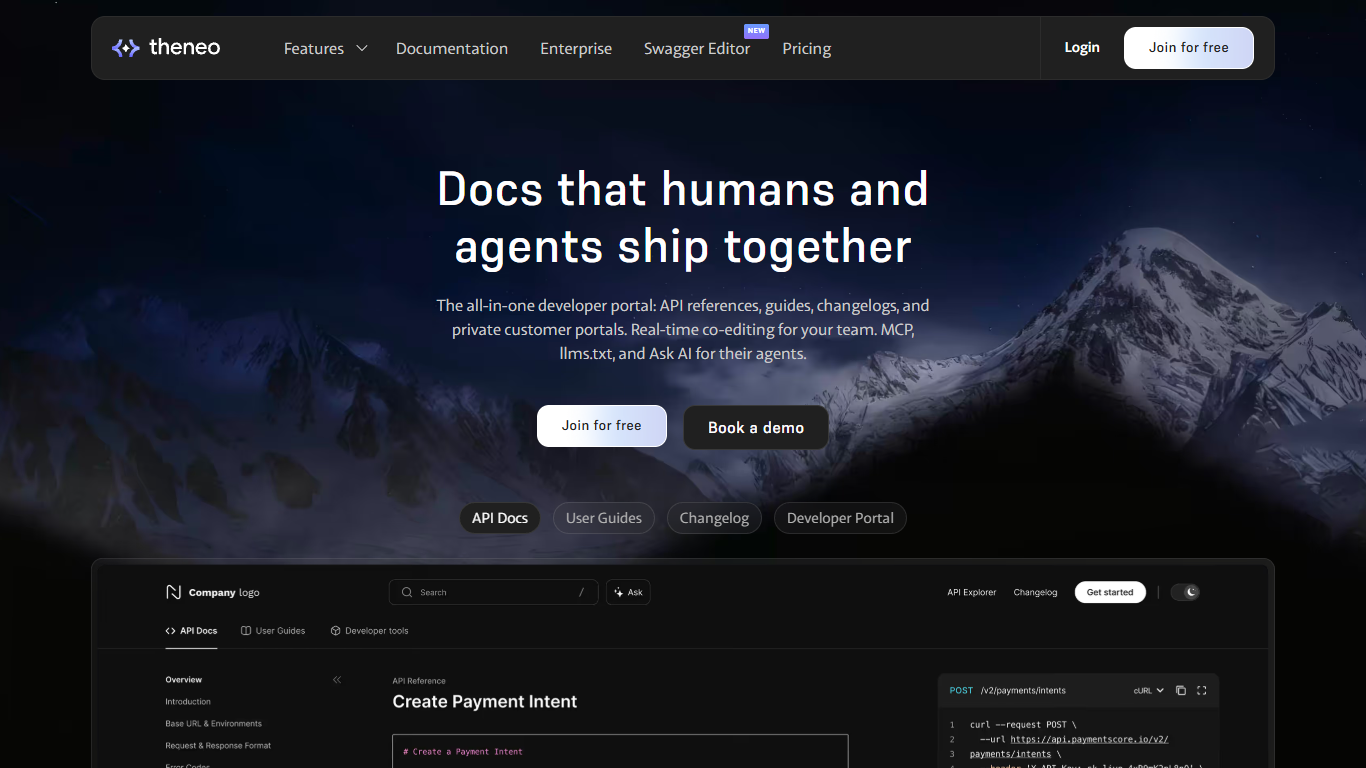
Theneo is a developer portal and API documentation web app where your team publishes references, guides, changelogs, and private customer hubs from one workspace. Upload OpenAPI, Postman, or GraphQL specs, or connect GitHub, GitLab, or Bitbucket, and Theneo generates interactive reference pages with code samples and a built-in Try-it console. More than 15,000 teams use it for docs that stay tied to the API instead of drifting in a separate writing tool.
Most API doc stacks split engineers and writers across export cycles: specs leave the repo, copy lands in a docs CMS, and nobody updates both when the API changes. Theneo keeps engineers, writers, PMs, and coding agents in the same documents with live cursors, inline comments, and version history. It also ships MCP server support, llms.txt, and Ask AI so customer agents can query your docs, not just humans reading static pages.
B2B API companies use Theneo when one public docs site is not enough. You can spin up authenticated portals per customer, restrict which APIs each account sees, and apply custom branding per segment. Enterprise teams pick it for SOC 2 Type II coverage, SAML SSO, optional self-hosting on AWS, Azure, or Google Cloud, and breaking-change alerts tied to CI deploys.
Free Starter plan includes 1 public project, 2 private projects, and up to 20 team members
Generates docs from OpenAPI 2.0/3.x, Postman collections, GraphQL schemas, or Git repos on GitHub, GitLab, and Bitbucket
Business plan at $120 per month on annual billing supports up to 7 projects and 5,000 API endpoints
Multi-language code samples in cURL, Python, JavaScript, Go, Java, Ruby, and PHP
MCP server and llms.txt expose documentation to coding agents alongside human readers
Enterprise adds SAML SSO, OAuth 2.0, and optional self-hosting on Kubernetes
Live co-editing keeps engineers, writers, and PMs in one doc instead of export handoffs
Git sync and CI hooks update references when specs change on deploy
Per-customer private portals with SSO and granular API access controls
Changelog and breaking-change detection included without a separate add-on
Paid tiers start at $120 per month on annual billing, which is steep for small API products
Free plan caps GPT-powered reader search at 100 results and TheneoAI assistance at 2,000 uses
Full self-hosting and custom SAML SSO require the Enterprise plan
Is Theneo free to use?
Yes, Theneo offers a free Starter plan with 1 public project, 2 private projects, and up to 20 team members. The free tier includes 100 GPT-powered reader search results and 2,000 TheneoAI doc builder assists per workspace. Paid Business and Growth plans add more projects, unlimited AI search, and custom domains.
What API formats does Theneo support?
Theneo accepts REST, AsyncAPI, SOAP, GraphQL, and gRPC specifications when building API references. You can upload OpenAPI 2.0 or 3.x files, Postman collections, or connect Git repositories. Theneo also exports projects back to OpenAPI and Markdown formats.
Does Theneo sync with GitHub?
Yes, Theneo syncs with GitHub, GitLab, and Bitbucket so documentation rebuilds when your API spec changes in CI. It supports preview deployments, breaking-change alerts, and automatic changelog generation from spec diffs. You can also edit docs in Theneo's web editor and deploy without Git.
Does Theneo offer private customer portals?
Yes, Theneo lets you create authenticated portals where each customer sees only the APIs, guides, and SDKs tied to their account. You can send email invites, enable SAML SSO or OAuth logins, and apply custom branding per customer segment. Analytics show which customers read which docs.
What security certifications does Theneo hold?
Theneo is SOC 2 Type II certified and lists ISO 27001, ISO 9001, and GDPR compliance on its security page. Data at rest uses AES-256 encryption and data in transit uses TLS 1.3. Enterprise customers can choose EU data residency or self-host on their own infrastructure.
Does Theneo include API testing in docs?
Yes, Theneo includes an API Explorer Try-it console on reference pages so developers send live requests from the docs. It supports API keys, OAuth 2.0, and OIDC authentication across sandbox and production environments. Sensitive values like API keys are masked in the explorer UI.