
Last updated 07-16-2026
Category:
Reviews:
Join thousands of AI enthusiasts in the World of AI!
dstack
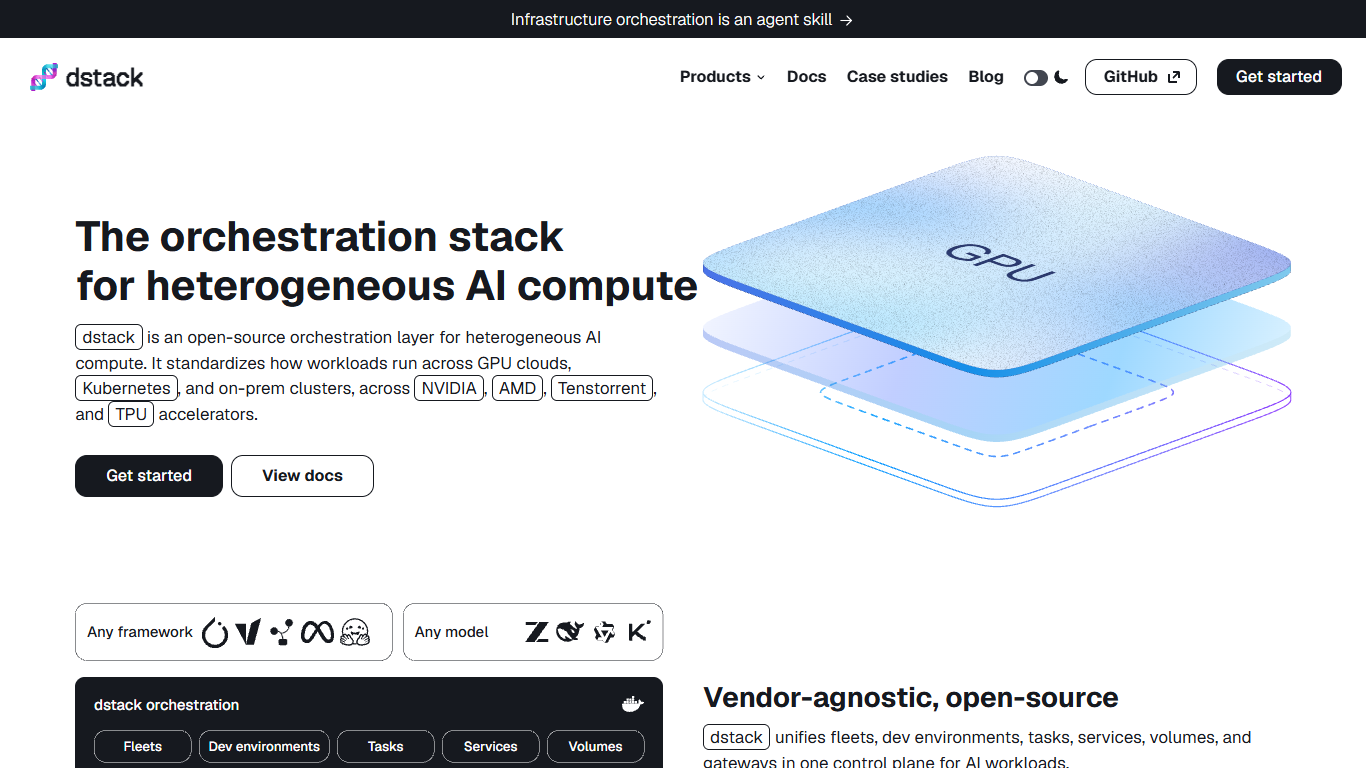
dstack is an open-source orchestration layer for heterogeneous AI compute. It gives ML teams one control plane to provision GPUs, schedule workloads, and run development, training, and inference across GPU clouds, Kubernetes clusters, and on-prem hardware.
The platform standardizes how containerized AI jobs run on NVIDIA, AMD, Tenstorrent, and TPU accelerators. You define fleets, dev environments, tasks, services, and volumes as YAML in your repo, then apply them through a CLI, web UI, or HTTP API without managing Kubernetes or Slurm directly.
dstack fits teams that juggle multiple cloud accounts or bare-metal clusters and want a single workflow from local experiments to distributed training and production inference. It also offers dstack Sky, a hosted GPU marketplace, plus an enterprise option with SSO and air-gapped deployment.
Provision fleets across AWS, GCP, Lambda, RunPod, and other GPU clouds from one config
Spin up remote dev environments with VS Code, Cursor, or SSH in a single command
Run single-node or distributed training tasks with retry, scheduling, and spot policies
Deploy model inference as scalable services with auto-scaling and ingress handled for you
Connect existing Kubernetes clusters or SSH-accessible bare-metal hosts as backends
Supports NVIDIA, AMD, TPU, and Tenstorrent accelerators out of the box
Open-source control plane you can self-host at no license cost
Single YAML-based workflow across multiple GPU clouds and on-prem clusters
Purpose-built primitives for dev environments, distributed training, and inference
Supports spot instances, retry policies, and GPU utilization monitoring
Documented examples for TRL, Axolotl, vLLM, SGLang, and major cloud providers
Self-hosted setup requires configuring cloud backends and credentials before first use
CLI on Windows depends on Git for Windows and OpenSSH via WSL-style tooling
dstack Sky GPU hourly rates vary by instance type and availability
Enterprise pricing requires a sales conversation rather than self-serve checkout
Is dstack free to use?
Yes. dstack is open source and can be self-hosted at no cost via pip, uv, or Docker. dstack Sky adds pay-as-you-go GPU marketplace access, and enterprise deployments with SSO and dedicated support require contacting the dstack team.
What cloud providers does dstack support?
dstack integrates with major GPU clouds including AWS, GCP, Azure, Lambda, Nebius, Crusoe, RunPod, Verda, DigitalOcean, and JarvisLabs. You provide credentials and dstack provisions compute in your own cloud accounts.
Can dstack run on existing Kubernetes clusters?
Yes. dstack connects to Kubernetes clusters through a kubeconfig file and schedules dev environments, tasks, and services on them. You can also use VM-based cloud backends or SSH fleets for bare-metal servers.
How does dstack differ from Kubernetes or Slurm?
dstack orchestrates containers like Kubernetes but offers a streamlined, ML-native interface with primitives for dev environments, distributed tasks, and inference services. Unlike Slurm, it supports interactive development and production inference alongside batch training jobs.
What is dstack Sky?
dstack Sky is a hosted GPU marketplace managed by dstack. It lets you access marketplace GPUs without your own cloud accounts, with hourly rates starting around $0.80/hr for L40S and $1.90/hr for H100, and can run alongside your own cloud backends.
What hardware accelerators does dstack support?
dstack supports NVIDIA, AMD, TPU, and Tenstorrent accelerators. The documentation includes examples for AMD, Tenstorrent, and TPU workloads alongside standard NVIDIA GPU training and inference.