
Last updated 08-21-2026
Category:
Reviews:
Join thousands of AI enthusiasts in the World of AI!
MLflow
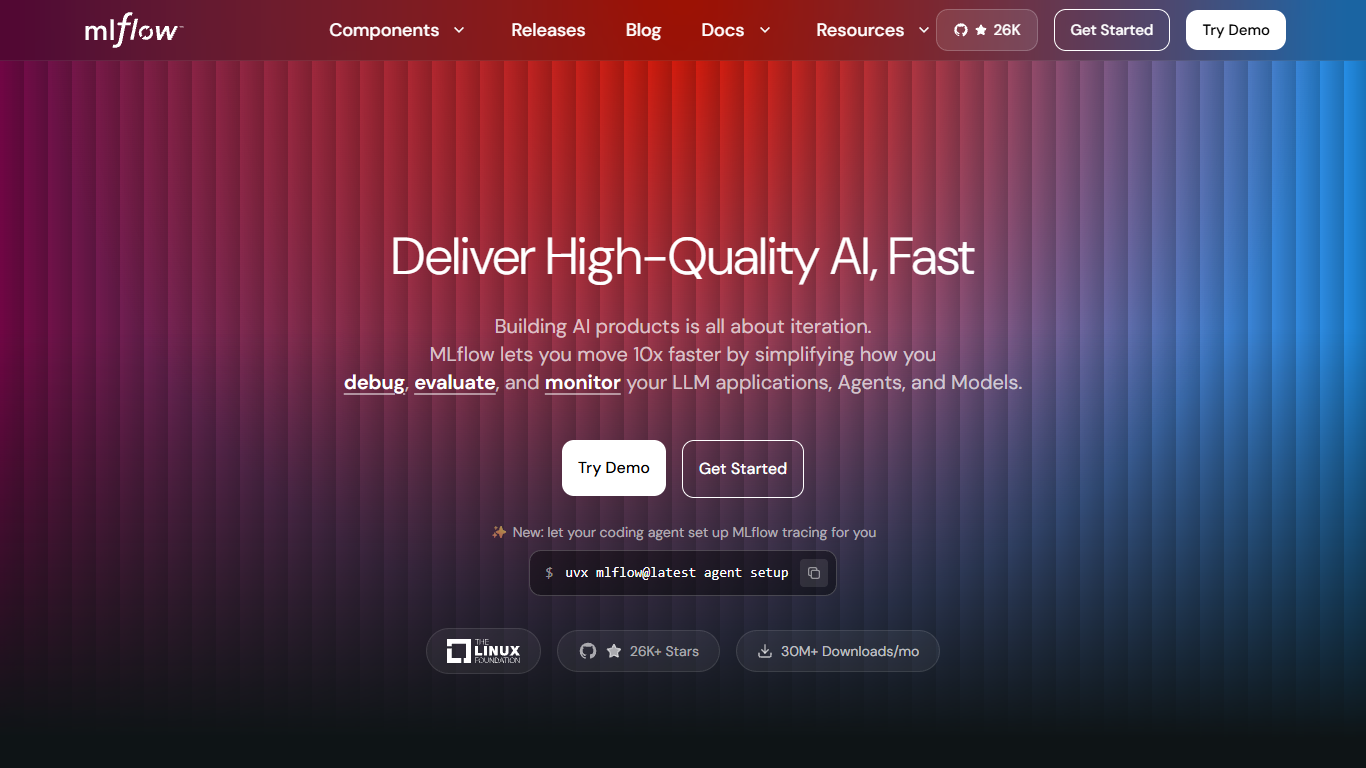
MLflow is the largest open source AI engineering platform for agents, LLMs, and traditional machine learning models. Teams use it to debug, evaluate, monitor, and optimize AI applications in production while controlling costs and model access. With 30 million monthly package downloads and 26,000+ GitHub stars, it is one of the most widely adopted tools for shipping AI with confidence.
Most observability tools focus on either classical ML experiments or LLM traces, not both. MLflow spans GenAI tracing with OpenTelemetry compatibility and classical experiment tracking, model registry, and deployment in one Apache 2.0 platform, so teams do not split tooling when they add agents on top of existing models.
ML engineers, data scientists, and platform teams at startups and Fortune 500 companies rely on MLflow to iterate faster without vendor lock-in. It integrates with 100+ frameworks including LangChain, OpenAI, PyTorch, and scikit-learn, supports Python, TypeScript, Java, and R, and runs locally, on-premises, or in any cloud. The project is Apache 2.0 licensed and backed by the Linux Foundation.
OpenTelemetry-compatible tracing captures every prompt, retrieval, and tool call
50+ built-in evaluation metrics plus LLM-as-a-judge scorers for quality testing
Prompt Registry versions prompts with lineage and automated optimization
AI Gateway routes requests across LLM providers through one OpenAI-compatible API
Agent Server deploys agents to production with streaming and built-in tracing
Experiment tracking logs parameters, metrics, artifacts, and code for ML runs
Integrates with LangChain, OpenAI, PyTorch, and 100+ other AI frameworks
Apache 2.0 open source with no vendor lock-in across clouds, frameworks, and LLM providers.
Covers both LLMOps and classical MLOps in one platform from tracing to model registry.
30 million monthly downloads and 26,000+ GitHub stars signal broad industry adoption.
OpenTelemetry-compatible tracing integrates with existing observability infrastructure.
Start locally with a single command and minimal code changes via autologging.
Self-hosted deployments require operational effort to run and maintain the tracking server.
The breadth of features across GenAI and classical ML can feel overwhelming for newcomers.
No managed SaaS offering from the MLflow project itself; production hosting is self-managed.
Is MLflow free to use?
Yes. MLflow is 100% open source under the Apache 2.0 license with no licensing fees. You can self-host the MLflow server locally or on your own infrastructure, and the core platform features are free to use.
What programming languages does MLflow support?
MLflow supports Python, TypeScript and JavaScript, Java, and R. The documentation covers SDKs and autologging integrations across these languages, with Python being the most widely documented.
What LLM providers and agent frameworks work with MLflow?
MLflow integrates with OpenAI, Anthropic, Gemini, Amazon Bedrock, LangChain, LangGraph, LlamaIndex, CrewAI, AutoGen, Vercel AI, LiteLLM, and dozens more. The site lists 100+ integrations across LLM providers and agent frameworks.
How do I get started with MLflow?
Run `uvx mlflow server` to start a local tracking server in about 30 seconds. Then set your tracking URI and enable autologging for your framework, such as `mlflow.openai.autolog()` for LLM apps or `mlflow.sklearn.autolog()` for scikit-learn models.
Does MLflow support OpenTelemetry?
Yes. MLflow Tracing is fully compatible with OpenTelemetry and supports GenAI Semantic Conventions. This lets teams integrate MLflow traces with existing observability stacks without vendor lock-in.
Can MLflow be used in enterprise organizations?
Yes. MLflow is battle-tested at scale by Fortune 500 companies and thousands of teams. It runs on-premises, in any cloud, or through managed services, and recent releases add role-based access control for LLM team management.