
Last updated 08-22-2026
Category:
Reviews:
Join thousands of AI enthusiasts in the World of AI!
Neptune
Neptune was an experiment tracking platform for machine learning teams that logged training runs, compared metrics across thousands of jobs, and surfaced gradient or loss spikes during model development. Researchers used it to monitor per-layer losses, activations, and logs while training foundation-scale models.
Where notebook exports and spreadsheet tabs break down at GPT-scale training, Neptune indexed runs in one searchable UI so teams could diff hyperparameters, replay charts without lag, and debug unstable jobs before burning more GPU hours. OpenAI collaborated with Neptune on training dashboards before acquiring the company in December 2025.
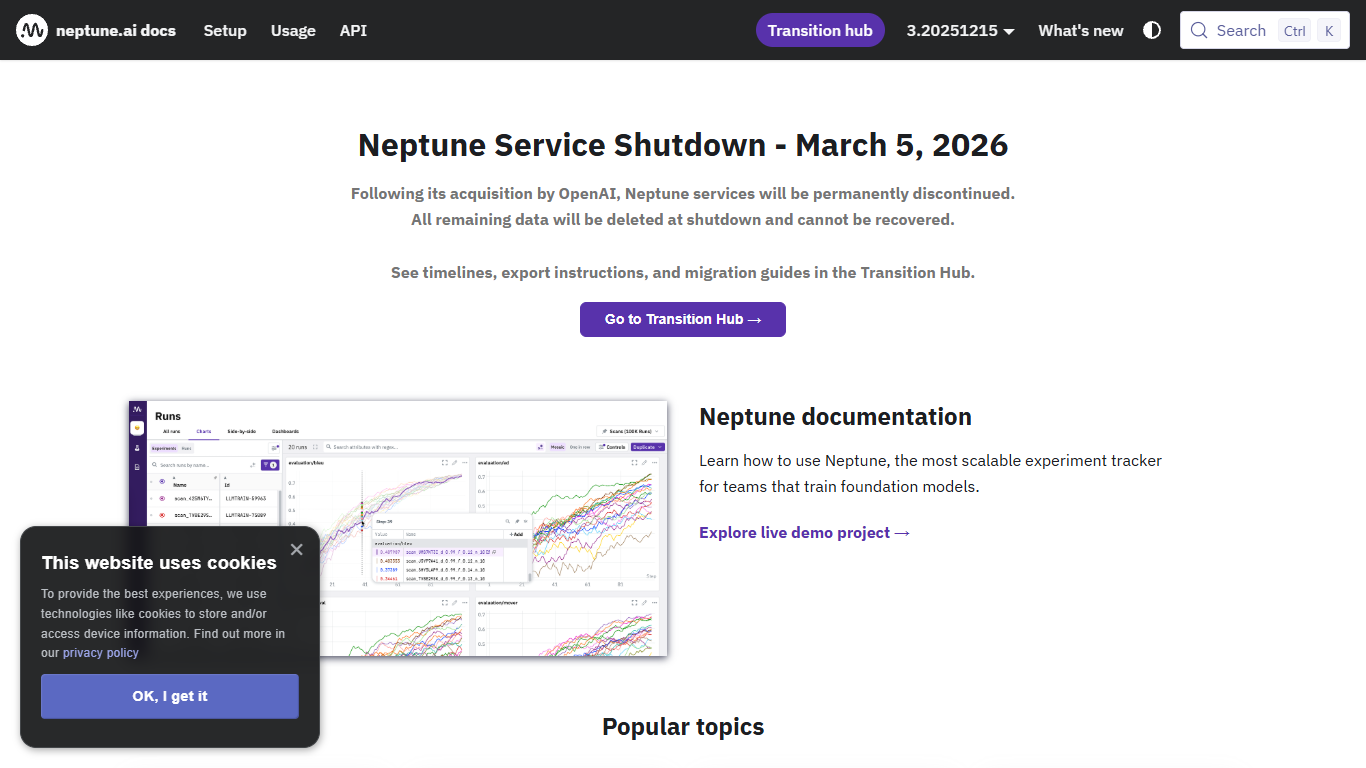
The hosted Neptune SaaS service shut down on March 6, 2026 after the acquisition, and neptune.ai now redirects to OpenAI's announcement. Historical users included ML engineers, research labs, and enterprises running large fine-tuning or pretraining workloads who needed experiment lineage and artifact storage.
Tracked thousands of concurrent training runs with per-layer loss, gradient, and activation metrics
Compared experiments side by side without chart lag or missed spikes
Stored run metadata, parameters, metrics, logs, artifacts, and dashboards in one workspace
Integrated with Python training loops through the Neptune SDK and API
Supported enterprise self-hosted deployments alongside the hosted SaaS product
Collaborated with OpenAI on foundation-model training visibility before the 2025 acquisition
Handled thousands of concurrent runs with responsive metric charts for large training jobs.
Deep experiment comparison and artifact storage suited foundation-model research teams.
Offered both hosted SaaS and self-hosted enterprise deployments before shutdown.
Hosted service is permanently discontinued after the OpenAI acquisition.
neptune.ai redirects to OpenAI and no data export path remains post-shutdown.
Product no longer accepts new signups or API logging after March 6, 2026.
What happened to Neptune?
OpenAI acquired Neptune in December 2025, and Neptune discontinued its hosted SaaS on March 6, 2026. Neptune now redirects to OpenAI's acquisition page, and remaining hosted data was permanently deleted after shutdown.
What did Neptune do?
Neptune logged ML training experiments, compared runs, and helped researchers debug model training with metrics, logs, and artifacts in one UI. Neptune focused on large-scale jobs where teams needed to monitor thousands of layers and runs at once.
Can I still use Neptune?
No. Neptune shut down hosted login, APIs, and the UI after March 6, 2026, and neptune.ai redirects away from the product. Neptune's support docs state there is no export or recovery path for data deleted at shutdown.
Who acquired Neptune?
OpenAI entered a definitive agreement to acquire Neptune in December 2025 to integrate experiment tracking into its internal training stack. Neptune CEO Piotr Niedźwiedź said the team would build training tools inside OpenAI after the deal.
What were alternatives to Neptune?
Neptune's transition hub pointed users toward tools such as Weights and Biases, MLflow, Comet, Lightning AI, and ZenML when migrating off the platform. Neptune competed in the same experiment-tracking category as TensorBoard for large training workflows.
Where was Neptune based?
Neptune was founded in 2017 and listed headquarters at 2100 Geng Rd, Palo Alto, California. Neptune raised about $12.7 million in venture funding before the OpenAI acquisition.