
Last updated 08-30-2026
Category:
Reviews:
Join thousands of AI enthusiasts in the World of AI!
Ottermind
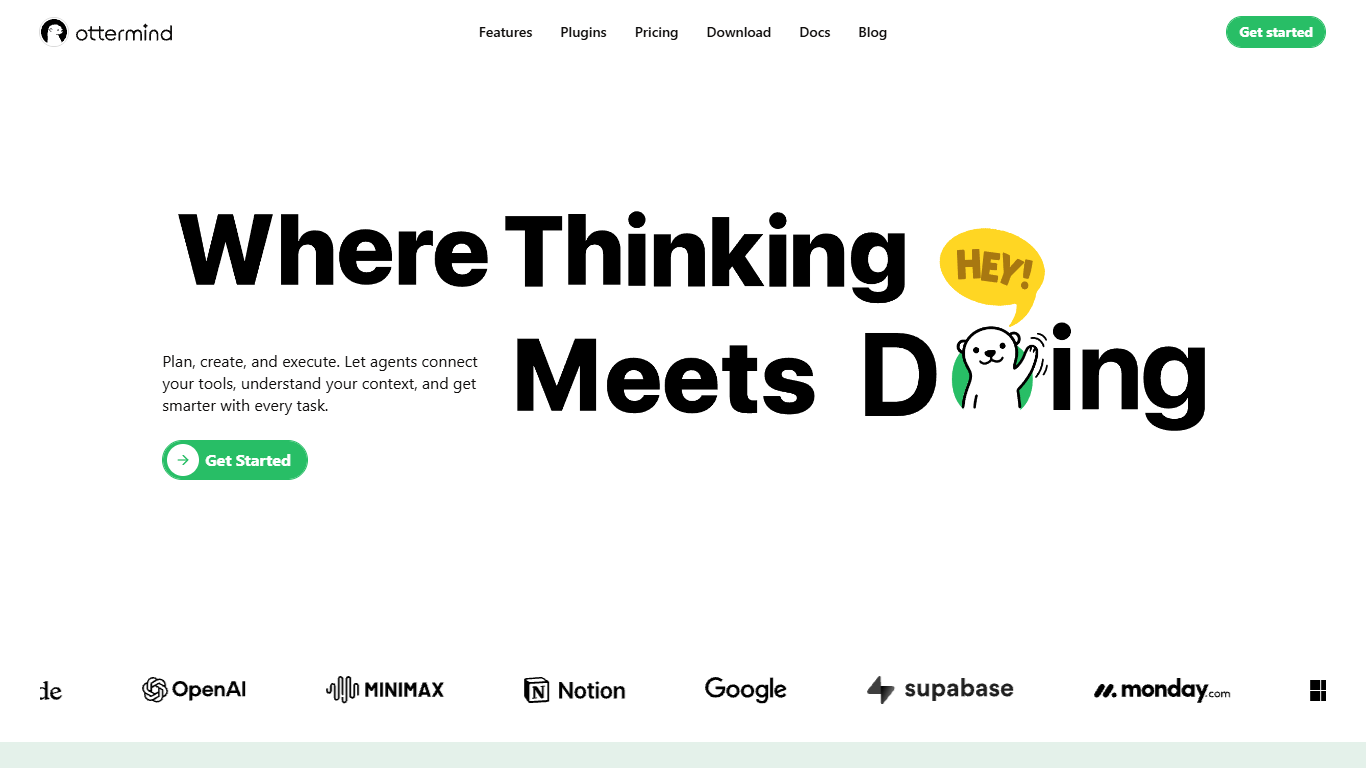
Ottermind is an agent workspace that turns rough ideas, files, and recordings into finished deliverables like slide decks, websites, images, and short videos. You describe the outcome you want, and agents plan the steps, pick models, and connect your tools until something editable lands on screen. It runs in the browser, on desktop, and on mobile, with longer jobs continuing in the cloud after you close the tab.
Unlike a single-model chatbot where you choose GPT or Claude yourself, Ottermind routes each job to whichever model it considers strongest for that format. Conversation might run on Gemini 3.5 Flash or GPT-5.6 Sol, slides on GPT Image 2, and video on Seedance 2.5 or HappyHorse 1.1, without you switching apps or comparing model cards. That model-mixing approach trades one-chat simplicity for output that matches how different vendors actually specialize.
Solo users on the $20 Solo plan get 2,000 monthly credits and one IM workspace hookup. Teams on Squad or Colony gain faster cloud sandboxes, more credits, and multi-agent orchestration when one thread is not enough. If your work already lives in Gmail, Slack, Notion, or GitHub, MCP connectors let agents act inside those tools instead of pasting exports back and forth.
The Skills marketplace covers coding, documents, data, and browser automation, and you can chain them into repeatable workflows. Critical actions ask for approval before they run, which matters when an agent has keys to your stack.
Routes conversation, image, and video tasks across Claude Fable 5, GPT-5.6 Sol, Midjourney, and Seedance 2.5 without manual model picks
Solo plan includes 2,000 monthly credits, roughly 80 slide decks or 1,333 images per month
MCP connectors for Gmail, Slack, Notion, GitHub, and Zapier included on every paid plan
Cloud agents keep running after you close the browser tab
Colony plan includes a 4-core, 8GB RAM elite cloud sandbox for heavy automation
Skills marketplace with official, coding, document, data, and browser categories
Routes each task to a specialized frontier model instead of forcing one chat model to handle slides, images, and video.
Cloud agents continue working after you close the browser, so longer tasks do not need you to babysit a tab.
MCP connectors let agents act inside Gmail, Slack, Notion, GitHub, and Zapier instead of only generating text.
Projects sync across web, desktop, mobile, and IM channels so you can start a task on one device and review on another.
Critical agent actions require your approval before execution, which limits surprise changes to connected tools.
No permanent free tier; the Solo plan is $20 per month after the introductory month.
Credit limits can interrupt heavy workflows, and refills cost extra on top of the subscription.
iOS subscriptions purchased in the app are managed through Apple, separate from web billing.
Heavy multi-step automations burn credits faster than quick chats, so power users may need refills or a higher plan.
Does Ottermind have a free plan?
No. Ottermind is a paid subscription service with Solo starting at $20 per month. New users can try Ottermind before committing, and the pricing page shows the trial offer on each plan card.
How much does Ottermind cost?
Ottermind offers three plans: Solo at $20 per month, Squad at $49 per month, and Colony at $200 per month. Yearly billing saves 20%. Credit refills cost $10 for 1,000 credits or $20 for 2,500 credits.
What integrations does Ottermind support?
Ottermind connects to Gmail, Slack, Notion, GitHub, and Zapier through MCP connectors on every plan. IM workspace integrations cover Slack, DingTalk, and Telegram, with limits of 1, 5, or unlimited workspaces depending on your plan.
What platforms does Ottermind run on?
Ottermind runs in the browser and offers desktop apps for macOS 13 or later and Windows 10 or later, plus mobile apps for iOS and Android. Projects, chats, and results sync across all devices in real time.
What are Ottermind credits?
Credits are the usage unit Ottermind agents consume when running tasks. The Solo plan includes 2,000 monthly credits, roughly 80 slide decks or 1,333 images. Heavier multi-step automations use more credits than quick conversations.
How is Ottermind different from ChatGPT?
ChatGPT answers questions in a thread. Ottermind retains project memory, orchestrates agents across connected tools, and carries tasks through to finished deliverables like decks, videos, and websites. Critical actions also require your approval before execution.
What models does Ottermind use?
Ottermind picks models per task rather than locking you to one. Its site lists Claude Fable 5 for long autonomous work, GPT-5.6 Sol for reasoning, Gemini 3.5 Flash for chat, GPT Image 2 for slides, and Seedance 2.5 or HappyHorse 1.1 for video.