
Last updated 08-22-2026
Category:
Reviews:
Join thousands of AI enthusiasts in the World of AI!
APIDot
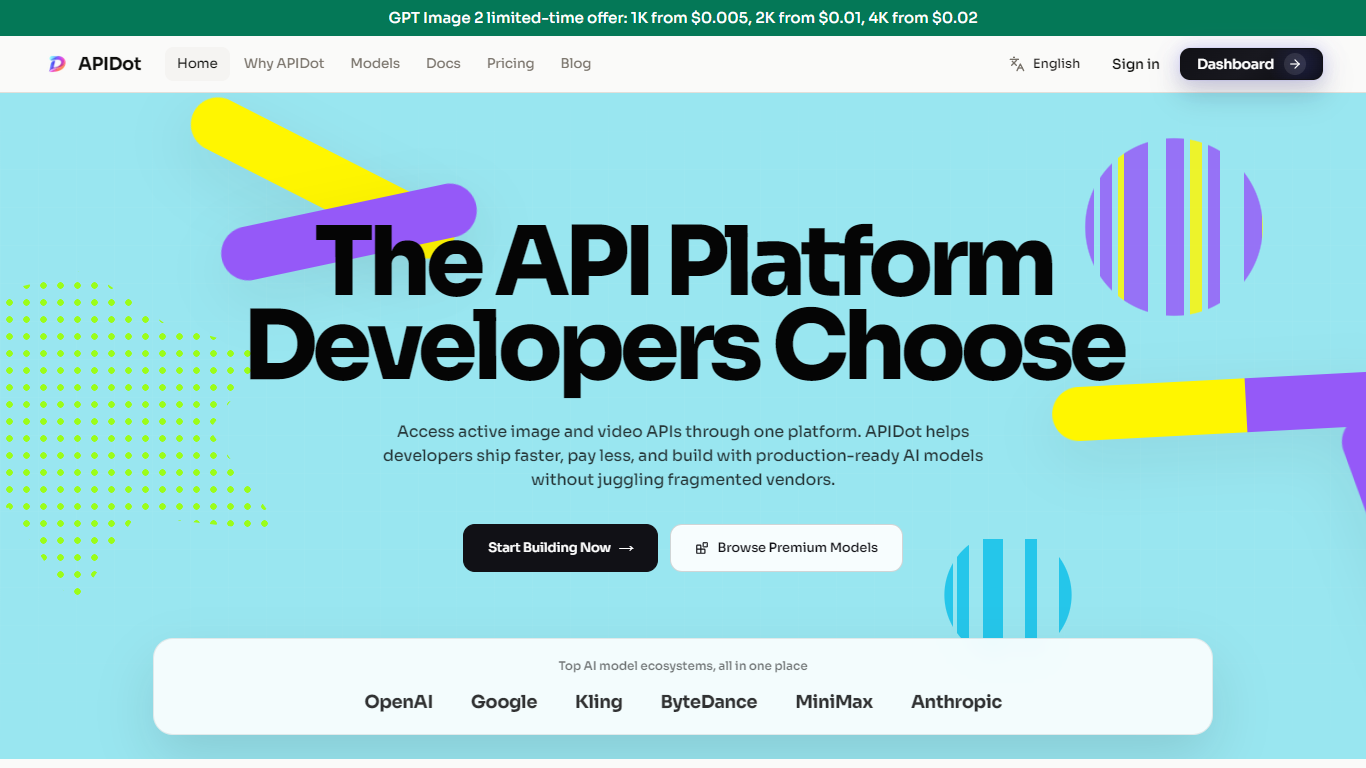
APIDot routes image, video, music, chat, and 3D generation through one account and one async workflow for backend teams. Developers get a single API key, submit generation tasks to api.apidot.ai, and retrieve results through polling or webhooks instead of wiring up separate vendor integrations.
Unlike juggling direct accounts with OpenAI, Google, ByteDance, and Anthropic, APIDot aggregates 75 listed models behind one submit contract with published per-model credit rates. You validate payloads in the playground on a model page, then ship the same request shape in production across GPT Image 2, Seedance 2.5, Sora 2, Claude Opus 5, and Meshy 6 3D without rewriting your integration layer.
Backend engineers and product teams use it when they need production media APIs without managing fragmented billing, auth, or vendor accounts. Teams building ad creatives, ecommerce visuals, short-form video, music prototypes, or multimodal assistants can swap models by changing a model ID rather than rebuilding vendor-specific clients.
75 models across image, video, music, chat, and 3D APIs on one async submit endpoint
Seedance 2.5 supports 4 to 30 second scenes with up to 50 combined reference inputs
GPT Image 2 from $0.005 per generation with published Fal price comparisons
Webhook callbacks and task status polling for async media jobs
Bearer API key authentication with server-side key rotation guidance
llms.txt docs index for agent-assisted integration in Cursor or Claude
Failed generation tasks do not consume credits per APIDot billing policy
One API key and async contract across 75 image, video, music, chat, and 3D models
Failed generation tasks do not consume credits according to APIDot policy
Published per-model pricing with Fal price comparisons on the pricing page
Webhook and polling options documented for production async workflows
Usage-based credit billing only; no free tier is advertised on the pricing page.
Music and media tasks use separate webhook and detail query endpoints.
Low public domain authority suggests the platform is still early in market reach.
How does APIDot pricing work?
APIDot uses transparent credit-based billing with pay-as-you-go pricing and no tiers or minimum commitments. Per-model rates are listed on the pricing page, for example GPT Image 2 from $0.005 per generation and Seedance 2.5 from $0.085 per request.
Does APIDot charge for failed generations?
No. APIDot states that failed generation tasks do not consume credits, so teams can retry or test high-volume workflows without paying for unsuccessful runs.
What API modalities does APIDot support?
APIDot covers image, video, music, chat, and 3D generation through one unified async workflow. The models catalog lists 75 APIs including GPT Image 2, Seedance 2.5, Claude Opus 5, MiniMax Music 2.6, and Meshy 6 3D.
How do I authenticate with the APIDot API?
All APIDot requests use Bearer API keys passed in the Authorization header. The docs recommend keeping keys on the server side and rotating them deliberately rather than exposing them in client apps.
How do I receive results from APIDot async tasks?
APIDot supports two delivery paths: poll the Get Task Status endpoint for media jobs, or pass a callback_url when submitting to receive terminal updates via webhook. Music tasks have a separate detail query and webhook format documented in the API reference.
Can I test APIDot before integrating in production?
Yes. APIDot provides a playground on each model page where you can validate request payloads before submitting the same shape through the production async endpoint with your API key.
What support channels does APIDot offer?
APIDot lists professional technical support through Discord, Telegram, and email for production API users, alongside published docs covering authentication, rate limits, errors, and retries.