
Last updated 08-21-2026
Category:
Reviews:
Join thousands of AI enthusiasts in the World of AI!
Qdrant
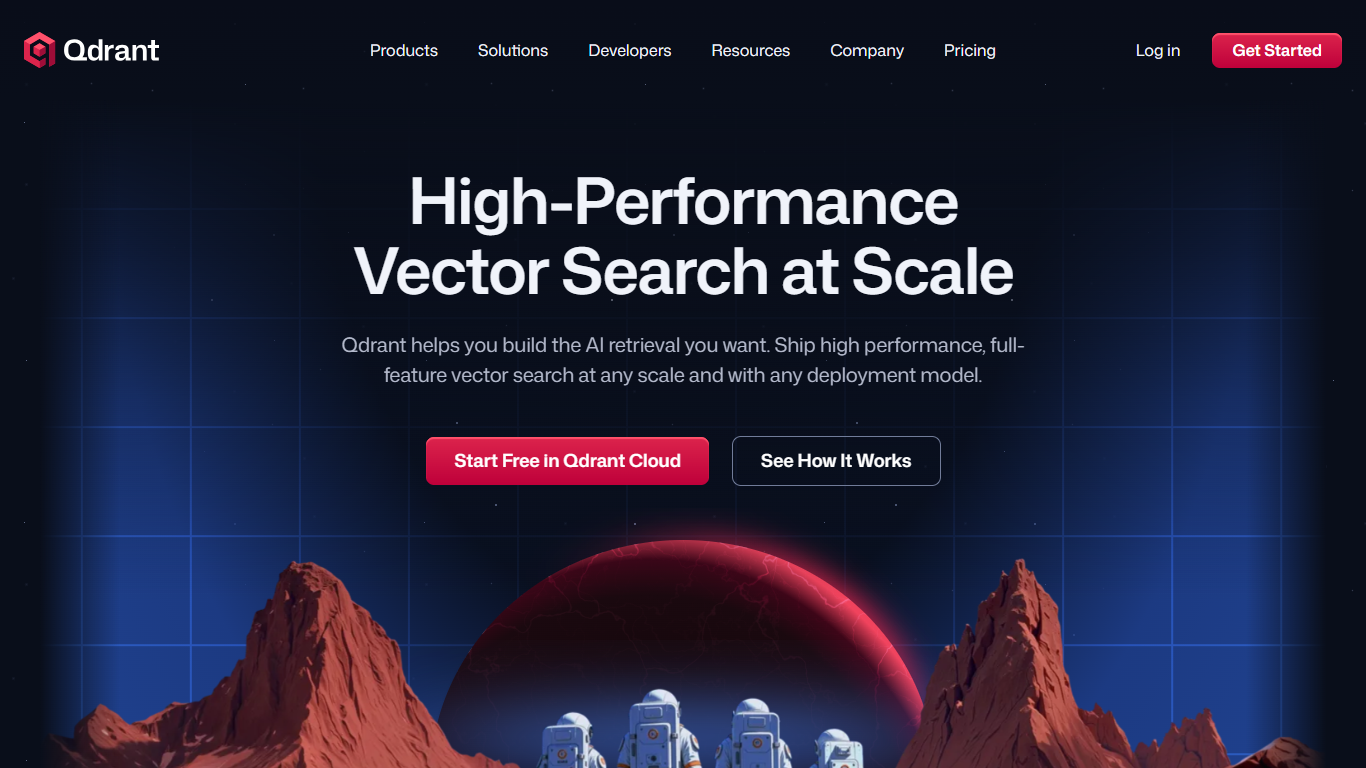
Qdrant stores embeddings and runs fast similarity search with metadata filtering for production AI workloads like RAG chatbots, semantic search, recommendations, and agent memory. You can start on the free cloud tier, self-host the database, or scale on managed clusters across AWS, GCP, and Azure.
The engine is written in Rust and uses a customized HNSW algorithm for approximate nearest neighbor search. Qdrant stands out with native hybrid search that blends dense and sparse vectors in one query, one-stage filtering during graph traversal, and multivector support when a single object needs several embeddings. Compression options like scalar, product, and binary quantization help cut memory use on large collections.
Developers connect through REST, gRPC, or official client libraries, with a built-in Web UI for inspecting collections and running test queries. Qdrant Cloud adds managed backups, zero-downtime scaling, and optional cloud inference. The project launched on GitHub in 2021 and now backs enterprise deployments from companies like Tripadvisor, HubSpot, and Deutsche Telekom.
Hybrid dense and sparse search in one query, with BM25, SPLADE++, and miniCOIL support
Metadata filters run during HNSW traversal, not as a slow pre- or post-filter step
Written in Rust and benchmarked at up to 4x RPS versus alternatives
Free cloud tier includes 0.5 vCPU, 1GB RAM, and 4GB disk on a single node
REST, gRPC, and official clients for Python, JavaScript, Go, and more
Built-in Web UI to browse collections, test queries, and inspect results visually
Run managed on Qdrant Cloud, self-host OSS, or deploy Hybrid and Private Cloud options
Open-source core with a permanent free cloud tier for prototypes and early testing.
Native hybrid search and one-stage metadata filtering reduce the need for separate retrieval stacks.
Flexible deployment from self-hosted OSS to fully managed, hybrid, and private cloud options.
Strong open-source traction with 30k+ GitHub stars cited on the homepage.
SOC2 and HIPAA compliance badges listed for enterprise cloud deployments.
Standard and Premium cloud pricing is usage-based or sales-led rather than fixed monthly rates on the public page.
Free Tier caps at 1GB RAM and 4GB disk without high availability, so production workloads need a paid tier.
Self-hosted deployments require your own ops work compared to the managed cloud console setup.
Does Qdrant have a free plan?
Yes. Qdrant Cloud offers a Free Tier that stays free forever for testing and prototypes. It includes a single-node cluster with 0.5 vCPU, 1GB RAM, 4GB disk, and free cloud inference with selected models.
Can I self-host Qdrant instead of using Qdrant Cloud?
Yes. Qdrant is open source and can be self-hosted as the Qdrant Vector Database. Qdrant also provides managed Qdrant Cloud, Hybrid Cloud on your infrastructure, and Private Cloud for isolated enterprise deployments.
What is hybrid search in Qdrant?
Qdrant hybrid search combines dense vector similarity with sparse keyword matching in a single query. It supports BM25, SPLADE++, and miniCOIL so you can blend semantic and lexical retrieval without running two separate systems.
What can I build with Qdrant?
Qdrant supports RAG and GenAI pipelines, AI agents with persistent memory, semantic search, recommendation systems, and data analysis with anomaly detection. Its Recommendation API can score multiple vectors in one request for personalized results.
Can I migrate an existing Qdrant OSS deployment to Qdrant Cloud?
Yes. Qdrant documents migration from open-source deployments to Qdrant Cloud and provides tooling to move existing data. If your cluster outgrows the Free Tier limits of 1GB RAM and 4GB disk, you can upgrade to a Standard Tier dedicated cluster.
Which cloud providers does Qdrant Cloud support?
Qdrant Cloud runs on AWS, Google Cloud, and Azure regions globally. Qdrant is also listed on AWS Marketplace, Google Cloud Marketplace, and Microsoft Azure Marketplace for subscription billing.
How does Qdrant Cloud billing work on paid tiers?
Qdrant Cloud Standard Tier billing is usage-based on compute (vCPU), memory (GB), storage (GB), backup storage, and inference tokens for paid models. Usage is metered hourly and visible in the Qdrant Cloud dashboard.