
Last updated 08-03-2026
Category:
Reviews:
Join thousands of AI enthusiasts in the World of AI!
Audit Landing Page
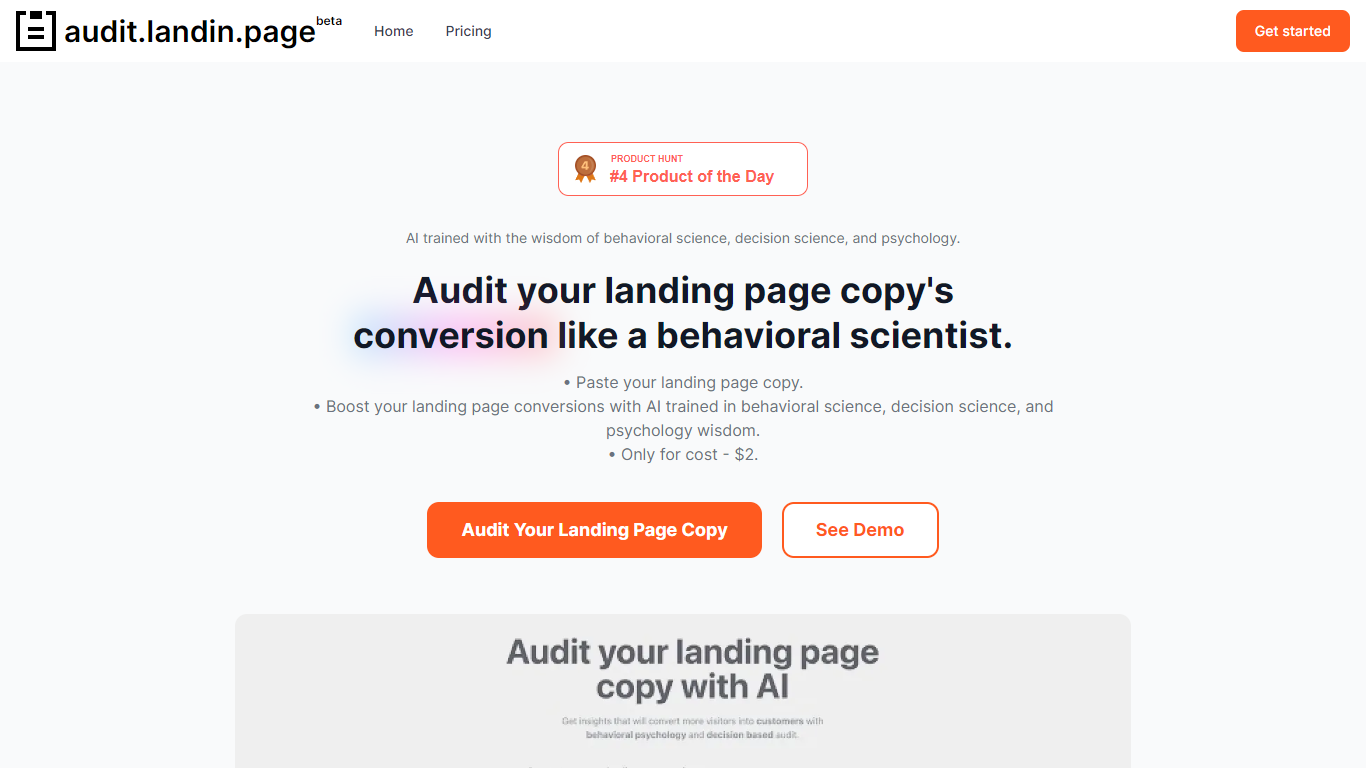
Paste a landing page URL for a copywriting audit that applies behavioral science to your page copy and visual hierarchy. Audit Landing Page runs four steps across positioning, trust signals, conversion elements, and design hierarchy in sequence. Each step flags what is present or missing and ties feedback to named cognitive biases like loss aversion, social proof, and the BJ Fogg behavior model. A full run uses four credits from a $4.99 pack of ten.
Most landing page graders focus on load speed, keyword density, or template best practices. Audit Landing Page instead walks through competitor contrast, objection handling, CTA strength, urgency, and visual hierarchy with ratings like Present, Absent, or Needs Improvement. The public case study on getyourfirstclient.freelancerpath.com shows how each section produces analysis plus concrete rewrite suggestions. That behavioral economics lens is the product's main angle, not a feature bolted onto a generic SEO report.
The tool targets indie makers and small teams who ship products quickly but lack formal marketing training. Homepage copy positions it for people who cannot explain their product's value clearly and want feedback grounded in decision science rather than gut feel. It was built by Terspective as a low-cost way to access insights the site compares to an $8,000 consulting engagement or a psychology degree.
Full audit spans 4 steps: positioning, trust, conversion CRO, and visual hierarchy
Each audit step costs 1 credit; a complete review uses 4 credits from a $4.99 ten-credit pack
Feedback references 200+ cognitive biases including loss aversion, anchoring, and BJ Fogg's behavior model
Every checklist item gets a Present, Absent, or Needs Improvement rating with rewrite suggestions
Built by Terspective and priced near $2 per full audit versus $8,000 behavioral economics consulting cited on the site
Four-step audit covers positioning, trust, conversion, and visual hierarchy in one pass
Each finding names the relevant cognitive bias and gives actionable rewrite guidance
$4.99 credit pack prices a full audit near $2, far below consulting alternatives cited on the site
Public case study demo shows real output structure before you purchase credits
No free tier or trial credits; every audit step requires purchased credits
App requires sign-in at app.audit.landin.page before you can run an audit
Product is in beta with limited public documentation beyond the marketing site
Audits analyze page copy and layout signals but do not replace live A/B testing
How much does Audit Landing Page cost?
Audit Landing Page sells a 10-credit pack for $4.99. One audit step costs 1 credit, and a full four-step review uses 4 credits, which works out to about $2 per complete audit.
How does Audit Landing Page work?
Audit Landing Page accepts a landing page URL and runs an automated review trained on behavioral science, decision science, and psychology. Each section scores elements as Present, Absent, or Needs Improvement and explains which cognitive bias applies.
What does a full Audit Landing Page audit include?
Audit Landing Page breaks a review into four steps: Positioning and Value Proposition, Trust and Credibility, Conversion and CRO, and Visual Design and Hierarchy. The demo case study shows detailed analysis and actionable recommendations for each step.
Who is Audit Landing Page for?
Audit Landing Page is designed for makers who ship products but lack deep marketing knowledge. The homepage targets founders who struggle to communicate product value and want feedback rooted in behavioral economics rather than generic copy tips.
Does Audit Landing Page review design or only copy?
Audit Landing Page reviews both copy and visual design. The fourth audit step covers visual hierarchy, first-impression blink tests, cognitive load, and CTA button prominence alongside written messaging checks.
How many cognitive biases does Audit Landing Page reference?
Audit Landing Page says its model draws on distilled insights from more than 200 cognitive biases. Reported examples include anchoring, loss aversion, social proof, framing effects, and BJ Fogg's behavior change model.