APIPark vs ALBERT
In the battle of APIPark vs ALBERT, which AI Large Language Model (LLM) tool comes out on top? We compare reviews, pricing, alternatives, upvotes, features, and more.
Between APIPark and ALBERT, which one is superior?
Upon comparing APIPark with ALBERT, which are both AI-powered large language model (llm) tools, The upvote count is neck and neck for both APIPark and ALBERT. Every vote counts! Cast yours and contribute to the decision of the winner.
You don't agree with the result? Cast your vote to help us decide!
APIPark

What is APIPark?
APIPark is an open-source LLM gateway and API developer portal for enterprises that need one place to call, govern, and bill AI models and internal APIs. It routes traffic to 200+ large language models through a single OpenAI-compatible endpoint, so teams stop wiring separate vendor SDKs for every model they add.
Where most API gateways only forward requests, APIPark also treats models and APIs as tradable assets. It bundles unified authentication, approval workflows, recharge billing, multi-level distribution, and profit reporting so platform teams can sell surplus model capacity or package business APIs without building a separate marketplace stack.
Platform engineers and AI teams use it to set per-tenant quotas, rate limits, and masking rules before production traffic hits upstream models. API managers get portals for publishing APIs, tracking usage, and approving access requests. The Community Edition covers core gateway and portal features; the Enterprise Edition adds advanced governance, runtime statistics, and premium support.
ALBERT
What is ALBERT?
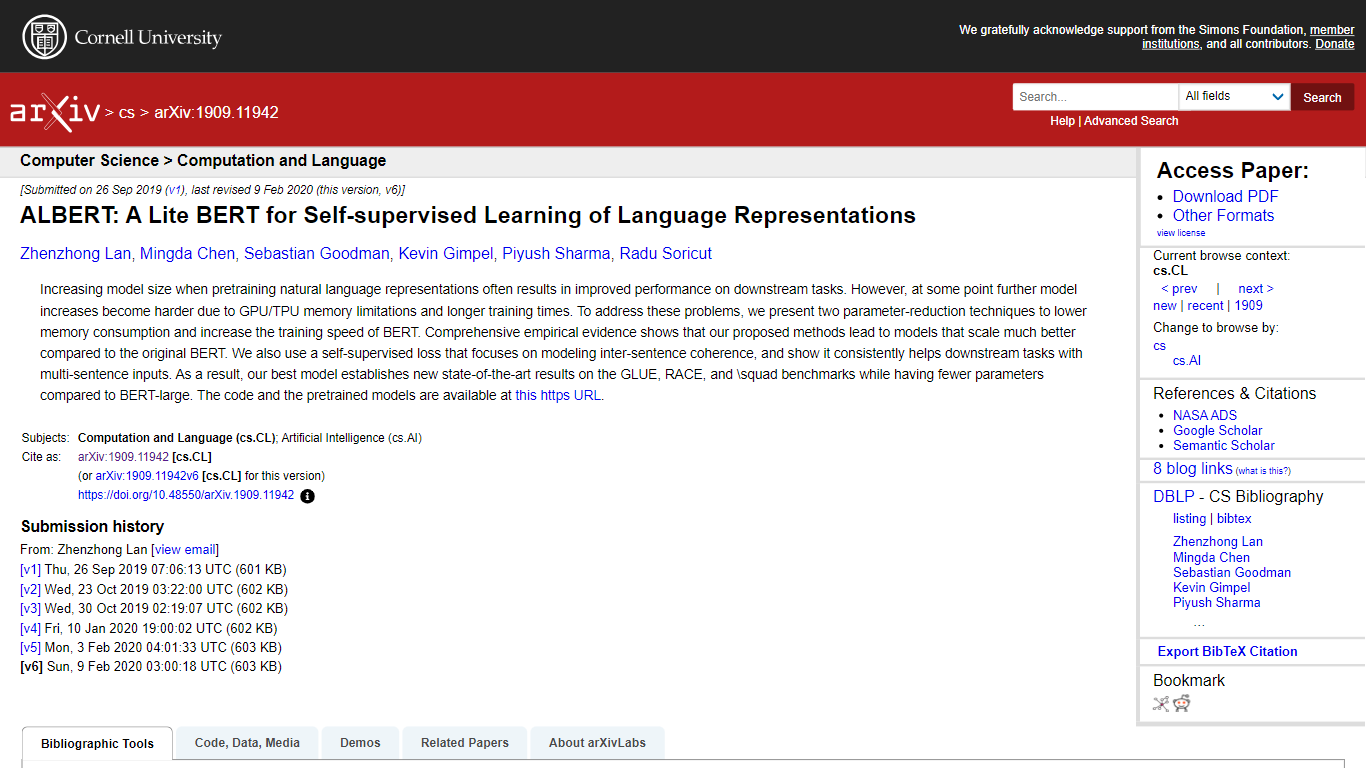
ALBERT is an open source language model from Google Research that shrinks BERT's parameter count while matching or beating its benchmark scores. The name stands for A Lite BERT, and the architecture uses two tricks: factorized embedding parameterization splits the vocabulary matrix into smaller pieces, and cross-layer parameter sharing reuses weights across transformer layers.
Where BERT-large hits GPU memory walls during pretraining, ALBERT scales to larger hidden sizes with fewer total parameters. It also swaps BERT's next-sentence prediction loss for sentence-order prediction (SOP), which the authors found more effective for multi-sentence downstream tasks. The best ALBERT configuration set records on GLUE (89.4), RACE (89.4% accuracy), and SQuAD 2.0 (92.2 F1) at the time of publication.
Pretrained models and training code ship free on GitHub and load through Hugging Face Transformers. Researchers and NLP engineers use ALBERT when they need BERT-level performance on limited hardware or want a lighter model for fine-tuning on classification, question answering, and token-level tasks.
APIPark Upvotes
ALBERT Upvotes
APIPark Top Features
Routes 200+ LLMs through one OpenAI-compatible API signature so existing client code needs no vendor-specific rewrites
Deploy the gateway and developer portal in about 5 minutes with a single command-line install
Load balancing distributes requests across LLM instances to keep failover and throughput predictable under load
Built-in API billing tracks per-user consumption so teams can meter and monetize internal or partner API access
Fine-grained quotas cap daily or monthly spend by amount, tokens, or call counts to block runaway model usage
Data masking engine flags and masks sensitive fields in request and response payloads for compliance workflows
ALBERT Top Features
Factorized embedding parameterization reduces memory vs standard BERT vocabulary matrices
Cross-layer parameter sharing cuts learnable weights across transformer layers
Sentence-order prediction (SOP) loss replaces BERT's next-sentence prediction
89.4% accuracy on RACE and 92.2 F1 on SQuAD 2.0 benchmark results
Pretrained models and code available on GitHub and Hugging Face Transformers
APIPark Category
- Large Language Model (LLM)
ALBERT Category
- Large Language Model (LLM)
APIPark Pricing Type
- Freemium
ALBERT Pricing Type
- Free