Claude 3 \ Anthropic vs ALBERT
In the battle of Claude 3 \ Anthropic vs ALBERT, which AI Large Language Model (LLM) tool comes out on top? We compare reviews, pricing, alternatives, upvotes, features, and more.
Between Claude 3 \ Anthropic and ALBERT, which one is superior?
Upon comparing Claude 3 \ Anthropic with ALBERT, which are both AI-powered large language model (llm) tools, The upvote count shows a clear preference for Claude 3 \ Anthropic. Claude 3 \ Anthropic has 8 upvotes, and ALBERT has 6 upvotes.
You don't agree with the result? Cast your vote to help us decide!
Claude 3 \ Anthropic

What is Claude 3 \ Anthropic?
Claude 3 is Anthropic's third-generation large language model family, released in March 2024. It includes three tiers: Haiku for speed and cost, Sonnet for balanced performance, and Opus for the highest reasoning depth. Each model targets a different tradeoff between intelligence, latency, and price.
The family handles text, code, analysis, and vision tasks. Claude 3 models process photos, charts, graphs, and technical diagrams. They support a 200K token context window at launch, with inputs exceeding 1 million tokens available to select customers. Opus and Sonnet launched on claude.ai and the Claude API in 159 countries, with Haiku following shortly after.
Anthropic built Claude 3 with Constitutional AI safety methods and Responsible Scaling Policy guardrails. The models are available through the Claude API, Amazon Bedrock, and Google Cloud Vertex AI. Sonnet powers the free tier on claude.ai, while Opus is available to Claude Pro subscribers.
ALBERT
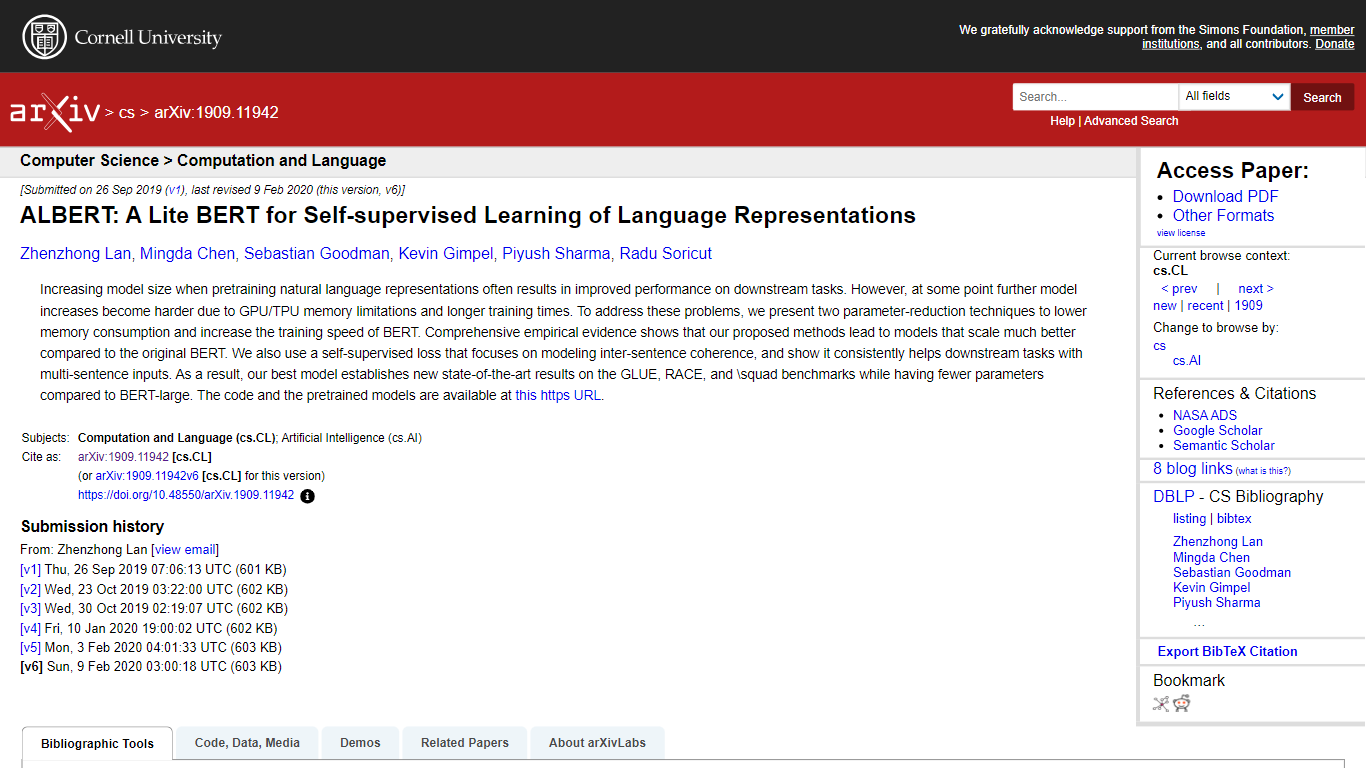
What is ALBERT?
ALBERT is an open source language model from Google Research that shrinks BERT's parameter count while matching or beating its benchmark scores. The name stands for A Lite BERT, and the architecture uses two tricks: factorized embedding parameterization splits the vocabulary matrix into smaller pieces, and cross-layer parameter sharing reuses weights across transformer layers.
Where BERT-large hits GPU memory walls during pretraining, ALBERT scales to larger hidden sizes with fewer total parameters. It also swaps BERT's next-sentence prediction loss for sentence-order prediction (SOP), which the authors found more effective for multi-sentence downstream tasks. The best ALBERT configuration set records on GLUE (89.4), RACE (89.4% accuracy), and SQuAD 2.0 (92.2 F1) at the time of publication.
Pretrained models and training code ship free on GitHub and load through Hugging Face Transformers. Researchers and NLP engineers use ALBERT when they need BERT-level performance on limited hardware or want a lighter model for fine-tuning on classification, question answering, and token-level tasks.
Claude 3 \ Anthropic Upvotes
ALBERT Upvotes
Claude 3 \ Anthropic Top Features
Three model tiers (Haiku, Sonnet, Opus) let you pick the right balance of speed, cost, and reasoning depth
200K token context window at launch, with 1M+ token inputs available to select enterprise customers
Vision support for photos, charts, graphs, PDFs, and technical diagrams
Haiku reads a ~10k token research paper with charts in under three seconds for live chat workloads
Available on claude.ai, the Claude API, Amazon Bedrock, and Google Cloud Vertex AI
ALBERT Top Features
Factorized embedding parameterization reduces memory vs standard BERT vocabulary matrices
Cross-layer parameter sharing cuts learnable weights across transformer layers
Sentence-order prediction (SOP) loss replaces BERT's next-sentence prediction
89.4% accuracy on RACE and 92.2 F1 on SQuAD 2.0 benchmark results
Pretrained models and code available on GitHub and Hugging Face Transformers
Claude 3 \ Anthropic Category
- Large Language Model (LLM)
ALBERT Category
- Large Language Model (LLM)
Claude 3 \ Anthropic Pricing Type
- Freemium
ALBERT Pricing Type
- Free