FinetuneFast vs ALBERT
In the clash of FinetuneFast vs ALBERT, which AI Large Language Model (LLM) tool emerges victorious? We assess reviews, pricing, alternatives, features, upvotes, and more.
When we put FinetuneFast and ALBERT head to head, which one emerges as the victor?
Let's take a closer look at FinetuneFast and ALBERT, both of which are AI-driven large language model (llm) tools, and see what sets them apart. The community has spoken, FinetuneFast leads with more upvotes. FinetuneFast has received 8 upvotes from aitools.fyi users, while ALBERT has received 6 upvotes.
Think we got it wrong? Cast your vote and show us who's boss!
FinetuneFast
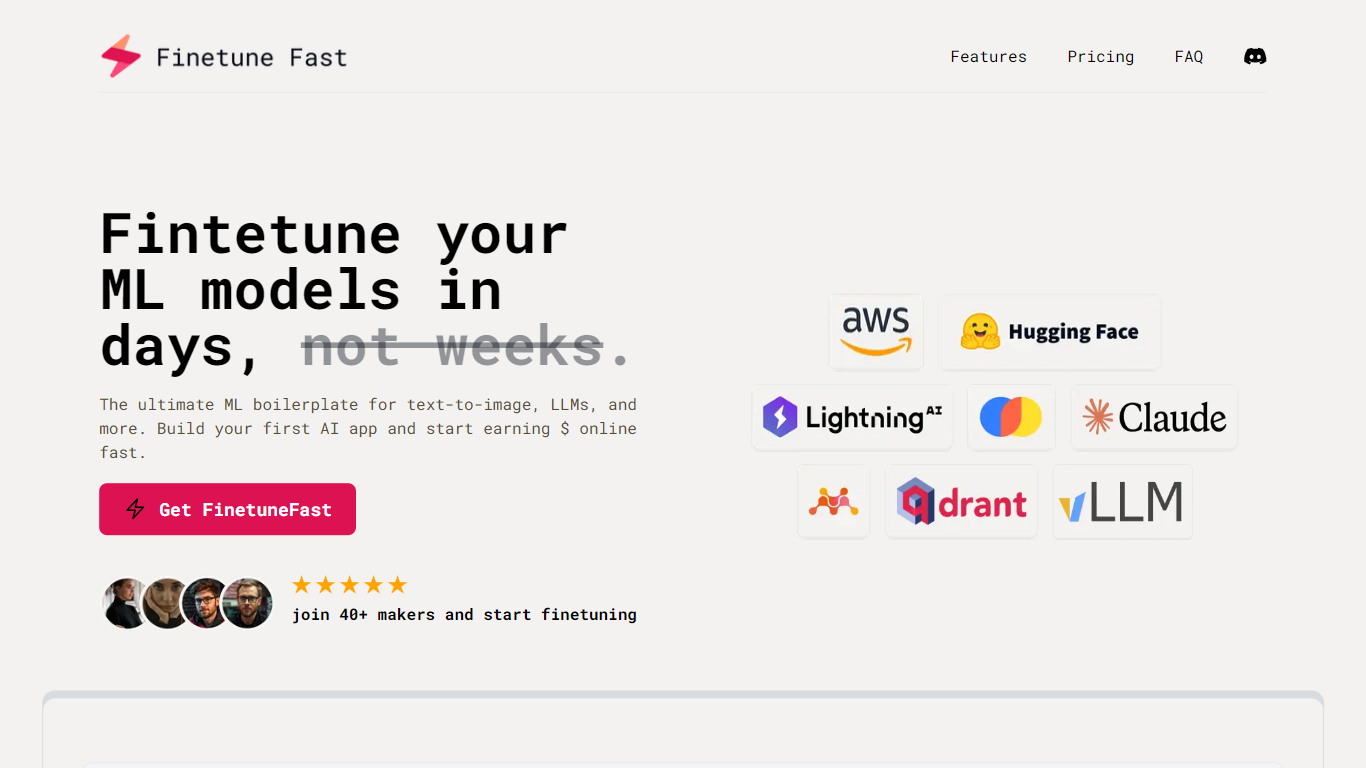

What is FinetuneFast?
FinetuneFast is a paid boilerplate kit for fine-tuning and deploying machine learning models. It bundles pre-configured training scripts, data loading pipelines, hyperparameter optimization, and deployment templates so developers can move from setup to production faster than building everything from scratch.
The package covers text-to-image, large language models, RAG applications, and related workflows. Included examples reference providers such as AWS Bedrock, Mistral AI, and OpenAI, along with templates for Flux-Schnell text-to-image, Fish-Speech text-to-speech, and retrieval-augmented generation.
After purchase, buyers receive access to GitHub repository materials with documentation. The All In plan adds Discord community access and lifetime updates. Founder Patrick built the product from hands-on ML engineering experience, including work on model training, inference APIs, and scalable infrastructure.
ALBERT
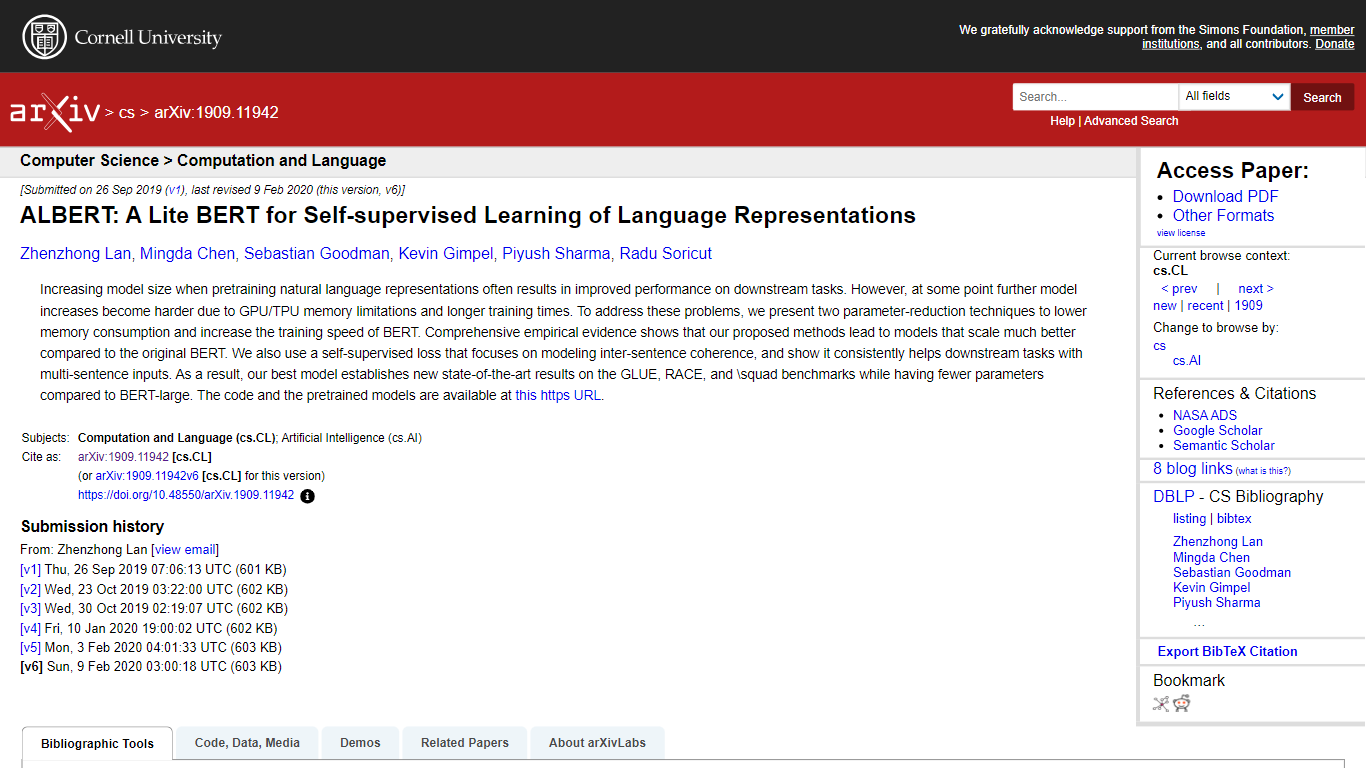
What is ALBERT?
ALBERT is an open source language model from Google Research that shrinks BERT's parameter count while matching or beating its benchmark scores. The name stands for A Lite BERT, and the architecture uses two tricks: factorized embedding parameterization splits the vocabulary matrix into smaller pieces, and cross-layer parameter sharing reuses weights across transformer layers.
Where BERT-large hits GPU memory walls during pretraining, ALBERT scales to larger hidden sizes with fewer total parameters. It also swaps BERT's next-sentence prediction loss for sentence-order prediction (SOP), which the authors found more effective for multi-sentence downstream tasks. The best ALBERT configuration set records on GLUE (89.4), RACE (89.4% accuracy), and SQuAD 2.0 (92.2 F1) at the time of publication.
Pretrained models and training code ship free on GitHub and load through Hugging Face Transformers. Researchers and NLP engineers use ALBERT when they need BERT-level performance on limited hardware or want a lighter model for fine-tuning on classification, question answering, and token-level tasks.
FinetuneFast Upvotes
ALBERT Upvotes
FinetuneFast Top Features
Pre-configured training scripts with multi-GPU support and no-code fine-tuning options
Efficient data loading pipelines for preparing and organizing training datasets
Hyperparameter optimization tools to tune model performance
One-click deployment with auto-scaling infrastructure and generated API endpoints
Production-ready inference boilerplates, RAG examples, and AI SaaS starter templates
Model coverage includes Flux-Schnell, Mistral, OpenAI integrations, Fish-Speech TTS, and RAG workflows
ALBERT Top Features
Factorized embedding parameterization reduces memory vs standard BERT vocabulary matrices
Cross-layer parameter sharing cuts learnable weights across transformer layers
Sentence-order prediction (SOP) loss replaces BERT's next-sentence prediction
89.4% accuracy on RACE and 92.2 F1 on SQuAD 2.0 benchmark results
Pretrained models and code available on GitHub and Hugging Face Transformers
FinetuneFast Category
- Large Language Model (LLM)
ALBERT Category
- Large Language Model (LLM)
FinetuneFast Pricing Type
- Paid
ALBERT Pricing Type
- Free