Athina AI vs ggml.ai
Explore the showdown between Athina AI vs ggml.ai and find out which AI Large Language Model (LLM) tool wins. We analyze upvotes, features, reviews, pricing, alternatives, and more.
When comparing Athina AI and ggml.ai, which one rises above the other?
When we contrast Athina AI with ggml.ai, both of which are exceptional AI-operated large language model (llm) tools, and place them side by side, we can spot several crucial similarities and divergences. ggml.ai is the clear winner in terms of upvotes. ggml.ai has 7 upvotes, and Athina AI has 6 upvotes.
Feeling rebellious? Cast your vote and shake things up!
Athina AI

What is Athina AI?
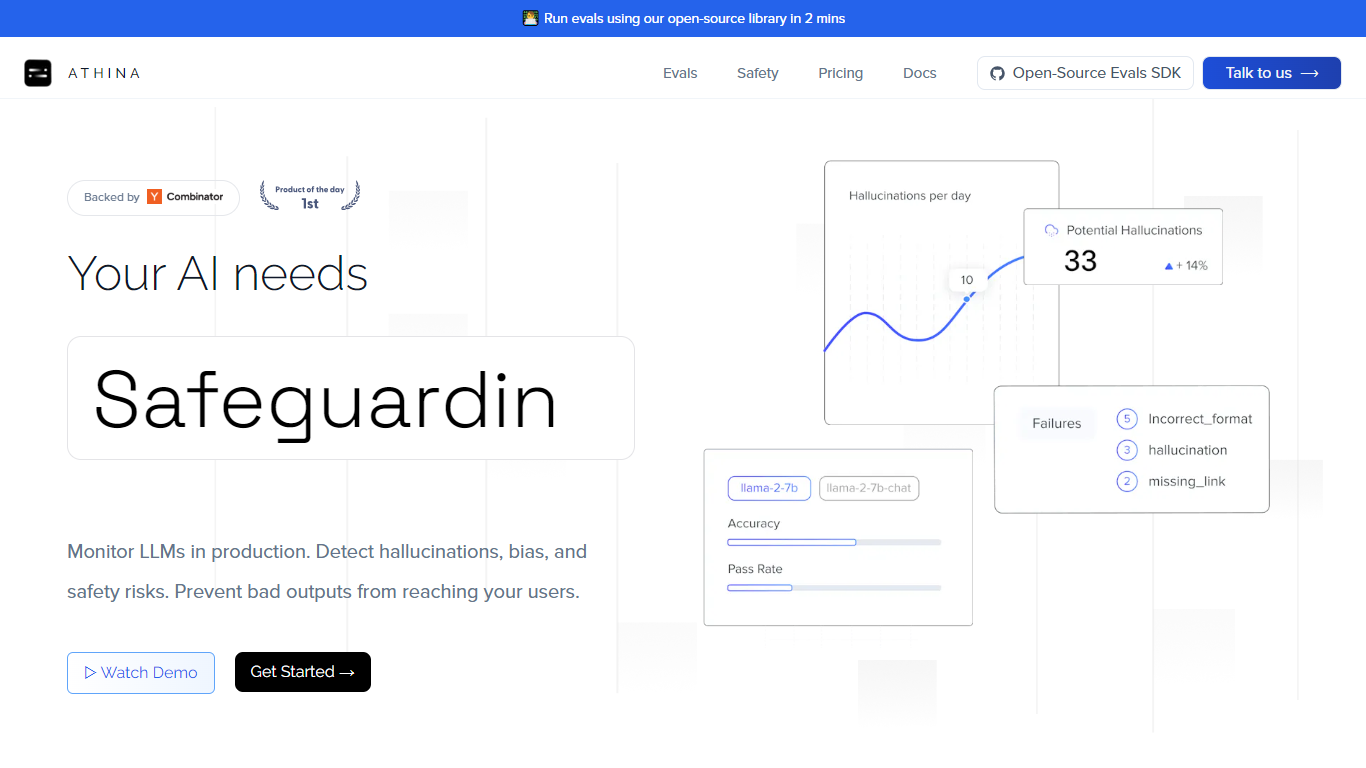
Athina AI is a collaborative development platform where teams build, test, and monitor production AI features in one workspace. It is built for mixed technical teams that need a shared place to iterate on prompts, datasets, evaluations, and live application behavior without handing every step to engineering.
The platform covers the loop from prototyping to production. Teams manage and version prompts, run experiments across models, evaluate outputs with preset or custom metrics, annotate datasets for human review, and monitor inference traces for cost, latency, and quality regressions.
Athina also offers Flows, a visual pipeline builder for chaining prompts, API calls, document retrieval, and custom code into deployable workflows. Enterprise options include self-hosted deployment in your own VPC, SOC-2 Type 2 compliance, and support for custom model providers such as Azure OpenAI and AWS Bedrock.
Teams at companies including Perplexity, You.com, Vetted, and PhysicsWallah use Athina to move AI features from experiment to production faster.
ggml.ai
What is ggml.ai?
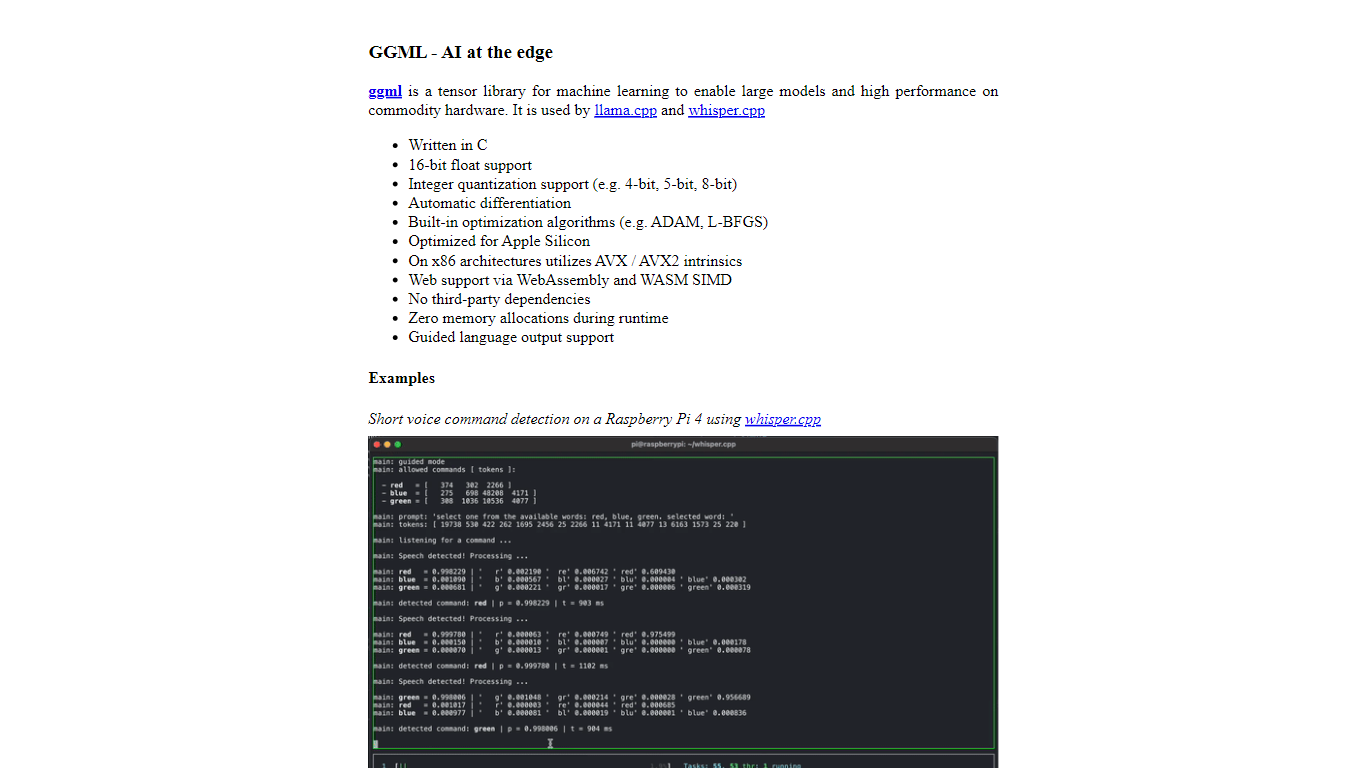
ggml runs large language and speech models on everyday CPUs and GPUs through a compact C tensor library built for on-device inference. ML engineers and app developers adopt it via llama.cpp and whisper.cpp when they want LLaMA or Whisper workloads without cloud-only dependencies.
Frameworks like PyTorch optimize for training clusters and heavy runtimes. ggml keeps the core library minimal with zero runtime memory allocations, no third-party dependencies, and integer quantization so llama.cpp can serve Meta LLaMA weights on laptops and Apple Silicon.
The ggml.ai company was founded in 2023 by Georgi Gerganov to support the library and was acquired by Hugging Face in 2026. The core ggml project stays MIT licensed with open development on GitHub.
Athina AI Upvotes
ggml.ai Upvotes
Athina AI Top Features
Run 50+ preset evaluations or build custom evals with LLM judges, Python functions, or external APIs
Manage, test, and version prompts across any model, including custom endpoints you host
Regenerate datasets in a few clicks to compare models, prompts, or retrievers side by side
Chain prompts, APIs, retrievals, and code in Flows, then deploy pipelines with one click
Log production inferences asynchronously so monitoring does not add latency to your app
Let human QA teams annotate datasets and verify evaluation results alongside automated scoring
Query datasets with SQL and compare results in a workspace built for mixed technical teams
ggml.ai Top Features
Powers llama.cpp for Meta LLaMA inference and whisper.cpp for OpenAI Whisper speech models
Written in C with zero runtime memory allocations during inference
Integer quantization support for smaller models on commodity hardware
No third-party dependencies in the core tensor library
Cross-platform low-level implementation with broad hardware support
MIT licensed open-core library with public development on GitHub
Athina AI Category
- Large Language Model (LLM)
ggml.ai Category
- Large Language Model (LLM)
Athina AI Pricing Type
- Freemium
ggml.ai Pricing Type
- Free