Cascadeur vs Riverside
In the contest of Cascadeur vs Riverside, which AI Video Editing tool is the champion? We evaluate pricing, alternatives, upvotes, features, reviews, and more.
If you had to choose between Cascadeur and Riverside, which one would you go for?
When we examine Cascadeur and Riverside, both of which are AI-enabled video editing tools, what unique characteristics do we discover? Riverside is the clear winner in terms of upvotes. Riverside has 25 upvotes, and Cascadeur has 6 upvotes.
Does the result make you go "hmm"? Cast your vote and turn that frown upside down!
Cascadeur


What is Cascadeur ?
Cascadeur is standalone 3D keyframe animation software for rigging, posing, and cleaning up character motion in video editing and game pipelines. You build animations from scratch, import baked clips from mocap or other DCC tools, and export finished work as FBX, DAE, or USD when your license allows. The desktop app runs on Windows, Mac, and Linux.
Where general-purpose suites leave you to fight secondary motion and finger poses by hand, Cascadeur bakes physics and neural posing into the workflow. AutoPhysics suggests gravity-correct motion on a green preview twin, AutoPosing fills in limbs from a few control points, and Animation Unbaking turns dense mocap keyframes into editable intervals. That focus is narrower than Blender or Maya, but it targets the grunt work those tools skip.
Game studios, VFX shops, and solo animators use Cascadeur to retarget clips between rigs, polish Rokoko or Move AI mocap, and block action sequences with believable body mechanics. Quick Rigging supports Mixamo, Metahuman, Daz3D, and Character Creator skeletons out of the box.
Riverside
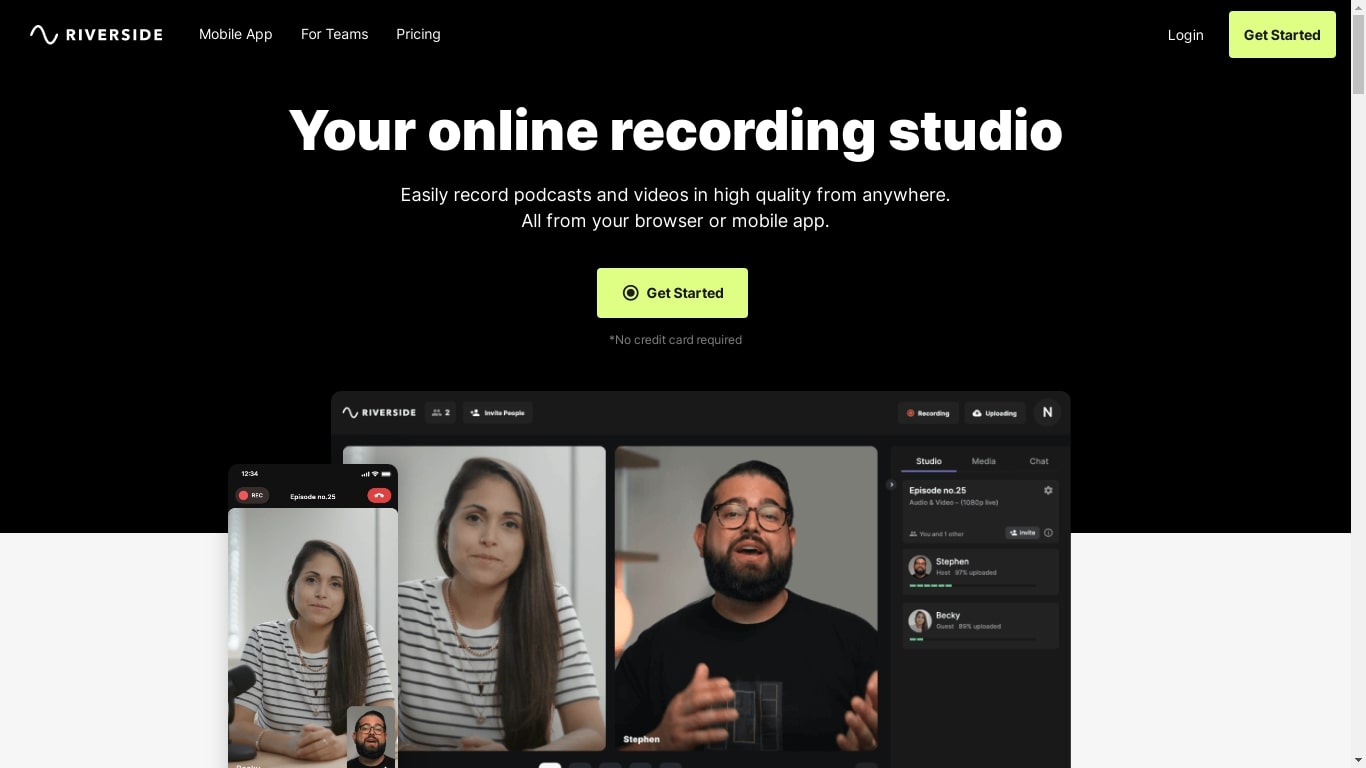
What is Riverside?
Riverside is a video editing and recording platform built for remote podcasts, interviews, and webinars. It records up to 4K video and uncompressed audio locally on each participant's device, so spotty internet does not tank quality. After recording, you edit in a text-based timeline, generate Magic Clips, captions, and show notes, then publish to YouTube, Spotify, and Apple Podcasts from the same workflow.
Zoom and Google Meet optimize for live calls, not post-production. Riverside records separate tracks locally, then layers AI cleanup, filler-word removal, and clip generation on top. The trade-off is that it is built for creators who publish regularly, not for one-off internal meetings that never leave the call app.
Podcasters, marketers, and producers at companies like Spotify and The New York Times use Riverside for studio-style remote recordings. Founded in 2020 by brothers Gideon and Nadav, the product now lives at riverside.com while riverside.fm redirects to the same experience.
Cascadeur Upvotes
Riverside Upvotes
Cascadeur Top Features
AutoPhysics previews gravity-correct motion on a green character twin before you commit changes
AutoPosing uses neural networks to position limbs from a handful of control points, including finger controllers
Animation Unbaking converts baked mocap (every frame a keyframe) into editable keyframe intervals
Copy/paste retargeting transfers animations between humanoid rigs of different proportions in two clicks
Imports and exports FBX, DAE, and USD files for Blender, Maya, Unreal Engine, and Unity workflows
Quick Rigging auto-generates rigs from Daz3D, Mixamo, Metahuman, Character Creator, and Unreal skeletons
Riverside Top Features
Local recording up to 4K video with separate WAV and MP4 tracks per speaker
Free plan includes 2 hours of multi-track recordings and unlimited single-track editing
Pro plan at $24 per month (billed annually) adds 15 hours of separate track downloads and 4K output
AI Co-Creator generates clips, show notes, captions, and filler-word removal from recordings
Built-in podcast hosting publishes to Spotify, Apple Podcasts, and YouTube
Grow and Webinar tiers add multistream live streaming and webinar registration for up to 100 attendees
Cascadeur Category
- Video Editing
Riverside Category
- Video Editing
Cascadeur Pricing Type
- Freemium
Riverside Pricing Type
- Freemium